Complete BSD syscall catalog and dispatch
Interface guide · Documentation home · Every number and conditional alternative
This catalog accounts for all 558 numbers, 0–557, in this checkout's syscalls.master: 669 declaration alternatives, including 455 non-nosys/enosys declarations and 214 placeholder alternatives. Every non-placeholder declaration has an authored purpose, master signature and condition, local implementation link, and selected helper/mechanism explanation. The counts span mutually exclusive configurations; they are not the syscall count of one kernel build.
“Complete” here means complete enumeration and an implementation-oriented explanation for each declaration. It does not mean every command of every multiplexor, protocol/filesystem backend, input combination, or handler branch has been reconstructed. Some named handlers are unsupported stubs or successful no-ops. One declaration, conditional vfork, has no local handler definition. These limits are stated at the relevant entries rather than inferred from names.
Find a call by operation
The number index preserves every source alternative, including old slots and disabled features. The family pages contain the actual mechanisms. Names in headings are the master's kernel handler names: for example, number 6 is sys_close, while generated names and SYS_ constants strip sys_, yielding close. The transformation is visible in makesyscalls.sh.
What the master generates
The master is a build input, not C public API documentation. Its preamble identifies generated init_sysent.c, syscall-name/number output, argument structures/prototypes and audit mapping. Its file-selection column controls which outputs receive each entry. NO_SYSCALL_STUB suppresses automatic libSystem stub generation, not kernel implementation; the preamble also gives names beginning with __ that attribute automatically. Custom wrappers may perform conversions, cancellation work, caching or argument packing before the trap. The prototype in each catalog section is retained exactly in meaning, including this annotation, and should not be substituted for a public header declaration. Master format, argument-structure name generation.
At runtime the generated table supplies a function pointer, return-width classification and argument layout metadata:
typedef int32_t sy_call_t(struct proc *, void *, int *);
#if CONFIG_REQUIRES_U32_MUNGING
typedef void    sy_munge_t(void *);
#endif

struct sysent {         /* system call table */
	sy_call_t       *sy_call;       /* implementing function */
#if CONFIG_REQUIRES_U32_MUNGING
	sy_munge_t      *sy_arg_munge32; /* system call arguments munger for 32-bit process */
#endif
	int32_t         sy_return_type; /* system call return types */
	int16_t         sy_narg;        /* number of args */
	uint16_t        sy_arg_bytes;   /* Total size of arguments in bytes for
	                                 * 32-bit system calls
	                                 */
};
The callable kernel ABI is int32_t handler(proc, args, retval): its C return is the BSD error/control result, while the result payload is written through retval, normally into uthread.uu_rval. Thus a master declaration returning user_ssize_t does not mean the handler returns a byte count as its C function result. sy_arg_munge32, when configured, expands/rearranges narrow userspace arguments into the expected kernel structure; it is separate from dereferencing the user addresses stored in those arguments. The syscall usually performs those later copyin, copyinstr, copyout or uio transfers itself.
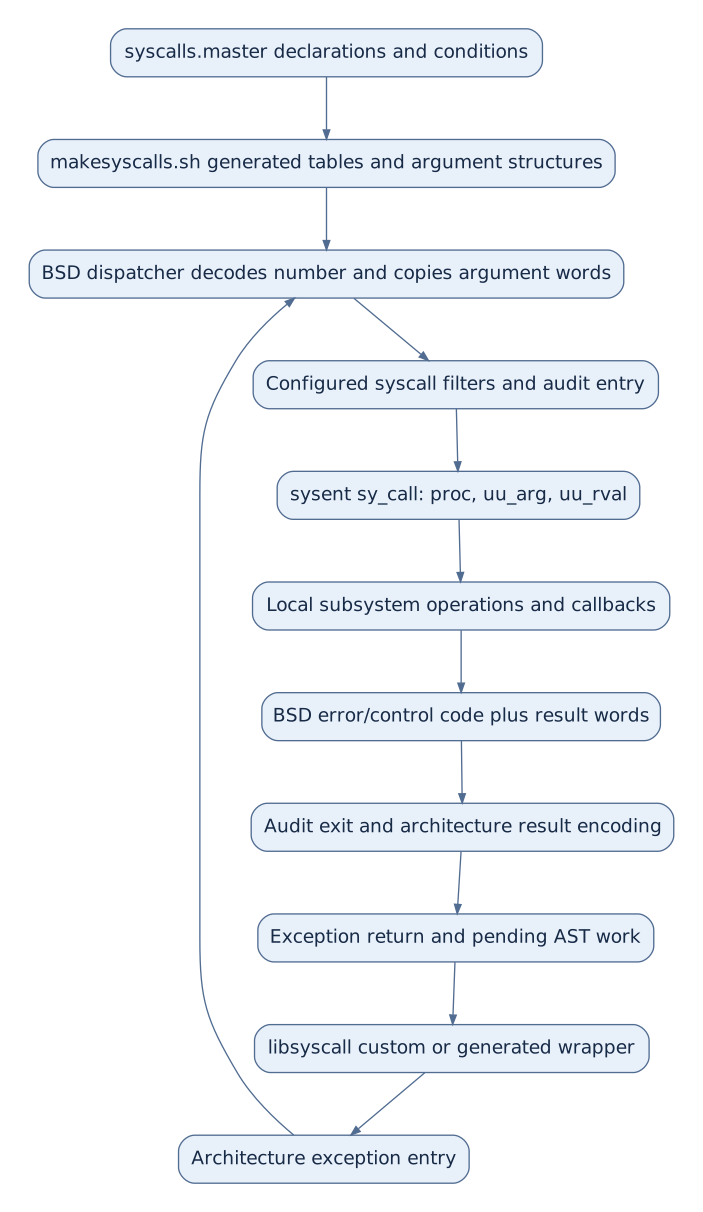
Mermaid source
flowchart TD
    A[syscalls.master declarations and conditions] --> B[makesyscalls.sh generated tables and argument structures]
    U[libsyscall custom or generated wrapper] --> E[Architecture exception entry]
    E --> D[BSD dispatcher decodes number and copies argument words]
    B --> D
    D --> F[Configured syscall filters and audit entry]
    F --> H[sysent sy_call: proc, uu_arg, uu_rval]
    H --> O[Local subsystem operations and callbacks]
    O --> R[BSD error/control code plus result words]
    R --> X[Audit exit and architecture result encoding]
    X --> T[Exception return and pending AST work]
    T --> U
The table's nosys and enosys names are meaningful. enosys returns ENOSYS. nosys can also post SIGSYS to the current thread when send_sigsys is enabled, then returns ENOSYS. Number 0 names nosys in the master but is recognized specially as the indirect syscall encoding by the dispatchers. Out-of-range numbers are redirected to SYS_invalid. A historical comment such as “old creat” identifies a reserved ABI slot; it does not recover a working creat handler.
ARM64: wrapper, SVC and argument materialization
The common libsyscall assembly macro puts a BSD number in x16, executes svc, and branches according to the returned carry bit. cerror is the userspace error adapter, not a kernel exception handler:
#define DO_SYSCALL(num, cerror)                 \
	mov   x16, #(num)                     %%\
	svc   #SWI_SYSCALL                    %%\
	b.cc  2f                              %%\
	ARM64_STACK_PROLOG                    %%\
	PUSH_FRAME                            %%\
	bl    _##cerror                       %%\
	POP_FRAME                             %%\
	ARM64_STACK_EPILOG                    %%\
2:
The detailed vector/register saves are in ARM64 assembly walkthroughs. After that entry, handle_svc reads the saved SVC number, handles the platform special case, refreshes cached process credentials, and distinguishes negative Mach trap numbers from nonnegative BSD numbers. It passes the saved state, thread and BSD process to unix_syscall. Mach traps and MIG messages have their own trap catalog and message catalog.
arm_get_syscall_number takes x16 when nonzero, otherwise x0; this implementation returns an unsigned short. The ARM64 argument copier skips the first argument register for the indirect form:
indirect_offset = (regs->x[ARM64_SYSCALL_CODE_REG_NUM] == 0) ? 1 : 0;
/*
* Everything should fit in registers for now.
*/
if (callp->sy_narg > (int)(sizeof(uthread->uu_arg) / sizeof(uthread->uu_arg[0]))) {
return -1;
}
memcpy(&uthread->uu_arg[0], ®s->x[indirect_offset], callp->sy_narg * sizeof(uint64_t));For direct calls the argument words start at saved x0; for indirect calls they start at x1. This copies register values, including userspace pointer values, into uu_arg; it does not make their pointed-to buffers safe or kernel-resident. Under CONFIG_REQUIRES_U32_MUNGING, an indirect call from an ARM64 task with a narrow data model invokes the selected 32-bit argument munger. The separate 32-bit saved-state path uses its register/stack layout and sy_arg_bytes; its presence is not evidence that every product supports 32-bit processes.
The custom __syscall wrapper itself loads the supported varargs from the user stack into registers. Its visible load sequence, the dispatcher's capacity check and each generated call's sy_narg are separate constraints; a general assertion that any arbitrary-length varargs list is supported would be incorrect. An ARM argument-copy failure selects the invalid handler in the visible dispatcher, unlike the x86 stack-copy failure path described next.
x86-64: class encoding, register order and stack tail
The x86-64 wrapper loads SYSCALL_CONSTRUCT_UNIX(number) into eax, moves the fourth C argument from rcx to r10, and executes syscall. The encoding uses class 2 shifted by 24 bits: for example, the direct read number 3 is encoded as 0x02000003. The assembly dispatcher selects hndl_unix_scall64, which calls the BSD C dispatcher with the saved-state pointer. Wrapper macro.
unix_syscall64 strips the class bits, bounds the index and locates sysent. The saved-state layout deliberately stores the syscall argument sequence contiguously: rdi, rsi, rdx, r10, r8, r9. This is why the dispatcher can copy an argument prefix with memcpy.
bsd/dev/i386/systemcalls.c:318
	if (__improbable(callp == sysent)) {
		/*
		 * indirect system call... system call number
		 * passed as 'arg0'
		 */
		code    = regs->rdi;
		syscode = (code < nsysent) ? code : SYS_invalid;
		callp   = &sysent[syscode];
		args_start_at_rdi = FALSE;
		args_in_regs = 5;
	} else {
		args_start_at_rdi = TRUE;
		args_in_regs = 6;
	}
An indirect call uses rdi for the number and leaves five register arguments; a direct call has six. If more are required, the dispatcher copies the tail from saved userspace rsp + sizeof(user_addr_t), skipping the return-address slot. A failed stack copy places the error in saved rax, sets carry and returns through thread_exception_return before the handler/audit bracket. The visible x86-64 implementation asserts at most eight arguments. Stack-tail import.
The older unix_syscall handles the x86 32-bit saved-state and stack ABI. This catalog preserves declarations across configurations, but the detailed comparison here is ARM64 versus x86-64. Machine-specific non-BSD classes are described in the machine entry-point guide.
Dispatch filters, credentials and auditing
Normal dispatch starts with UT_NOTCANCELPT set, a recorded syscall number and cleared result words. The ARM64 SVC handler refreshes cached credentials before BSD dispatch; x86-64 does so in its C dispatcher. The process pointer, current thread, cached credential and imported argument words form the local context from which the handler obtains subsystem objects.
The ARM dispatcher shows the ordering precisely:
#if CONFIG_MACF
	if (__improbable(proc_syscall_filter_mask(proc) != NULL && !bitstr_test(proc_syscall_filter_mask(proc), syscode))) {
		error = mac_proc_check_syscall_unix(proc, syscode);
		if (error) {
			goto skip_syscall;
		}
	}
#endif /* CONFIG_MACF */

#if CONFIG_DEBUG_SYSCALL_REJECTION
	unsigned int call_number = mach_trap_count + syscode;
	if (__improbable(uthread->syscall_rejection_mask != NULL &&
	    uthread_syscall_rejection_is_enabled(uthread)) &&
	    !bitmap_test(uthread->syscall_rejection_mask, call_number)) {
		if (debug_syscall_rejection_handle(syscode)) {
			goto skip_syscall;
		}
	}
#endif /* CONFIG_DEBUG_SYSCALL_REJECTION */

	AUDIT_SYSCALL_ENTER(code, proc, uthread);
	error = (*(callp->sy_call))(proc, &uthread->uu_arg[0], &(uthread->uu_rval[0]));
	AUDIT_SYSCALL_EXIT(code, proc, uthread, error);
A cleared bit in the process's MAC syscall filter triggers mac_proc_check_syscall_unix; it is a request for policy evaluation, not by itself the final denial. A nonzero policy error skips the handler. The ARM source also contains the separately configured per-thread debug-rejection mask indexed after mach_trap_count. The shown x86-64 dispatcher has the MAC filter but does not contain that same debug-rejection block; feature parity should not be inferred from a shared syscall declaration.
Audit entry and exit surround the handler after these filters. AUDIT_SYSCALL_ENTER checks audit-enabled state; AUDIT_SYSCALL_EXIT checks whether a record remains on the uthread, because a record can outlive a global disable. A master AUE_NULL supplies no audit event for that entry; it does not remove the architecture's audit macro sites. Helpers may capture arguments and command-specific subevents. Audit macro bodies, record selection, commit and worker output.
A handler can block using a continuation and complete through unix_syscall_return, which finds saved user registers, uses the stored syscall number to select return layout, runs audit completion and returns through the exception-return machinery. The ordinary C call stack is therefore not a universal lifetime boundary for syscall state or audit records.
Results, errno and restart are separate outcomes
| Handler outcome | ARM64 saved state | x86-64 saved state | Meaning |
|---|---|---|---|
| Zero error | Return classification selects x0 and possibly x1; carry was cleared before dispatch |
Classification selects rax and possibly rdx; carry cleared |
The result payload is valid according to the entry's return type |
| Ordinary nonzero error | x0 = error, x1 = 0, carry set |
rax = error, carry set |
Wrapper invokes its error adapter |
ERESTART |
Saved PC moves backward by 4 bytes | pal_syscall_restart repairs the saved instruction position |
Re-execute the syscall instruction; this internal code is not ordinary userspace errno |
EJUSTRETURN |
Ordinary result rewrite skipped | Ordinary result rewrite skipped | Preserve state established by the handler, such as signal-state restoration |
The ARM implementation's branch makes the control-result distinction explicit:
	if (error == ERESTART) {
		add_user_saved_state_pc(regs, -4);
	} else if (error != EJUSTRETURN) {
		if (error) {
			ss64->x[0] = error;
			ss64->x[1] = 0;
			/*
			 * Set the carry bit to execute cerror routine.
			 * ARM64_TODO: should we have a separate definition?
			 * The bits are the same.
			 */
			ss64->cpsr |= PSR64_CF;
			unix_syscall_return_kprintf("error: setting carry to trigger cerror call\n");
		} else {        /* (not error) */
Both dispatchers use sy_return_type: INT_T/UINT_T can export two 32-bit result words, while OFF_T, address, size, signed-size and uint64 forms assemble a 64-bit payload from uu_rval and clear the second result register. The syscall's mechanism determines how those result words are populated; for example, a pipe wrapper can use two result registers. The x86 restart helper distinguishes its supported saved-state/trap cases; do not generalize the two-byte x86-64 syscall length to every historical entry instruction.
In userspace, cerror_nocancel stores the error in the global fallback and, if present, the thread-specific errno slot, then returns an all-ones failure result of the appropriate width. cerror first calls _pthread_exit_if_canceled(err). The implementation of that pthread routine is outside this checkout. Some wrappers select the noncanceling adapter or have special result handling, so the kernel table alone is not the entire libc contract.
Cancellation and noncanceling syscall pairs
The kernel does not mark every syscall a cancellation point simply because it can sleep. The ordinary read handler explicitly opts into the cancellation check before sharing the implementation with read_nocancel:
int
read(struct proc *p, struct read_args *uap, user_ssize_t *retval)
{
	__pthread_testcancel(1);
	return read_nocancel(p, (struct read_nocancel_args *)uap, retval);
}
The check clears UT_NOTCANCELPT. A pending cancellation is acted on only when it is neither disabled nor already consumed:
void
__pthread_testcancel(int presyscall)
{
	thread_t self = current_thread();
	struct uthread * uthread;

	uthread = (struct uthread *)get_bsdthread_info(self);


	uthread->uu_flag &= ~UT_NOTCANCELPT;

	if ((uthread->uu_flag & (UT_CANCELDISABLE | UT_CANCEL | UT_CANCELED)) == UT_CANCEL) {
		if (presyscall != 0) {
			unix_syscall_return(EINTR);
			/* NOTREACHED */
		} else {
			thread_abort_safely(self);
		}
	}
}
With presyscall != 0, it completes the syscall through unix_syscall_return(EINTR) without entering the operation. The other form safely aborts the current thread's wait. __pthread_markcancel marks a target thread and, if it is currently cancelable and cancellation is enabled, requests a safe abort. Cancellation completion in libpthread is distinct from kernel wait abortion; a read_nocancel call can still encounter ordinary signal/wait errors.
The separate numbered _nocancel interfaces are retained in the catalog instead of merged away. They commonly reach the same I/O helper while omitting the preliminary cancellation test. Wrapper-level behavior remains relevant for command-selecting calls such as fcntl. See pthread/workqueue lifetime and signal delivery/return for the related thread state transitions.
Multiplexors and external implementation boundaries
The catalog describes the syscall's selector, authorization/import boundary and selected dispatch mechanism. These nested interfaces need their own inventories for command-complete coverage:
| Entry/family | Included here | Separate surface and existing guide |
|---|---|---|
ioctl, fcntl |
Descriptor lookup, command-shaped buffer/flag handling and file operations or common command switch | Device/protocol ioctl command spaces; advisory locks, file controls and signature installation |
sysctl, sysctlbyname |
Numeric/named lookup, sysctl_req, access checks and output-length handling |
Every registered OID and OID-specific structure; sysctl traversal/lifetime |
proc_info, proc_policy, memorystatus_control, persona, coalition calls |
Command/flavor entry and principal helper path | Per-flavor records, policy rules and memorystatus/freezer mechanisms |
auditon, csops, __mac_syscall |
Audit controls, process signing commands, named MAC callback dispatch | Individual audit/signing operations and externally supplied MAC policy command ABIs |
Socket options, connectx, NECP actions |
Socket/protocol or policy/session lookup and selected request conversion | Every protocol option and policy action; network policy boundaries |
| Nexus/channel commands | Controller/channel descriptors, operation selectors, ring synchronization entry points | Provider implementations and complete ring/packet/flow subinterfaces; Skywalk lifetime guide |
workq_kernreturn, bsdthread_ctl, psynch calls |
Local workqueue commands and pthread_functions handoffs, including local stubs |
The separately supplied pthread implementation and userspace runtime; local servicing and cleanup |
| NFS, mount, metadata and filesystem-control calls | Local VFS/NFS dispatch and owned objects | Operations of filesystems not present here, user daemons and storage/network providers |
This is also why a generated function-name index would be insufficient: psynch_rw_upgrade and psynch_rw_downgrade locally return success without implementing their nominal operation, mlockall/munlockall return ENOSYS, objc_bp_assist_cfg_np returns literal KERN_FAILURE, and audit/recount/search/quota bodies have configuration-specific alternatives. The family entries name those facts explicitly.
Regeneration, validation and inspection limits
Authored descriptions are separate from the generated inventory. The generator parses every numbered declaration and preprocessor branch; checks that numbers cover the entire contiguous range; requires exactly one authored entry for every non-placeholder name; verifies implementation source lines and defining symbols; and renders all family pages plus the number index. vfork is the single explicitly permitted declaration-only exception. The inventory records the master's SHA-256 and source candidates; discovered call-token lists are navigation aids, not proof that those calls execute on all paths.
Run these documentation commands from the Platydoc project root; the generator reads its kernel input from xnu/.
python3 -B docs-ai/tools/build_bsd_syscall_catalog.py
python3 -B docs-ai/tools/build_bsd_syscall_catalog.py --check
python3 -B docs-ai/tools/check_links.py
--check verifies all generated files against the current master and authored metadata without rewriting them. --inventory-only refreshes just the inventory. Edit descriptions in JSON, then regenerate; edits directly to generated family pages will otherwise be overwritten. The hand-authored dispatch guide is not generated.
| Inspection level | Source surface | Limit |
|---|---|---|
| Exhaustive declaration accounting | Every row/alternative of syscalls.master; names, signatures, conditions and audit events |
No product build's preprocessor environment was evaluated |
| Per-entry implementation/mechanism identification | All 455 non-placeholder declarations; 454 with local handler definitions and one explicit absent vfork body |
Selected helpers and dispatch decisions, not every branch or backend implementation |
| Detailed dispatch/body checks | ARM/x86 dispatch, sysent, wrapper assembly, errno adapter, audit macros, cancellation, no-op/stub handlers and selected security/diagnostic wrappers |
No kernel build, live syscall execution or hardware behavior test |
| Existing deep subsystem analysis | Linked process, VM, VFS, network, security and runtime guides | Their own source-inspection limits still apply; a link does not imply an entire source file was analyzed |
Source paths and line numbers refer to this checkout. Build-generated files, third-party/filesystem implementations, external policy providers and the separately delivered pthread runtime are not invented to fill gaps. The reconciliation establishes catalog completeness; technical depth remains measured by the particular bodies and mechanisms explained.