Machine entry points: ARM64 SVC, x86 syscall classes, and compatibility routes
Interface overview · All Mach trap slots · Platform exceptions · Scheduler execution
A userspace function name does not identify its kernel entry mechanism. Ordinary Mach traps use a shared 128-slot table, but ARM time queries and the ARM platform selector bypass it. x86 uses a class field to choose Mach, BSD, machine-dependent, or diagnostic dispatch. Eventlinks have Mach-style public names but use BSD syscalls. MIG operations are message IDs carried through the Mach message transport; they are not additional trap numbers. This page covers the actual entry classifiers and every operation in the local machine-dependent tables and ARM platform switch. ARM classifier, x86 classifier, eventlink wrapper.
1. ARM64: the SVC instruction and selector are separate
The ARM64 library trap macro loads a signed operation number into x16, executes svc #SWI_SYSCALL, then returns. SWI_SYSCALL is 0x80. The operation number is therefore not the SVC immediate: -10 selects the VM-allocation trap through the register, while 0x80 is the instruction's immediate. The saved-state accessor takes the low 32 bits of the selector register as an int. Stub macro, SVC constant, selector extraction.
#define kernel_trap(trap_name, trap_number, num_args) \
.globl _##trap_name                                           %% \
.text                                                         %% \
.align  2                                                     %% \
_##trap_name:                                                 %% \
    mov x16, #(trap_number)                                   %% \
    svc #SWI_SYSCALL                                          %% \
    ret
After the assembly vector has saved context, sleh_synchronous() classifies the exception syndrome. The ESR_EC_SVC_64 branch requires a 64-bit saved state originating in userspace and calls handle_svc(). It does not treat every synchronous exception as a syscall: data faults, instruction faults, trapped instructions and other exception classes take other branches. The surrounding exception/return machinery is described in the platform guides. SVC classification, exception-level boundaries.
handle_svc() resets the thread's I/O-tier override. It checks the platform selector before the sign test, updates cached process credentials for the ordinary route, then handles two negative time selectors before Mach-table dispatch:
	if (trap_no == (int)PLATFORM_SYSCALL_TRAP_NO) {
		platform_syscall(state);
		panic("Returned from platform_syscall()?");
	}

	current_cached_proc_cred_update();

	if (trap_no < 0) {
		switch (trap_no) {
		case MACH_ARM_TRAP_ABSTIME:
			handle_mach_absolute_time_trap(state);
			return;
		case MACH_ARM_TRAP_CONTTIME:
			handle_mach_continuous_time_trap(state);
			return;
		}

		/* Counting perhaps better in the handler, but this is how it's been done */
		thread->syscalls_mach++;
		mach_syscall(state);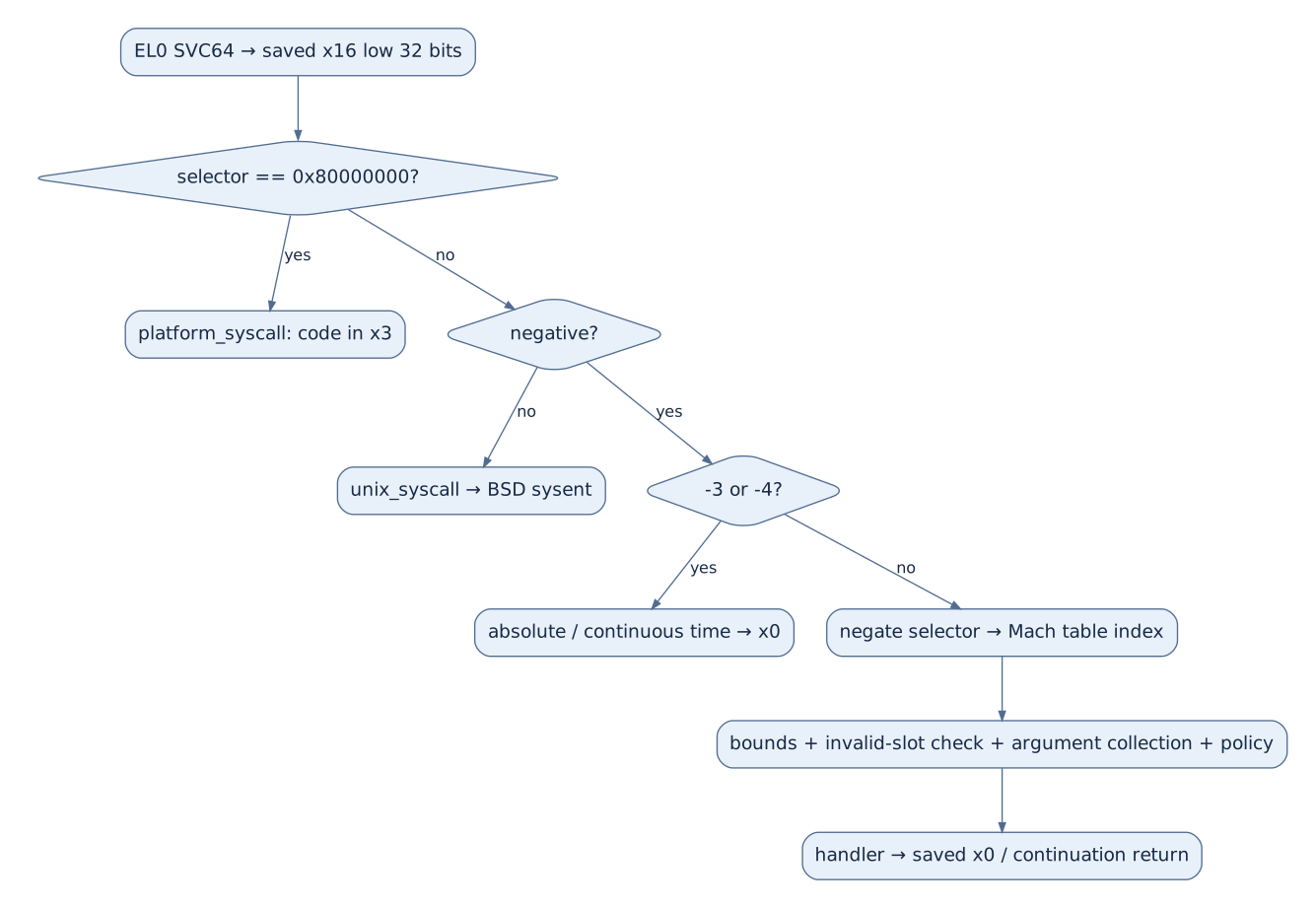
Mermaid source
flowchart TD
    S["EL0 SVC64 → saved x16 low 32 bits"] --> P{"selector == 0x80000000?"}
    P -->|yes| PL["platform_syscall: code in x3"]
    P -->|no| N{"negative?"}
    N -->|no| B["unix_syscall → BSD sysent"]
    N -->|yes| T{"-3 or -4?"}
    T -->|yes| C["absolute / continuous time → x0"]
    T -->|no| M["negate selector → Mach table index"]
    M --> V["bounds + invalid-slot check + argument collection + policy"]
    V --> H["handler → saved x0 / continuation return"]
ARM selectors outside the common Mach table
| Register selector | Additional inputs | Local operation and return |
|---|---|---|
-3 / MACH_ARM_TRAP_ABSTIME |
None | handle_mach_absolute_time_trap() writes the 64-bit absolute time directly to saved x0. |
-4 / MACH_ARM_TRAP_CONTTIME |
None | handle_mach_continuous_time_trap() writes continuous time directly to saved x0. |
0x80000000 / PLATFORM_SYSCALL_TRAP_NO |
Operation code from low 32 bits of saved x3; value/input in x0 |
platform_syscall() switch below, then thread_exception_return(). |
The time constants and handlers are at traps.h and sleh.c; the platform constant is at proc_reg.h. Common table slots 3 and 4 are invalid: the early ARM classifier is why these negative numbers still have meaning on this architecture. These time paths bypass mach_syscall() and its per-task Mach trap filter; that exception is stated in the dispatcher. Library time routines also contain direct counter/commpage paths, so a time API call need not execute an SVC at all. Filter comment, ARM64 time fallbacks.
The entire local platform switch has only two active operations:
x3 code |
Behavior |
|---|---|
| 0 | Historical instruction-cache flush, removed; falls through to no action. |
| 1 | Historical data-cache flush, removed; falls through to no action. |
| 2 | Pass saved x0 to thread_set_cthread_self() → machine_thread_set_tsd_base(current_thread(), self). The switch does not place that helper's status into x0. |
| 3 | Obtain thread_get_cthread_self() and write its value to saved x0. |
| Any other value | No action in this switch; no synthesized invalid-selector error before returning. |
This is a four-explicit-case switch, two functional cases, not a hidden generic cache-control API. The TSD setter rejects a kernel task, clamps an out-of-range base to zero, updates thread->machine.cthread_self, and updates the current thread's read-only-user thread-pointer register under preemption disable. The getter reads that register and asserts consistency with the thread field. Platform switch, helpers, TSD update.
2. ARM Mach-table arguments, policy, and return
mach_syscall() negates the selector, rejects an index at or above 128, and rejects entries whose function is kern_invalid. Its bad path delivers EXC_SYSCALL using exception_triage(); the ordinary invalid-table case does not call the stub and return KERN_INVALID_ARGUMENT. An exception handler may affect the eventual outcome, so this is also not equivalent to an unconditional process kill. Dispatch and bounds, bad path.
For a 64-bit saved state, arm_get_mach_syscall_args() copies the table's argument count of 64-bit words starting at saved x0 into a zero-initialized mach_call_args. The table currently uses at most eight logical arguments. Kernel argument structures use PAD_ARG_ to lay out each field at the required slot width; the field's C type still matters, especially userspace pointer integers and pairs of packed 32-bit values. Argument collection, argument padding.
Under CONFIG_MACF, a task filter mask can trigger mac_task_mach_trap_evaluate(). On policy denial, a trap flagged as returning a port gets MACH_PORT_NULL, while ordinary traps retain the error result. Debug syscall rejection has a separate configuration and returns KERN_DENIED or null for port-return traps. After a normal handler return, the dispatcher writes the result to the saved return register and performs its accounting/throttling checks. Policy checks and invocation.
A blocking handler can instead complete with thread_syscall_return(): it writes saved x0, emits the trace exit if enabled, and enters thread_exception_return(). This is used by semaphore and scheduling continuations; a C call's stack does not need to remain intact until the user resumes. The platform return path handles pending user-return work before restoring the saved context. Continuation return, semaphore continuation entry, scheduler continuation.
Historical ARM32 stub/collection code remains in the source: it uses r12 for the number, skips frame-pointer register r7 during argument collection, and applies conditional 32-bit mungers. The retained collector has another literal discrepancy: for more than seven words, its first bcopy copies seven complete words, but the second starts at saved r8 with a byte count of reg_count - 7, without multiplying by sizeof(uint32_t). It must not be described as a verified complete-word transfer. This chapter does not infer an active 32-bit SVC route from those helper branches: the SVC64 dispatch shown above explicitly requires a 64-bit saved state, and additional compatibility metadata discrepancies are called out in the trap catalog. ARM32 stubs, actual compatibility copies.
3. x86-64: syscall class selects the dispatcher
The x86-64 library Mach stub moves the fourth C argument from rcx to r10, constructs (1 << 24) | slot, places it in eax, and executes syscall. This accounts for syscall using rcx for the saved instruction pointer. It is not the negative selector used by the ARM64 and legacy i386 Mach stubs. Stub and class macros.
#define kernel_trap(trap_name,trap_number,number_args) \
LEAF(_##trap_name,0) ;\
	movq	%rcx, %r10	;\
	movl	$ SYSCALL_CONSTRUCT_MACH(-##trap_number), %eax	;\
	syscall		;\
END(_##trap_name)
idt64_syscall preserves the user stack, synthesizes an interrupt-style saved frame with SYSCALL_CS, and records the syscall number in its error/code slot before common dispatch. The synthesized selector also tells the eventual return code that SYSRET is an available return route. Frame construction.
The class is bits [31:24]; the number is the remaining low 24 bits. The header defines six class constants, but the assembly classifier accepts only four:
| Class | Name | Actual 64-bit dispatch |
|---|---|---|
| 0 | NONE |
Unknown-class EXC_SYSCALL path. |
| 1 | MACH |
hndl_mach_scall64 → mach_call_munger64 → shared Mach table. |
| 2 | UNIX |
hndl_unix_scall64 → unix_syscall64 → BSD table. |
| 3 | MDEP |
hndl_mdep_scall64 → seven-slot machdep_call_table64. |
| 4 | DIAG |
hndl_diag_scall64 → diagCall64; selector is in rdi. |
| 5 | IPC |
Defined in the header but no matching dispatch branch here; falls to unknown-class handling. It is not the route used for mach_msg2_trap. |
	movl	R64_RAX(%r15), %eax		/* syscall number/class */
	movl	%eax, %edx
	andl	$(SYSCALL_CLASS_MASK), %edx	/* syscall class */
	cmpl	$(SYSCALL_CLASS_MACH<<SYSCALL_CLASS_SHIFT), %edx
	je	EXT(hndl_mach_scall64)
	cmpl	$(SYSCALL_CLASS_UNIX<<SYSCALL_CLASS_SHIFT), %edx
	je	EXT(hndl_unix_scall64)
	cmpl	$(SYSCALL_CLASS_MDEP<<SYSCALL_CLASS_SHIFT), %edx
	je	EXT(hndl_mdep_scall64)
	cmpl	$(SYSCALL_CLASS_DIAG<<SYSCALL_CLASS_SHIFT), %edx
	je	EXT(hndl_diag_scall64)

	/* Syscall class unknown */
	sti
	CCALL3(i386_exception, $(EXC_SYSCALL), %rax, $1)
	/* no return */
mach_call_munger64() masks out the class, bounds-checks the number, rejects kern_invalid, and copies up to six logical arguments from the saved registers in rdi,rsi,rdx,r10,r8,r9 order. Extra arguments come from the user stack immediately after the return-address word. Copyin failure stores KERN_INVALID_ARGUMENT in rax and returns through exception return. The table supports a maximum of nine arguments in this helper, while the current trap table's maximum is eight. Munger.

Mermaid source
flowchart LR
    U["syscall: EAX class + number"] --> C["hndl_syscall: inspect class"]
    C --> M["Mach: mask number, validate slot"]
    M --> R["First six: RDI RSI RDX R10 R8 R9"]
    R --> S["If needed: copy stack arguments at RSP + 8"]
    S --> P["Mach filter → handler"]
    P --> E["saved RAX result → exception return"]
    C --> B["BSD sysent"]
    C --> D["machine-dependent table"]
    C --> G["diagnostic RDI selector"]
The Mach dispatcher returns a raw Mach result in rax; it does not apply the BSD errno/carry-bit translation. mach_trap_returns_port has the same filter-denial role as on ARM. Return to user restores address-space/debug/register state and selects sysretq versus iretq from the frame's route and checks; it is not a C ret from the trap body. Mach result/filter, return preparation, SYSRET/IRET selection.
4. Legacy x86 entry and 32-bit argument munging
The IDT installs userspace-callable gates at 0x80 for BSD, 0x81 for Mach, and 0x82 for machine-dependent calls. Their entry stubs label the saved frame with the corresponding handler. The separate sysenter route uses the sign of saved eax to distinguish Mach from BSD. The i386 Mach library stub loads a negative number and calls __sysenter_trap; that helper removes its own return address into edx, records the user stack in ecx, and executes sysenter. IDT gates, entry stubs, sign dispatch, library helper.
The kernel synthesizes the saved frame because SYSENTER does not supply the same interrupt-frame state as an interrupt gate. The legacy Mach munger negates eax, validates the slot, copies mach_trap_u32_words * sizeof(int) bytes from the user stack after the return-address word, and applies mach_trap_arg_munge32 when configured. That produces the wider/aligned kernel argument structure; merely copying the logical argument count would mishandle 64-bit scalar arguments from a 32-bit ABI. SYSENTER frame, 32-bit copy/munge, legacy dispatch.
32-bit Mach argument collection
{
	if (copyin((user_addr_t)(sp + sizeof(int)), (char *)args, trapp->mach_trap_u32_words * sizeof(int))) {
		return KERN_INVALID_ARGUMENT;
	}
#if CONFIG_REQUIRES_U32_MUNGING
	trapp->mach_trap_arg_munge32(args);
#else
#error U32 mach traps on x86_64 kernel requires munging
#endif
	return KERN_SUCCESS;
A legacy invalid Mach slot raises EXC_SYSCALL; a user-stack copy failure returns a Mach invalid-argument result. The saved state and synthetic code selector later determine SYSEXIT versus IRET restoration. These are source-retained compatibility paths, not evidence that every historical userspace ABI is enabled in a given modern product configuration. Invalid/argument errors, legacy return choice.
5. Complete x86 machine-dependent tables
Each machine-dependent table has seven slots. The 32-bit table has four named handlers and three invalid entries. The 64-bit table has three unconditional named handlers, two conditional hypervisor handlers, and two always-invalid entries: five named/two invalid with HYPERVISOR, otherwise three/four. These counts are separate from the 128-slot Mach table. Both arrays.
| Slot | 32-bit route | 64-bit route | Arguments and actual purpose |
|---|---|---|---|
| 0 | kern_invalid |
hv_task_trap if HYPERVISOR, otherwise invalid |
index,arg as two 64-bit values; dispatch through a registered hypervisor task-trap table using the current task target. |
| 1 | kern_invalid |
hv_thread_trap if HYPERVISOR, otherwise invalid |
index,arg; same registration boundary for the current thread target. |
| 2 | kern_invalid |
kern_invalid |
No operation. |
| 3 | thread_fast_set_cthread_self |
thread_fast_set_cthread_self64 |
One pointer-width self; updates TSD base and returns the USER_CTHREAD selector, explicitly not an ordinary kern_return_t. |
| 4 | thread_set_user_ldt |
kern_invalid |
Three 32-bit arguments address,size,flags; build the thread's user-settable data-segment descriptor, return selector or -1. |
| 5 | i386_set_ldt |
i386_set_ldt64 |
start_sel,descs,num_sels; validate and install task LDT entries. BSD-style error/result convention. |
| 6 | i386_get_ldt |
i386_get_ldt64 |
Same argument roles; copy selected task/current LDT entries out. BSD-style error/result convention. |
Handlers: TSD and user-settable LDT, LDT set implementation, LDT get implementation, pointer-width wrappers, hypervisor dispatch.
machdep_syscall() gets its number from saved eax and its arguments from the 32-bit user stack. machdep_syscall64() masks the class from rax and reads rdi,rsi,rdx. The table entry's bsd_style flag chooses whether a three-argument handler returns a raw value or produces an error plus separate result. In the latter case the dispatcher sets carry and returns the error, or clears carry and returns the value. Out-of-range machine-dependent calls directly use kern_invalid() and return its result; this differs from the shared Mach-table invalid-slot exception path. 32-bit dispatcher, 64-bit dispatcher.
machine-dependent BSD-style return
			error = (*entry->routine.args64_bsd_3)(&rval, regs->rdi, regs->rsi, regs->rdx);
			if (error) {
				regs->rax = (uint64_t)error;
				regs->isf.rflags |= EFL_CF;    /* carry bit */
			} else {
				regs->rax = rval;
				regs->isf.rflags &= ~(uint64_t)EFL_CF;
			}
The LDT bodies serialize task state with task_lock, check selector ranges and descriptor contents, and use userspace copy operations. The table number grants no blanket permission to install arbitrary kernel descriptors. Hypervisor handlers similarly perform only an index-bounded dispatch into registered callbacks here; the callback implementation is responsible for target validation. The local registered tables start empty, so an absent handler or out-of-range subindex yields KERN_INVALID_ARGUMENT. Do not infer the external hypervisor's complete operation surface from these two entry points. LDT validation, hypervisor registration, dispatch boundary.
6. x86 diagnostic selectors
hndl_diag_scall64 calls diagCall64() with interrupts disabled. The diagnostic body reads its selector from rdi, manages interrupt state around selected work, stores its result in saved rax, and returns zero for an unhandled selector. The assembly takes nonzero success directly to return_to_user without the ordinary AST check at this dispatch point; zero invokes EXC_SYSCALL with code 0x6000. This special return is a concrete reason to avoid describing every system entry as one identical return protocol. Diagnostic assembly, diagnostic dispatcher.
Every handled selector in this body is listed below. Other numeric definitions in Diagnostics.h do not create dispatch cases by themselves.
| Selector | Case | Inputs, operation, and gating |
|---|---|---|
| 10 | dgGzallocTest |
DEVELOPMENT || DEBUG only; when diagnostic enable is set, performs the intentional allocator use-after-free test. The body leaves result zero, so this is not an ordinary success-returning service. |
| 17 | dgPowerStat |
rsi output buffer; sample package/core residency, energy and related counters, then copy statistics out. Not gated by the local diagflag test in this case. |
| 22 | dgEnaPMC |
Check CPUID architectural performance-monitor version and request per-CPU PMC enable when supported; mark the request successful. Not gated by diagflag here. |
| 25 | dgRuptStat |
rsi == 0 clears interrupt counts; otherwise treat it as an output address for CPU count, interval and per-CPU interrupt statistics. Not gated by diagflag here. |
| 26 | dgPermCheck |
DEVELOPMENT || DEBUG only; when diagnostic enable is set, run pmap_permissions_verify() and use its result. |
Numeric values are in Diagnostics.h; case bodies are interrupt statistics, power statistics, and PMC/debug cases. The source retains unchecked copyout return values in several diagnostic paths; do not interpret a nonzero diagnostic result as a comprehensive successful-copy guarantee.
7. Boundaries and source coverage
The normal result of a Mach trap is a 32-bit Mach status, boolean, or port name as specified by the handler. The early ARM time paths are deliberate exceptions returning 64-bit time directly. BSD eventlinks use their own 64-bit return encoding; platform calls and machine-dependent selector-returning calls are additional exceptions. A function's kern_return_t spelling alone does not establish its semantic result, as the TSD handlers explicitly demonstrate.
This page read the actual classifiers, argument gatherers, invalid-slot branches, filter/return boundaries, both machine-dependent arrays, ARM platform switch and its TSD helpers, every implemented x86 diagnostic case, and selected LDT/hypervisor bodies. It did not execute a syscall, build an ABI compatibility test, or reconstruct external hypervisor/monitor code. The assembly excerpts show entry classification and frame/return contracts; complete AST, signal, exception, and scheduler continuations remain in their own subsystem guides. Mach operation catalog, runtime, process signals, Mach exceptions.