Skywalk channels and flowswitch
For creation and teardown, allocation/free rings, detached RX packets, flow installation, and linger, continue with Skywalk lifecycles.
For the control interface, read controllers, providers and port lifetime, then channel ABI, readiness and event delivery. They explain how a client is admitted, when a descriptor is published, and why a wakeup and a packet-ownership transfer are separate operations.
For packet transformations, continue with fragment reassembly and passive flow tracking and TCP aggregation, segmentation and offload handoffs. Netif filtering and reinjection follows retained original packets through read-only filter views; agents and traffic rules explains local rule publication and selection.
Objects and the userspace boundary
For inspection and failure evidence across these paths, use Skywalk diagnostics, configuration and tests. It traces counter ownership and sysctl snapshots, distinguishes observation from control, and maps selected local tests to the operations they actually exercise.
For the storage below these objects, read packets, buflets and pools and memory arenas and task mappings. They explain separate user/kernel metadata, allocator backing, validation, mapping permissions and revocation.
Skywalk provides packet-oriented channels backed by rings and mapped memory, with nexus providers implementing different connections. It is not one replacement tcp_output() routine. Netif, flowswitch, user-pipe, and kernel-pipe nexus types have different operations and peers. SKYWALK and CONFIG_NEXUS_* options are declared in config/MASTER; provider registration and interface capabilities impose further runtime requirements.
| Object | Fields to follow | Role |
|---|---|---|
kern_channel |
ch_lock, ch_na, ch_nexus, ch_pp, ring ranges, ch_schema, ch_mmap, flags |
One endpoint and its mapped view |
kern_nexus |
Provider, UUID, channel list, port table, RX/TX pools | A provider instance with attachment points |
nexus_adapter |
Ring arrays, arena, references, interface/provider linkage, callbacks | Ring/endpoint implementation attached to a nexus port |
__kern_channel_ring |
Kernel/user heads and tails, slot arrays, busy state, pool, ckr_na_sync |
Protected kernel state for one ring |
kern_pbufpool |
Lock/references, caches, metadata/buffer regions, user-allocation hashes | Allocation, validation, and reclamation of packet storage |
__kern_packet |
Quantum metadata, common packet data, next-packet link, flow metadata, optional mbuf/packet backing | A packet representation distinct from an mbuf |
__channel_open() creates a DTYPE_CHANNEL descriptor and calls ch_open(). The latter resolves the nexus, checks its state and port range, constructs binding information for nonanonymous providers, and connects the endpoint. Process unique identity, executable UUID, optional keys, and mode-specific privileges can participate. A channel cannot safely be modeled as an arbitrary user pointer to a kernel ring.
The ring ABI exposes descriptors/metadata rather than trusting user-supplied kernel pointers. The kernel maintains its own slot descriptors and copied indices because userspace can modify its view concurrently. Packet pools track outstanding user allocations and buflet chains. A buflet describes a packet-buffer fragment; metadata, buffer storage, and ring slots have separate lifetimes.
TX sync validates and transfers ownership
__channel_sync() resolves a channel fd with an I/O reference, locks ch_lock, validates sync mode/flags, rejects defunct or inactive endpoints, and enters Skywalk sync protection. It scans the channel's selected ring range and serializes each ring with kr_enter().
For TX it runs kr_txsync_prologue(), the ring's provider-specific ckr_na_sync(), and kr_txsync_finalize() on success. RX and allocation/free rings have corresponding routines. The control flow is explicit: invalid user state is handled before provider transmission, and failure does not authorize blindly advancing all indices.
kr_txsync_prologue() snapshots user ring_head and kernel indices, applies the ring-range/invariant checks, and invokes ckr_prologue. For user-packet-pool mode, kr_txprologue_upp() holds the pool lock, resolves each user metadata index through pp_remove_upp_locked(), validates/internalizes metadata and buflets, resets the user slot descriptor, and attaches the packet to the kernel slot. Missing allocations and invalid metadata are rejected; selected invariant failures call skywalk_kill_process() with a reason.
pp_remove_upp_locked() removes a packet from the outstanding-user-allocation hash and updates accounting before validating/removing associated buflet ownership. This makes the handoff an ownership transition, not just incrementing an index over otherwise unchanged objects. Later freeing returns packets through pp_free_packet*() and the pool's caches. Pool references/close state protect the allocator across dependent objects.
kr_txsync_finalize() recomputes writable slots/bytes, calls the configured finalize callback, and publishes kernel-known tail/head state into the userspace ring. ckr_busy, owner/waiters, and ring state prevent simultaneous sync/modification and support disabling rings before structural teardown. Channel locking, ring serialization, pool locking, and flowswitch locks have different purposes; a mapped page does not eliminate the need for any of them.
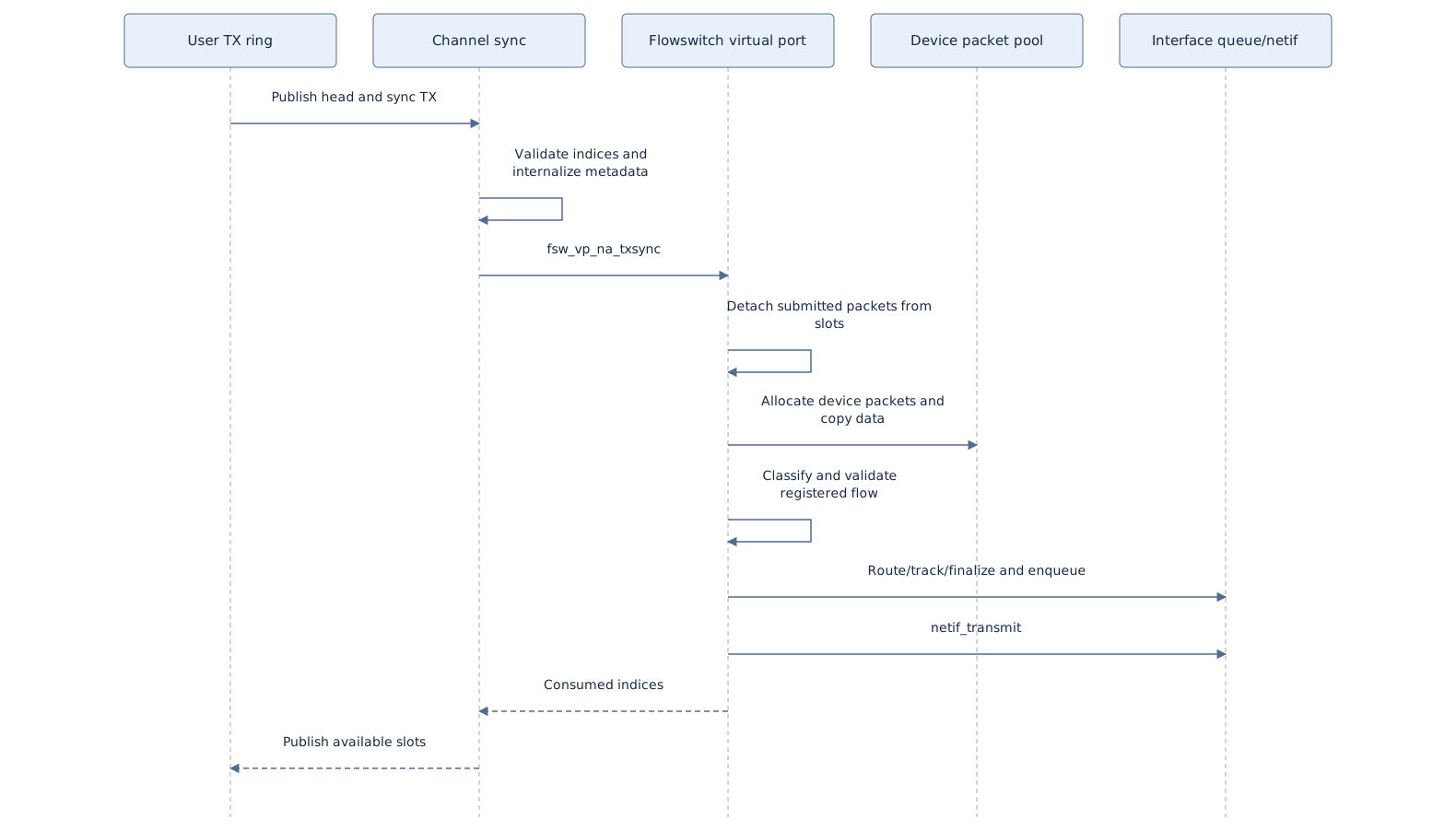
Concrete flowswitch transmit path
Mermaid source
sequenceDiagram
    participant U as User TX ring
    participant C as Channel sync
    participant F as Flowswitch virtual port
    participant P as Device packet pool
    participant Q as Interface queue/netif
    U->>C: Publish head and sync TX
    C->>C: Validate indices and internalize metadata
    C->>F: fsw_vp_na_txsync
    F->>F: Detach submitted packets from slots
    F->>P: Allocate device packets and copy data
    F->>F: Classify and validate registered flow
    F->>Q: Route/track/finalize and enqueue
    F->>Q: netif_transmit
    F-->>C: Consumed indices
    C-->>U: Publish available slots
fsw_vp_na_txsync() either flushes an active attached port or detaches/frees submitted packets when the ring cannot transmit. For a user port, fsw_ring_flush() selects fsw_user_ring_flush(). fsw_tx_ring_dequeue_pktq() moves submitted packets from kernel slots to a packet queue and advances ckr_khead/ckr_ktail.
The normal non-GSO branch enters dp_tx_pktq(). It takes flowswitch read protection, checks quiescence/device attachment, obtains interface data-movement protection, allocates packets from the device TX pool, and calls dp_copy_to_dev(). It then demultiplexes IP, classifies packets, looks up flows, and batches by flow. Source user-pool packets are freed by the surrounding user-ring flush after processing. Consequently this representative path performs a copy between pools; claims that all channel traffic bypasses copying would contradict it.
tx_lookup_flow() rejects torn-down/offload-only cases and validates the packet flow ID against the flow entry. flow_entry stores a key/hash, nexus port, receive/transmit queues, processing callbacks, and policy identifiers. A packet's addresses alone do not establish permission to transmit it on any flow.
dp_flow_tx_process() checks route viability, performs flow tracking, sets flow/policy/traffic-class metadata, finalizes packets, and enqueues into an interface class queue or queue set. netif_transmit() then selects starter-thread or doorbell servicing. The exact queue implementation and pacing/GSO branches are separate reading routes; sync completion does not certify physical transmission.
Continue with namespaces and flow lookup for reservation/key ownership, and classification, routes and datapaths for packet parsing, route invalidation and RX/TX decisions.
Netif and receive-side integration
The netif queue companion follows logical links, qsets, provider initialization, native/compat/host transfer, polling and completion. The shared interface scheduler chapter explains AQM admission, FQ-CoDel, pacing, ECN and flow-control feedback.
nx_netif_na_txsync() checks interface attachment/flow control, performs provider sync/reclaim where appropriate, and arranges a doorbell or interface start. nx_sync_tx() invokes the external provider's nxpi_sync_tx; nx_tx_doorbell() similarly delegates. Hardware queue management beyond these callbacks requires the actual provider/driver. Compatibility netif code in nx_netif_compat.c and the packet's optional mbuf backing show that mbuf and Skywalk representations coexist.
On receive, device-ring/notification paths can reach fsw_receive() and _fsw_receive(). The latter prepares packets, demultiplexes/classifies them, handles fragments, and looks up a receiving flow. Selected packets are batched into flow processing. Unclassified or unmatched packets can be placed on the host path, converted/enqueued for host delivery, and sent upward by fsw_host_sendup() after releasing the flowswitch lock. This is why the presence of a flowswitch does not mean all traffic avoids the BSD stack.
For a user-ring destination, fsw_ring_enqueue_pktq() serializes the ring, attaches packets to available slots, publishes the updated tail after a memory fence, and invokes the notification callback. Channel select/knote hooks and low-water thresholds connect available slots/packets to readiness. RX sync subsequently reconciles the user's consumption with kernel state.
This trace covers ring and pool handoff plus representative flowswitch processing. Skywalk lifecycles expands pool ownership, partial sync, defunct, flow installation/rollback, deletion, and close. Continue with controllers and ports for registration and authority, channel ABI and readiness for options, thresholds and event ownership, packets, buflets and pools for metadata validation, and memory arenas and mapping for backing and task protections. Receive aggregation, the remaining flow algorithms, and device-specific provider behavior remain separate work.