Vnodes, mounts, open files, and operation dispatch
The detailed vnode reclamation and mount lifecycle chapters expand drain, callback, publication, unmount and failure paths.
Vnode cache identity and reuse explains which cached associations survive closing, how filesystem lookup reacquires a vnode, and how allocation reuse differs from namespace eviction and permission-cache invalidation.
The vnode structure companion follows allocation, field/union access, identity validation, reference kinds, publication and reclamation. The fileproc/fileglob companion explains the open-file records that dispatch into these vnode operations.
Four objects with different lifetimes
struct vnode describes an in-memory filesystem object. Its v_type distinguishes VREG, VDIR, VCHR, VBLK, and other kinds; v_op selects vnode operations; v_mount identifies the containing filesystem instance; v_data belongs to the filesystem. A union holds type-specific state such as v_ubcinfo, v_specinfo, v_fifoinfo or v_mountedhere. v_id identifies the current incarnation, while v_name and v_parent assist name caching rather than defining the object's only possible pathname.
struct mount describes a mounted instance. mnt_op contains filesystem-level operations, mnt_vtable points to registered type information, mnt_data is instance-private state, and mnt_vnodecovered is the directory hidden by the mount. The mount also carries vnode lists, lifecycle flags, root-cache identity, device vnode, transfer limits, block size and I/O accounting. One filesystem type can supply several mount instances, each containing many vnodes.
An open descriptor leads through a fileproc to a shared fileglob. The fileglob stores fg_ops, fg_data, fg_cred, fg_offset, flags and references. For vnode-backed files, fg_data denotes the vnode and fg_ops points to vnops. The offset belongs to the open-file object, not the vnode: independent opens can have different positions; descriptors sharing a fileglob share its position.
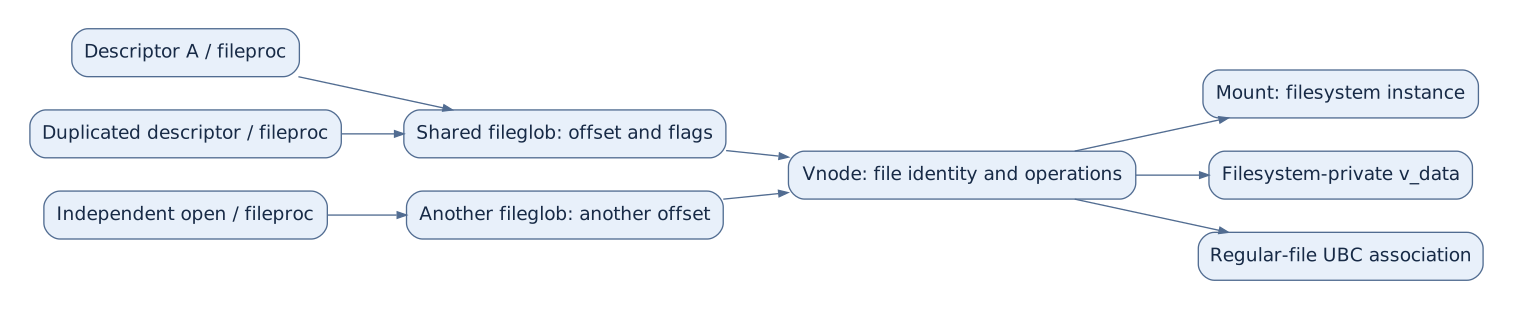
Mermaid source
flowchart LR
    A[Descriptor A / fileproc] --> G[Shared fileglob: offset and flags]
    B[Duplicated descriptor / fileproc] --> G
    C[Independent open / fileproc] --> H[Another fileglob: another offset]
    G --> V[Vnode: file identity and operations]
    H --> V
    V --> M[Mount: filesystem instance]
    V --> D[Filesystem-private v_data]
    V --> U[Regular-file UBC association]
vfs_context supplies a thread and credentials for an operation. vfs_context_current uses the current thread's read-only context layout. vfs_context_create copies a context and retains credentials; vfs_context_rele releases owned resources. A context is not a vnode or mount reference, nor a guarantee that the caller uses its current process credentials: descriptor I/O can substitute the fileglob's stored credential.
Iocount, usecount, holdcount and identity
The API comments in vnode.h distinguish the references precisely:
| Mechanism | What it protects | Typical pairing |
|---|---|---|
| Iocount | Short-lived active use; prevents vnode recycling during an operation | vnode_get* / vnode_put |
| Usecount | Persistent association, such as an open file; prevents reuse for a different file | vnode_ref* / vnode_rele* |
| Holdcount | Allocation storage while reclaim/reuse synchronization proceeds | vnode_hold / vnode_drop internally |
v_id / vid |
Detects that an old pointer now names a different incarnation | Record vid while valid; reacquire with vnode_getwithvid |
A usecount does not guarantee that filesystem-private state remains live after forced reclaim. vnode_getwithref can return a dead vnode with deadfs operations; those operations provide appropriate errors. Conversely, plain vnode_get does not verify identity if the caller had no stable reference before acquiring it. A remembered pointer plus a matching numerical address is insufficient.
vnode_getwithvid checks identity and can cut ahead of a drain to avoid filesystem-lock deadlocks. The confusingly named vnode_getwithvid_drainok variant actually waits behind drain, as its implementation comment explains. vnode_getiocount handles dead/suspended/draining/terminating states, sleeping and rechecking identity. Acquiring an iocount using the wrong variant can therefore be a lock-order bug, not merely an incorrect increment.
From open to filesystem method
openat_internal prepares attributes, applies the process creation mask and initializes nameidata. open1 allocates a fileproc/descriptor slot, calls vn_open_auth, then installs fg_ops = &vnops, the vnode and effective flags. vn_open_auth_finish takes the persistent vnode reference. The temporary lookup iocount is dropped before the completed descriptor is published.
vn_open_auth handles existing files, creation, retries and compound-open support. A filesystem may combine lookup/create/open; the generic path does not require exactly one standalone VNOP_LOOKUP followed by exactly one VNOP_OPEN. See pathname lookup for the compound continuation state.
For a read, readv_internal obtains the fileproc and creates a context whose credential is fg_cred. fp_readv calls fo_read, interprets partial completion and computes transferred bytes from the uio residual. The vnode method vn_read takes an iocount using the file's usecount, serializes the shared regular-file offset when needed, calls vn_read_common, updates the offset, and drops the iocount. FOF_OFFSET identifies operations supplying an explicit offset.
vn_read_common checks MAC policy when configured, translates descriptor flags into I/O flags, validates offsets and calls VNOP_READ (with a separate swapfile path). VNOP_READ builds vnop_read_args and invokes vp->v_op[vnop_read_desc.vdesc_offset]. That indirect call is where the concrete filesystem begins. Writes use vn_write, adding append, size-limit and write-policy handling before VNOP_WRITE.
Closing follows vn_closefile, which reacquires an iocount, removes applicable advisory locks/leases, and calls vn_close. That performs VNOP_CLOSE and releases the persistent vnode reference; special-device ordering differs because last-close behavior matters. Closing a descriptor is not synonymous with forcing every byte to durable storage.
Lifecycle and lock boundaries
The vnode header's lock-domain comment assigns freelist links to the vnode-list lock, mount-list membership to the mount lock, name links to the name-cache lock, buffer lists to buf_mtx, and remaining state primarily to v_lock. Filesystem-private v_data needs the filesystem's own synchronization. Holding a vnode reference does not lock its contents.
vnode_put_internal_locked may trigger VNOP_INACTIVE on the last appropriate active reference. It drops v_lock for that callback and reevaluates state after reacquiring it because callbacks can change reference/lifecycle state. A pager-originated last put can defer reclaim to an asynchronous cleaner to avoid deadlocking the pager against itself.
vnode_reclaim_internal marks termination, drains I/O and invokes cleanup. vclean coordinates filesystem close/sync, buffers, UBC destruction, inactive/reclaim callbacks and identity-cache cleanup as required by flags. It installs dead_vnodeop_p, clears filesystem-private data and removes the vnode from its mount. Reclaim increments v_id, making stale cached identities fail subsequent validation. INACTIVE and RECLAIM are distinct callbacks: becoming unused need not destroy reusable cached vnode state.
Mount lifetime has its own counts and locks. vfs_busy obtains a shared mount rwlock and rechecks unmount/dead state; vfs_unbusy releases it. Mount references, iterator references and crossing references serve other lifetime obligations. Treating all of these as one generic “refcount” loses the conditions that make mount traversal and unmount safe.