Code signing and platform policy
For the complete vnode-attachment path, read signature format and blob validation, then vnode signature lifecycle. These separate serialized layout and hash selection from input acquisition, policy/monitor checks, protected publication, revalidation, and cleanup.
Continue through executable signing policy and page integrity to follow the attachment into exec, mappings, page faults, and pmap. The complete route is:
| Question | Detailed chapter |
|---|---|
| What do a SuperBlob, CodeDirectory, code hash, special slot, and CDHash contain? | Signature format and blob validation |
| Who supplies signature bytes, where are they attached, and what survives failure or invalidation? | Vnode signature lifecycle |
| When do the loader, MAC hooks, task-access service, and mapping monitor admit an image or mapping? | Executable signing policy |
| When are resident bytes hashed, which results are cached, and what happens on mismatch or modification? | Page integrity |
For the data beneath those checks, read file-data caching, buffer-cache ownership, and vnode identity and reuse. A filesystem's VNOP_VERIFY completion protocol, a resident page's ordinary validity, and executable code-signing validation have distinct entry points and results.
The dedicated TXM guide expands the protected-monitor path: call/return ABI, stacks and shared state, signature/profile/trust ownership, address-space association and executable-mapping decisions. The cross-domain entry map connects it to SPTM and Exclaves.
Three decisions to keep separate
Executable handling must establish that signature data is structurally usable, determine the trust/policy attributed to that signature, and check that mapped bytes satisfy applicable integrity and mapping rules. These occur at different points. A validly laid-out CodeDirectory is not by itself a complete trust decision; CS_VALID and page-validation fields also have meanings that depend on their context.
The loader's load_code_signature() reuses/revalidates a suitable vnode blob or reads signature bytes and calls ubc_cs_blob_add(). Executable loading covers the Mach-O parser, segments, dyld, and the point where LC_CODE_SIGNATURE is processed.
Signature state belongs to the file-backed VM connection
ubc_info connects a vnode to its pager/control object and contains the cs_blobs list, validation generation, and recorded file modification time. A cs_blob describes one signature's coverage and interpreted state:
| Fields | Meaning |
|---|---|
csb_vnode, csb_next, csb_ro_addr |
Vnode association, list linkage, and protected allocation identity |
csb_base_offset, csb_start_offset, csb_end_offset |
Slice offset in a fat file and covered range relative to that slice |
csb_mem_kaddr/size, csb_cd, csb_hashtype, csb_hash_pageshift |
Signature storage, CodeDirectory, and page-hash algorithm/granularity |
csb_cdhash |
Digest derived from the CodeDirectory, used as a code identity in other interfaces |
csb_flags, csb_signer_type, csb_teamid, platform fields |
Interpreted signing and policy properties |
Entitlement blob pointers and csb_entitlements |
Raw signed material versus the external AMFI-created entitlement object |
Conditional csb_csm_obj, managed/trust fields |
Code-signing-monitor association and ownership |
cs_blob_init_validated() takes ownership of signature storage by clearing the caller's address, including on error. It validates the container, selects a CodeDirectory/hash implementation, derives coverage and allowed Mach-O flags, and computes the CDHash. cs_validate_codedirectory() checks supported page/hash formats and buffer bounds for code/special slots and scatter data. Raw entitlement subblob pointers are recorded at this stage; the source explicitly distinguishes finding them from validating their content.
ubc_cs_blob_add() constructs a temporary blob, prepares protected storage, and proceeds through reconstitution, optional monitor registration/main-binary checks, and mac_vnode_check_signature(). Policy can supply signing flags, signer type, and entitlement state. Optional monitor verification, further reconstitution, multilevel hashing, and auxiliary-blob checks follow. The temporary value is protected across selected blocking operations on PAC builds before publication into the read-only allocation.
Under the vnode lock it checks existing slices for compatible signer/platform/team state and overlapping coverage. An equivalent existing blob can be reused; conflicting content is rejected. It marks the memory object as having signed pages, updates the generation, publishes the completed blob in protected storage at the list head after a fence, and unlocks. Later authorized changes use protected-update interfaces. The insertion code's contract is that published list nodes are not removed individually while concurrent readers walk the list. This does not mean the storage survives the vnode/UBC object's teardown forever.
cs_blob_cleanup() invalidates/releases entitlement objects, disassociates profiles and unregisters monitor state where configured, and frees storage according to ownership. Monitor-managed memory can already have been freed by unregistration; selected monitor refusal paths prevent XNU from touching that storage further. A plain unconditional kfree would not describe this lifetime.
A page fault checks bytes and mapping conditions
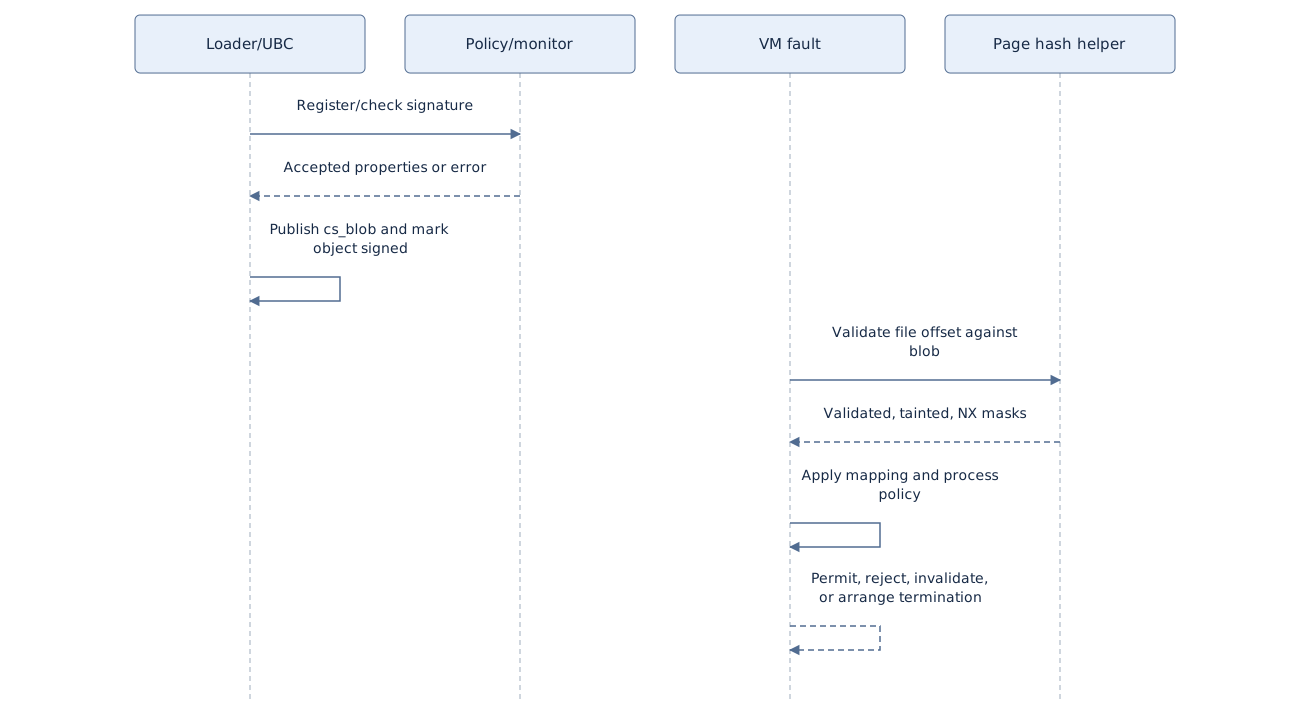
Mermaid source
sequenceDiagram
    participant L as Loader/UBC
    participant P as Policy/monitor
    participant V as VM fault
    participant H as Page hash helper
    L->>P: Register/check signature
    P-->>L: Accepted properties or error
    L->>L: Publish cs_blob and mark object signed
    V->>H: Validate file offset against blob
    H-->>V: Validated, tainted, NX masks
    V->>V: Apply mapping and process policy
    V-->>V: Permit, reject, invalidate, or arrange termination
vm_fault_cs_check_violation() decides when VM validation is needed and evaluates code-signing mapping conditions. Configured monitor-backed executable mappings can defer integrity evaluation to the monitor; other cases call the VM validation path. It also checks conditions such as write access to protected immutable pages and execute access to pages marked NX. The VM chapter explains how this fits into fault resolution and pmap entry.
vm_page_validate_cs_mapped_slow() requires a busy page and exclusive object protection, obtains the vnode through the pager, translates the page offset by the object's paging offset, and calls cs_validate_page(). Results are accumulated into vmp_cs_validated, vmp_cs_tainted, and vmp_cs_nx.
cs_validate_hash() searches blob coverage, obtains the expected hash slot, hashes the bytes using csb_hashtype, and compares the digest. It handles signature-page granularity and partial final ranges, which can be marked NX. A crucial detail: its boolean validated means a hash was available and evaluated. A mismatch still returns true while setting CS_VALIDATE_TAINTED. Absence of a hash returns false. The caller must interpret the separate outputs together; treating the validated bit alone as proof of matching content would misread the code.
cs_validate_page() translates chunk results to VM subpage masks, accommodating 4 KiB signing chunks within larger pages. cs_validate_range() provides a range-based variant. Some comments/debug strings still say SHA1, but the implementation dispatches through the selected hash type rather than assuming that one algorithm.
For a violation, vm_fault_cs_handle_violation() can call cs_invalid_page(). Under the process lock, CS_KILL arranges SIGKILL and rejection; CS_HARD rejects the mapping; other cases can clear CS_VALID and notify MAC policy of invalidation. VM has additional switched-map and protected-map handling. These are conditional mechanisms, so the simple rule “every bad hash immediately kills the process” is inaccurate.
Trust caches and external policy
The trust-cache control companion expands this route through typed admission, payload ownership, runtime locking, queries, backend selection and unload. It distinguishes locally visible checks from the imported TrustCache and Image4 policy implementations.
load_trust_cache_with_type() validates pointer/length combinations and cache type, extracts Image4 components when necessary, checks type-specific entitlement requirements and execution-mode constraints, then chooses a backend: TXM for CONFIG_SPTM, PPL for its monitor configuration, or the ordinary XNU implementation. The ordinary query path xnu_query_trust_cache() holds the runtime read lock around amfi->TrustCache.query; loading takes exclusive protection. A cache lookup is a separate input to trust decisions, not a replacement for checking file pages.
The repository defines amfi_t and entitlement/trust-cache interfaces, and amfi_interface_register() installs a provider once. coretrust_t exposes certificate/CMS/provisioning-related operations and coretrust_interface_register() similarly registers its provider. Their complete policy and cryptographic implementations are not supplied by these registration functions. mac_vnode_check_signature() is the policy callout, with structured fatal-error reporting; reading that wrapper cannot establish the entire AMFI decision.
CSR/SIP is boot-derived configuration consumed by checks
The process-control and CSR companion traces csops/csops_audittoken, command-specific identity, authorization, output and mutation, then follows ARM64 CSR initialization and concrete consumers. These controls act on process or boot policy; they do not replace signature attachment and page validation.
kern_csr.c has distinct Device Tree and legacy boot-argument implementations. With CONFIG_CSR_FROM_DT, early csr_bootstrap() starts from restrictive configuration, reads local policy properties, and derives selected environment-dependent flags before normal VM initialization. The legacy branch reads boot-argument state. csr_get_active_config() masks valid bits; csr_check(mask) evaluates the requested allowance bits with branch-specific rules.
CSR is therefore configuration consulted by security-sensitive operations, not a complete list of every protection in the system. Credential authorization, task-port conversion, MAC policies, code-signing enforcement, and hardware-protected memory have their own control paths. See platform for the lower-level PPL/SPTM and boot boundary.