Pathname resolution, name caching, and authorization
Continue with cache validation, publication and vnode reclamation for the reference-conversion, generation and drain protocols behind this overview.
A pathname lookup is a stateful operation
struct nameidata carries the pathname pointer and address-space type, starting/root directory, results ni_vp and ni_dvp, remaining path length, next component, symlink count, flags and componentname. componentname carries the operation (LOOKUP, CREATE, DELETE, RENAME), component bytes/length/hash, flags and context. Looking up an existing file and locating a parent for creation have different valid outcomes.
namei copies the pathname into kernel storage, chooses the starting/root directories, invokes component lookup and handles restart conditions. It begins with an inline PATHBUFLEN buffer; longer supported paths allocate larger storage, and this checkout has process-dependent long-path handling. ni_segflg determines whether copying uses copyinstr or copystr. Never treat an input user pointer as a stable, already trusted kernel string.
For openat, open1at prepares directory-fd handling because the eventual namei invocation occurs deeper inside vn_open_auth. Absolute paths, current-directory lookups and directory-relative lookups have distinct start rules. The NAMEI_ROOTDIR, NAMEI_RESOLVE_BENEATH, NAMEI_NODOTDOT, NAMEI_LOCAL, NAMEI_NODEVFS and related flags constrain traversal; they are not all enabled for ordinary open.
Component traversal and fast paths
lookup calls cache_lookup_path, which can consume cached components and report whether directory search has already been authorized. A miss continues through directory/type checks, search authorization and filesystem lookup. For a normal non-compound component, the route reaches VNOP_LOOKUP; successful results then pass through handling for mountpoints, links and cache updates.
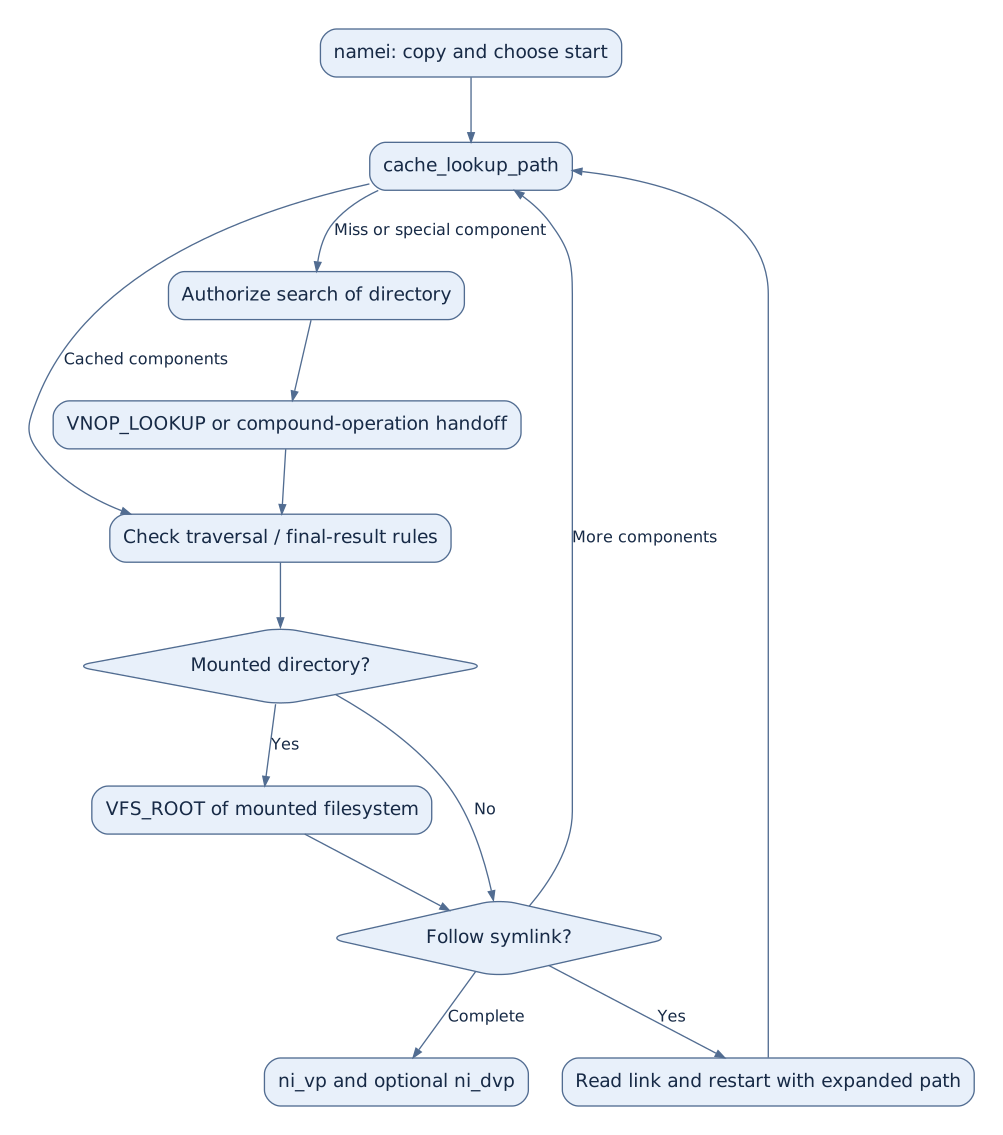
Mermaid source
flowchart TD
    N[namei: copy and choose start] --> C[cache_lookup_path]
    C -->|Cached components| T[Check traversal / final-result rules]
    C -->|Miss or special component| A[Authorize search of directory]
    A --> L[VNOP_LOOKUP or compound-operation handoff]
    L --> T
    T --> M{Mounted directory?}
    M -->|Yes| R[VFS_ROOT of mounted filesystem]
    M -->|No| S{Follow symlink?}
    R --> S
    S -->|Yes| B[Read link and restart with expanded path]
    B --> C
    S -->|More components| C
    S -->|Complete| O[ni_vp and optional ni_dvp]
.. is not a string deletion. lookup must honor the logical root, prevent prohibited escapes and potentially move from a mounted filesystem root to the covered directory in its parent filesystem. lookup_traverse_mountpoints takes a mount crossing reference, obtains vfs_busy, calls VFS_ROOT, then releases crossing/busy state while replacing the directory iocount. It also handles forced-unmount and traversal restrictions.
lookup_handle_symlink checks the symlink limit, performs the MAC readlink check, obtains link bytes through VNOP_READLINK, combines them with the unconsumed path and chooses a new starting directory. Relative targets restart at the link's directory; absolute targets require root handling. A symlink is processed by lookup policy rather than blindly treated as another ordinary directory entry.
Name cache entries are validated identities
struct namecache stores parent vnode nc_dvp, name/hash, target nc_vp, target identity nc_vid, and nc_counter. A null target can represent a negative result: a known absent name. The cache has links for parent children, target names and hash lookup. Multiple names can refer to the same vnode, which is another reason v_name is not a unique canonical pathname.
cache_lookup_ext has an SMR path: safe memory reclamation lets it inspect hash entries without holding the global cache lock for the entire read. It reads nc_counter, validates the entry, snapshots vnode/vid, and checks that the counter stayed unchanged. For a positive result it obtains a vnode hold, exits the SMR section, reacquires an iocount with the saved vid, then drops the hold. Each mechanism solves a different race: cache-entry reclamation, vnode allocation lifetime and vnode incarnation.
The API's return convention is unusual: -1 means a positive hit with *vpp populated, 0 means miss/fallback needed, and ENOENT means a negative hit. Negative entries are handled differently for create/rename so an old absence does not prevent a new object being created. Cache insertion uses directory generations to avoid publishing results that became stale while filesystem work was in progress; see lookup_consider_update_cache.
The multi-component fast path has additional authorization and mount-root caching. This chapter describes its interface and the single-component SMR mechanism, not every fast-path restart. Namespace mutation, unmount and hard links mean a reconstructed path can change even while the underlying vnode remains valid; the comment before filesystem lookup explains this limitation explicitly.
Authorization happens at several boundaries
lookup_authorize_search checks KAUTH_VNODE_SEARCH unless an appropriate cached authorization applies, and invokes mac_vnode_check_lookup when configured. Reaching the final vnode does not itself authorize opening its data. vn_authorize_open_existing checks object/open compatibility, MAC policy and requested actions, distinguishing read, write, append, execute and directory search.
vnode_authorize calls the vnode kauth scope using the operation context. The internal authorization callback gathers attributes and evaluates the applicable rights, ownership/group, ACL, immutable and mount restrictions. Parent-directory information matters for operations such as deletion. Authorization is therefore not just comparing the current process UID with a file owner.
Continue with vnode permissions and ACL evaluation for the action mask, attribute ownership, ordered permit/deny decisions, group-resolution errors, residual POSIX checks, delete-child/sticky rules and creation inheritance. The target ACL, parent directory permissions and cached authorization each answer different parts of a mutation request.
Opaque-authorization filesystems can make the final decision themselves. vnode_authorize_opaque tries VNOP_ACCESS; if unsupported, many operations rely on the filesystem's inline authorization. It treats advisory access checks and execute specially. Do not assume that a generic permission-cache hit overrides server-side authorization on a remote filesystem, or that every kernel caller of VNOP_READ automatically passes through the same authorization as a userspace open.
Compound operations and cleanup
When the filesystem supports the intended compound operation, lookup can stop before the final component, set NAMEI_UNFINISHED, and return enough state for a combined lookup/create/open or mutation. vn_open_auth handles EKEEPLOOKING and continuation when the filesystem encounters a symlink, mountpoint or other case requiring generic resolution. This reduces separate lookup/mutation work and lets the filesystem coordinate its own namespace locks.
Finally, nameidone frees allocated pathname storage. It does not release the returned vnode iocounts. Read each caller's success and failure paths for vnode_put(ni_vp) and any parent/start-directory references; confusing these cleanup responsibilities leaks active vnodes or accesses recycled state.