File descriptors: allocation, replacement and close
Back to processes · Pipes and UNIX rights · Advisory locks
A descriptor operation first stabilizes a process-local table slot, then uses a fileproc and its shared fileglob. This chapter follows allocation, publication, replacement and draining before crossing into the owning file, socket or IPC subsystem. The same slot number can later identify a different object; a saved integer is not an object reference.
Process inspection and snapshots applies that distinction to proc_info: listing descriptor numbers and later retrieving a typed record are separate operations, with separate process/object lookups and result lifetimes.
For the underlying declarations and storage contracts, keep descriptor tables and fileprocs/fileglobs beside this operation trace. They follow allocation, fields, lock domains, borrowed/retained access, sharing examples and staged release.
Three levels of identity

Mermaid source
flowchart LR
    A[Process A fd 3] --> AP[fileproc A3]
    B[Process A fd 7: dup] --> BP[fileproc A7]
    C[Process B inherited fd 3] --> CP[fileproc B3]
    AP --> FG[fileglob: shared offset, flags, credentials, ops]
    BP --> FG
    CP --> FG
    FG --> O[vnode / socket / pipe / other object]
An fd number is an index in one process's table. A fileproc is the descriptor instance. A fileglob is the shared open-file object behind one or more descriptor instances. This distinction explains why closing one fd does not necessarily close the underlying object, and why duplicates can share an offset while having distinct close-on-exec behavior.
struct filedesc is embedded as proc.p_fd. It contains fd_ofiles[], reservation flags in fd_ofileflags[], allocation bounds, the descriptor lock, directory references, knote lists, the workqueue kqueue pointer, and a dynamic-workloop hash. Its historical header comment about a shareable filedesc is less useful than the actual embedded field and fdt_fork() implementation in this snapshot.
struct fileproc has fp_iocount, volatile drain flags, per-descriptor flags such as FP_CLOEXEC/FP_CLOFORK, guard attributes, and fp_glob. struct fileglob has fg_count, message-queue references, file status flags, fg_cred, fg_ops, fg_offset, fg_data, and fg_lock. The data identifies a vnode, socket, pipe, or other supported resource. struct fileops supplies read/write, ioctl, select, close, kqueue-filter, and drain methods.
A slot can be occupied without being available
The descriptor lock protects the pointer and its slot flags together. UF_RESERVED means a transition owns the number; it can accompany either a null pointer or an initialized fileproc. Ordinary fp_lookup rejects both. A published descriptor has a nonnull pointer without UF_RESERVED. Closing adds both UF_RESERVED and UF_CLOSING, preserving the old pointer until I/O references drain. slot flags, lookup predicate.
| Slot state | fd_ofiles[fd] |
Relevant flags | What another operation can do |
|---|---|---|---|
| Available | Null | No reservation | fdalloc may reserve it |
| Allocation/replacement reserved | Null, or initialized but unpublished object | UF_RESERVED |
Ordinary lookup fails; dup2 can wait |
| Published | fileproc |
No reservation | Lookup can acquire an I/O reference |
| Closing/draining | Old fileproc |
`UF_RESERVED | UF_CLOSING` |
Target retained for dup2 |
Null | UF_RESERVED, no closing bit |
Replacement owns the number until publication or rollback |
UF_RESVWAIT records a waiter on reservation completion. Despite the header's short “close in progress” comment, its actual producer is procfdtbl_waitfd; releasing or clearing a reservation wakes the wait channel. reserve/release/wait/clear.
Publication is an explicit step, performed while holding the descriptor lock. A null fp argument means the initialized pointer is already in the slot. procfdtbl_releasefd, lines 453–464:
void
procfdtbl_releasefd(struct proc * p, int fd, struct fileproc * fp)
{
	if (fp != NULL) {
		p->p_fd.fd_ofiles[fd] = fp;
	}
	p->p_fd.fd_ofileflags[fd] &= ~UF_RESERVED;
	if ((p->p_fd.fd_ofileflags[fd] & UF_RESVWAIT) == UF_RESVWAIT) {
		p->p_fd.fd_ofileflags[fd] &= ~UF_RESVWAIT;
		wakeup(&p->p_fd);
	}
}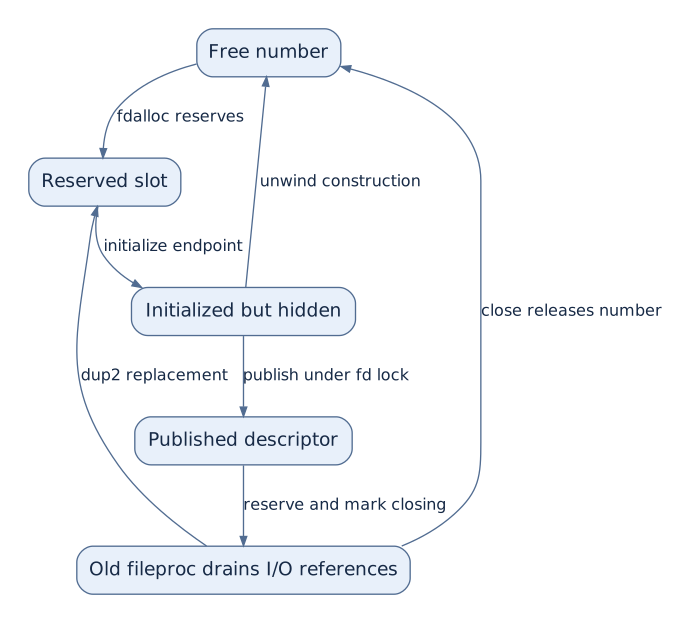
Mermaid source
flowchart TD
    E["Free number"] -->|fdalloc reserves| R["Reserved slot"]
    R -->|initialize endpoint| I["Initialized but hidden"]
    I -->|publish under fd lock| P["Published descriptor"]
    I -->|unwind construction| E
    P -->|reserve and mark closing| C["Old fileproc drains I/O references"]
    C -->|close releases number| E
    C -->|dup2 replacement| R
Allocation and table growth recheck after sleeping
fdalloc searches from the higher of the requested minimum and fd_freefile. It requires both a null pointer and no reservation, then updates fd_afterlast and the free-search hint. The process nofile limit bounds the search. With CONFIG_PROC_RESOURCE_LIMITS, reservation also increments the open-slot accounting and may trigger resource-limit notification; this is distinct from the ordinary RLIMIT_NOFILE allocation bound. search and limits.
If the arrays are too small, the allocator chooses NDEXTENT or doubles their size, capped by the process limit. It drops the lock to allocate the pointer and flag arrays, then reacquires it. Another thread may already have grown the table, so the candidate can be freed and the search repeated. Importantly, the current arrays are copied after reacquiring the lock; the allocation interval is not a snapshot whose old contents may be blindly published. growth and installation.
The allocation/recheck branch is explicit. lines 1272–1285:
		proc_fdunlock(p);
		newofiles = kalloc_type(struct fileproc *, numfiles, Z_WAITOK | Z_ZERO);
		newofileflags = kalloc_data(numfiles, Z_WAITOK | Z_ZERO);
		proc_fdlock(p);
		if (newofileflags == NULL || newofiles == NULL) {
			kfree_type(struct fileproc *, numfiles, newofiles);
			kfree_data(newofileflags, numfiles);
			return ENOMEM;
		}
		if (fdp->fd_nfiles >= numfiles) {
			kfree_type(struct fileproc *, numfiles, newofiles);
			kfree_data(newofileflags, numfiles);
			continue;
		}
falloc_withinit adds construction of a fresh open-file object. It checks the system-wide file limit, obtains a reserved number, performs the configured MAC create check, allocates the fileproc and fileglob, takes an additional constructor I/O reference and stores the pointer while leaving the reservation set. The caller still owns endpoint initialization. The fileproc allocator uses Z_WAITOK | Z_ZERO | Z_NOFAIL; do not infer an ordinary null-return branch from the older allocation-failure description above the caller. construction, fileproc allocation.
A concrete consumer is VFS open1: it calls falloc_withinit, initializes flags and opens the vnode, then clears the reservation and drops the constructor reference only after the endpoint is ready. Early failures after successful construction use fp_free; the later failure path closes the opened vnode before freeing descriptor construction. acquire and early unwind, publish and late unwind.
fp_free is construction rollback: release the reserved slot, free the new fileglob, release the constructor hold and free the fileproc. It is not ordinary close and does not run fg_drop's process-lock cleanup. rollback.
One source-visible qualification prevents claiming universal rollback: the MAC-denial branch inside falloc_withinit, after fdalloc succeeds, unlocks and returns directly without calling fdrelse in that branch. The VFS caller returns immediately on this error. The successful-construction cleanup contract should not be generalized to that earlier branch. This observation describes the checked-in bodies, not a runtime test of a particular policy provider. MAC-denial branch, caller return.
Duplication preserves the open file and replaces descriptor state
finishdup is shared by duplication interfaces. Under the descriptor lock it rechecks that the source is still published, applies the MAC duplication check, and retains the source fileglob. It drops the lock to allocate a new fileproc, associates the shared fileglob, then reacquires the lock and publishes into the reserved destination. The new descriptor starts with fresh descriptor state plus the requested flags; it is not a byte-for-byte copy of the source fileproc. The caller keeps the source I/O reference through this operation. finishdup, dup caller.
dup2(old, new) has additional steps because it must use a particular number:
- Look up and reference
old, checkGUARD_DUP, validatenew, and handleold == new. - Grow/reserve if necessary. If another transition already reserves
new, drop the source I/O reference, sleep usingprocfdtbl_waitfd, and restart source lookup after waking. - If
newis published, check itsGUARD_CLOSE, then callfp_close_and_unlockwithFD_DUP2RESV. That closes the old target while retaining its number as reserved. - Call
finishdup, drop the source I/O reference and unlock. A source recheck or MAC rejection can release the destination reservation and return an error after the previous target was already closed.
dup2, including restart and completion.
Illustrative interleaving: thread A calls dup2(3, 8) while thread B is opening into reserved slot 8. A releases its lookup reference on 3 and waits; B publishes 8 and wakes A. A starts again, so it acts on the source currently associated with 3, not a presumed identity cached before sleeping. If another close marks 3 reserved during a later unlocked phase, finishdup can fail its source recheck. Once A closes target 8 with FD_DUP2RESV, another allocator cannot claim 8 between that close and replacement.
This is why dup2 is not implemented as unrelated close(new) and dup(old) syscalls. It is also not a transaction restoring the previous target on every later error. The target close status is deliberately discarded by the dup2 caller. reserved-target wait, close and reserve, source/MAC failure.
Reference and close protocol
fp_lookup() validates the fd while holding the descriptor-table lock, rejects reserved entries, and increments fp_iocount. That I/O reference keeps the descriptor instance available while the lock is released and an operation runs. fp_drop() drops it and wakes a closing/draining thread when appropriate. The table reference, I/O references, and fileglob ownership are different counts; none should be treated as interchangeable.
fp_close_and_unlock first hides the slot with UF_RESERVED | UF_CLOSING. It can then drop the descriptor lock for MAC/kauth close notifications and AIO cancellation without permitting a new ordinary lookup. It reacquires the lock, removes descriptor knotes and invokes fileproc_drain. The historical caller names in its comment are not the authoritative names for current exec cleanup; follow fdt_exec and fdt_fork below. close ordering.
The drain sets FPV_DRAIN and loops while fp_iocount > 1: the remaining one is the descriptor's base hold. It calls the endpoint's fo_drain, wakes select/conflict waiters when applicable, sets fd_fpdrainwait, and sleeps while releasing the descriptor lock. fp_drop wakes the drain when a reference decrement leaves one. Waking is a reason to recheck the count, not proof that every descriptor in the table has drained. drain, drop and wake.
A closing pointer remains reachable through narrowly defined helpers for callers that already own an I/O count; this permits select and other operations to release that count even when they retained the fd instead of the pointer. fp_get_noref_locked_with_iocount asserts the ownership/state combination. This exception to ordinary lookup does not let a fresh operation bypass close. special lookup.
After draining, ordinary close releases the number; dup2 retains its reservation. lines 1812–1821:
	fileproc_drain(p, fp);

	if (flags & FD_DUP2RESV) {
		fdp->fd_ofiles[fd] = NULL;
		fdp->fd_ofileflags[fd] &= ~UF_CLOSING;
	} else {
		fdrelse(p, fd);
	}

	proc_fdunlock(p);
Only after dropping the descriptor lock does close free the fileproc and call fg_drop. For a vnode and a real process owner, fg_drop performs applicable POSIX record-lock cleanup even if other fileglob references survive. It invokes the endpoint's fo_close only when the fileglob count reaches zero. Fileports and UNIX-socket message references can therefore retain the open object after the descriptor disappears. final descriptor release, fileglob close.
A close error from the final endpoint callback arrives after descriptor removal. It does not reinstall the slot or promise that retrying the same integer targets the same object. Distinguish process-owned advisory locks from open-file-owned locks and from transferred references.
fdt_fork() allocates new fileprocs and retains the existing fileglobs. It skips reserved/confined entries, applies FP_CLOFORK on fork and FP_CLOEXEC for the exec-copy case, and preserves only the appropriate descriptor flags. This function participates in the shadow-proc exec design, so descriptor inheritance cannot be understood only by searching for an old fdexec() name.
Guards constrain operations on the descriptor instance
Ordinary close checks GUARD_CLOSE; source duplication checks GUARD_DUP; dup2 separately checks whether its target may be closed. Fileport conversion checks GUARD_FILEPORT, and UNIX descriptor transfer has its own send guard. These are checks at concrete operations, not a universal lock on all uses of the open file. ordinary close, dup2 checks, fileport check.
guarded_close_np copies in a guard ID, acquires the descriptor lock, and looks up the guarded descriptor with an I/O reference. An unguarded object returns EINVAL; a mismatching guard ID returns EPERM in this helper, explicitly without producing a mismatch exception. On success it drops its extra I/O reference while retaining the lock and enters the ordinary close machinery. Keeping the lookup reference while entering the drain would make the close wait for its own hold. guarded lookup, guarded close.
Following a read
read() → read_nocancel() → read_internal() constructs a uio, which describes the userspace buffers, residual byte count, transfer direction, and offset. readv_internal() calls preparefileread() to acquire the fileproc and check read permission, derives a VFS context using fg_cred, then calls fp_readv() and eventually fo_read(). It drops the I/O reference afterward.
The concrete fileops chooses the next subsystem: vnode operations reach VFS, socket operations reach networking, and pipe operations stay in sys_pipe.c. fp_readv() computes transferred bytes from the reduction in uio_resid(); interrupted/would-block returns can become a successful short read if bytes were already transferred. The write path follows the same dispatch pattern. Explicit-offset operations add validation; a non-vnode endpoint normally fails random-access requests with ESPIPE.
Readiness also uses methods on the underlying object. select() walks descriptor methods and associated wait state, while poll_nocancel() allocates a temporary kqueue and converts poll interests into kevent registrations. Events and workqueues explains that common event machinery.
Pipes and transferred file references
pipe() allocates a paired set of struct pipe endpoints, creates one read and one write fileproc, installs pipeops, links pipe_peer, and publishes the two descriptors after initialization. In this path the interface is half duplex. Continue with pipe buffering, atomic writes and closure for the pipe_read(), pipe_write() and pipeclose() mechanisms.
UNIX-domain SCM_RIGHTS transfers preserve open-file identity rather than copying an integer fd into another process. unp_internalize() validates control metadata, looks up each sending fd under the process descriptor lock, checks whether its fileglob is sendable and whether guards permit transfer, and replaces the fd array with retained/queued fileglob references. unp_externalize() reserves all destination fd slots before committing, creates fileprocs referring to those fileglobs, removes message-queue bookkeeping, and publishes the new fd numbers. The sender's and receiver's numbers can differ.
The fileglob tracks message references separately (fg_msgcount, f_msglist). unp_gc() exists because sockets containing descriptor references can form cycles that simple reference counting cannot reclaim. The rights-collection companion follows root marking, lock-conflict restarts, temporary references, queue flushing and final release.
Mach fileports provide another transfer interface. sys_fileport_makeport() checks sendability/guards, retains the fileglob, creates a fileport, and copies a send right into the task's IPC namespace. fileport_releasefg() drops that ownership when the port is destroyed. Conversely, sys_fileport_makefd() accepts a typed IKOT_FILEPORT send right and calls fileport_makefd() to allocate a descriptor sharing the fileglob; the syscall sets FP_CLOEXEC. This is a direct connection between the descriptor and Mach IPC object models.
The fileport no-senders callback uses ipc_kobject_dealloc_port with the notification's make-send count, then releases the associated fileglob through fileport_releasefg. That release uses FG_NOPROC, keeping final transferred-reference disposal separate from closing a process descriptor and its POSIX locks. typed port and no-senders, release.
sys_fileport_makeport also demonstrates partial publication: after ipc_port_copyout_send installs a name, copying that integer to the user's buffer can fail. Cleanup deallocates the installed name if still present and drops the fileproc lookup reference; it explicitly tolerates another thread racing to deallocate the name. sys_fileport_makefd instead accepts the typed right, creates a fresh descriptor and marks it close-on-exec. port-name publication and unwind, descriptor construction.
Other local communication entry points
| Facility | Source and useful starting symbols | Cross-subsystem relation |
|---|---|---|
| System V shared memory | sysv_shm.c: shmget(), shmat(), shmexit() |
Process attachment tracking in p->vm_shm; VM mappings |
| System V semaphores | sysv_sem.c: semop(), semexit() |
Blocking and exit-time undo/cleanup |
| System V message queues | sysv_msg.c: msgsnd_nocancel(), msgrcv_nocancel() |
Permission checks, queue storage, wait/wakeup |
| Common SysV permission handling | sysv_ipc.c |
Credentials and IPC permission records |
| POSIX shared memory/semaphores | posix_shm.c, posix_sem.c |
Distinct APIs with their own objects; some descriptor types in file_internal.h |
Continue with POSIX named IPC, System V IPC and user-address wait/wake for object ownership, blocking and cleanup. Build-time SYSV_* guards and syscall-table configuration must be checked before assuming any particular facility is enabled.
Configuration, source tests and inspection boundary
| Evidence | Invariant or boundary to read |
|---|---|
fd_guarded.c |
Adds guards after registering read monitoring. It exercises that coexistence, not every guard exception or close race. |
failed receive preserves locks |
Exhausts receive-side descriptor capacity after acquiring a POSIX lock, then checks failed SCM_RIGHTS reception did not remove the existing lock. Rollback is not ordinary process close. |
fd_table_limits.c |
Uses spawned clients to distinguish configured soft/hard resource-limit outcomes. These extensions are separate from the basic nofile limit. |
CONFIG_MACF, CONFIG_PROC_RESOURCE_LIMITS, DIAGNOSTIC |
Select create/dup policy hooks, additional resource notifications and assertions. The endpoint's fileops still determine read, drain and final-close behavior. create path, limit notification. |
These tests were inspected as source contracts, not executed. The selected review covers slot allocation/growth/publication, duplication, drain/release, guard checks, fork/exec linkage and fileport conversion. Individual filesystem/device fo_drain/fo_close implementations and every fcntl command have their own mechanisms; see their owning chapters and the descriptor syscall catalog.