Process objects and lifetime
For the detailed creation, publication, failure, and teardown protocols, continue with Fork, spawn, exec, exit, and wait.
For the storage and access model, read the process and its protected data and the task and its shared RO record. They explain the combined allocation, proc_ro field groups, validation, checked writes and final allocation holds, including bootstrap and corpse exceptions.
Four objects, distinct responsibilities
| Object | Fields or accessors to recognize | Responsibility |
|---|---|---|
struct proc |
p_pid, p_pptr, p_children, p_uthlist, p_fd, p_sigacts, p_lflag, p_refcount |
Unix identity, relationships, resources, and transitions |
struct proc_ro |
pr_proc, pr_task, p_uniqueid, p_idversion, p_ucred, p_csflags |
Protected association and identity/security data |
Mach task / thread |
proc_task(), get_bsdtask_info(), get_threadtask() |
VM/IPC ownership and scheduled execution; see runtime |
struct uthread |
uu_arg, uu_rval, uu_siglist, uu_sigmask, uu_save, workqueue state |
Per-thread BSD execution state |
proc and task share an allocation in this checkout. task_zone_init() computes aligned sizes and creates proc_task_zone; proc_get_task_raw() reaches the task by adding proc_struct_size. proc_task() additionally checks P_LHASTASK. Do not infer that a raw address guarantees the task is still attached, or that the two halves have identical reference lifetimes. P_REF_PROC_HOLD and P_REF_TASK_HOLD track holds on the combined allocation.
uthread_init() initializes BSD state when a Mach thread is created. It fills a thread_ro template with tro_proc, tro_proc_ro, tro_cred, and tro_realcred, then links the uthread into p_uthlist under proc_lock(). Ordinary threads inherit a signal mask; workqueue threads use a special mask. uthread_cleanup() and uthread_destroy() participate in thread teardown. The uthread is not a second independently scheduled thread.
Credentials and references
The process credential association is p_proc_ro->p_ucred, an SMR pointer. A running thread caches the process credential in tro_realcred and can have an effective per-thread credential in tro_cred. current_cached_proc_cred_update() checks whether the process credential has changed and refreshes the thread through the slow path. kauth_cred_get() returns the effective current-thread credential; callers needing ownership use a referenced form. Fork initialization explicitly uses the creating thread's credential, so thread impersonation is relevant to child identity. Authorization and credential contents are covered in security.
proc_find(pid) searches the PID hash under SMR, attempts a reference, and handles an exec transition before returning. The caller must pair a successful result with proc_rele(). A PID is a reusable namespace value; p_uniqueid and p_idversion provide additional identity information. A proc * reference preserves an object but is not a substitute for the lock required to read mutable fields.
Relevant synchronization is split across proc_list_lock() for process lists/relationships, proc_lock() for per-process state, proc_fdlock() for descriptors, and credential locks/accessors. Field annotations in proc_internal.h identify intended protection. proc_transstart()/proc_transend() serialize lifecycle transitions; signal serialization is separate. proc_refdrain_will_exec() stalls most new references while existing users drain, and proc_refdrain() is used during exit. Avoid holding references indefinitely across operations that need such a drain.
Fork and spawn
The creation path is visible in kern_fork.c:
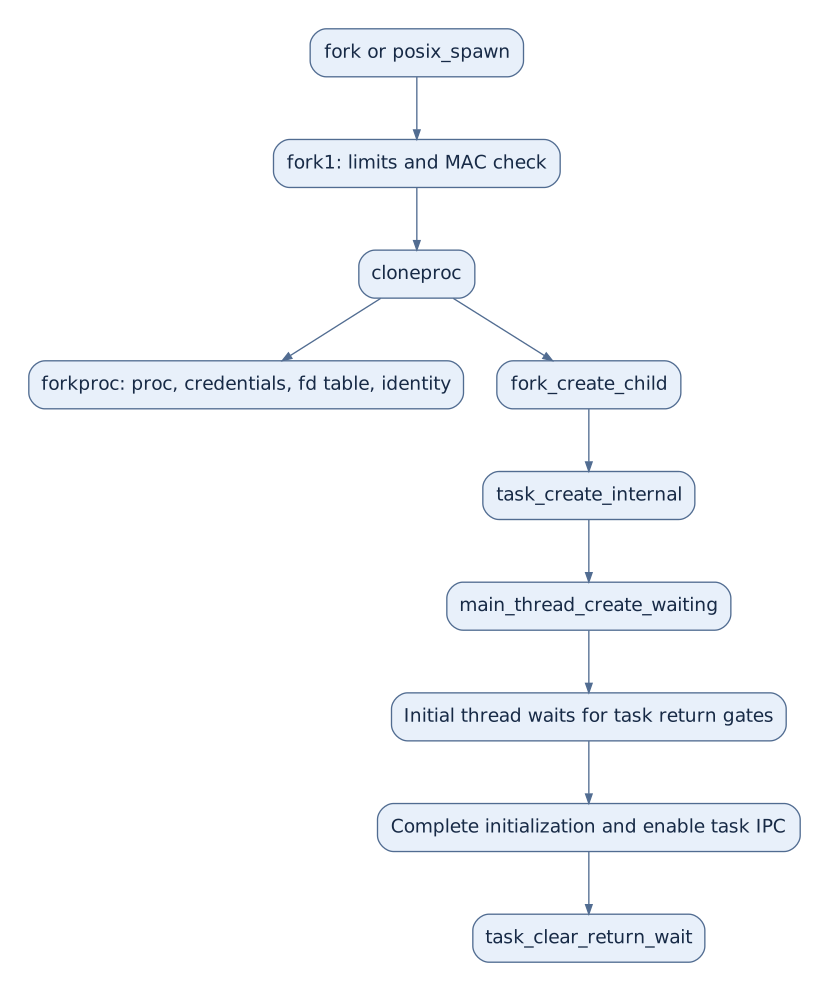
Mermaid source
flowchart TD
    F[fork or posix_spawn] --> F1[fork1: limits and MAC check]
    F1 --> C[cloneproc]
    C --> P[forkproc: proc, credentials, fd table, identity]
    C --> T[fork_create_child]
    T --> TC[task_create_internal]
    TC --> MT[main_thread_create_waiting]
    MT --> WAIT[Initial thread waits for task return gates]
    WAIT --> READY[Complete initialization and enable task IPC]
    READY --> RUN[task_clear_return_wait]
fork1() enforces global and per-user process limits, then chooses CLONEPROC_FORK or CLONEPROC_SPAWN. forkproc() allocates from the combined zone, initializes references/locks, allocates identity, copies the explicit p_forkcopy group, retains shared objects, and calls fdt_fork(). Descriptor table entries are copied while their fileglob objects remain shared; descriptor lifetime explains the consequences.
fork_create_child() sets inherit_memory only for CLONEPROC_FORK, creates the Mach task, associates it with the proc, and creates its main thread in a waiting state. For fork, fork1() duplicates the calling thread's machine state and installs child return values. It does not clone every parent thread. The task's VM inheritance behavior is implemented below this boundary in VM.
fork() sets the parent return value, sets up the child's map and task control port, enables task IPC, releases transition/signal protections, emits NOTE_FORK, and opens the return gates. A child may be present in kernel tables before it can execute user code; initialization visibility and runnability are different milestones.
posix_spawn() uses the creation machinery without copying the parent's address space, applies file actions/attributes, and activates an executable. Its set-exec mode takes the exec replacement path. The vfork syscall slot is guarded by CONFIG_VFORK in syscalls.master; this inspection did not find an in-tree C definition and does not infer active vfork semantics from residual comments or userspace stubs.
Exec replaces the proc/task pair
execve() → __mac_execve() builds image_params and creates a new proc/task/main-thread pair using CLONEPROC_EXEC. The new proc has the same PID, unique ID, and identity version but is marked P_REF_SHADOW; it is not exposed as a second ordinary process. This is a material distinction from a description of exec as merely overwriting the old task's map.
exec_activate_image() copies the path, resolves it with namei(), obtains transition protection on the old proc, checks permissions, reads the initial executable data, and walks the execsw activators. Fat binaries can select another slice; scripts redirect lookup to an interpreter, with an iteration limit. exec_mach_imgact() validates Mach-O identity/architecture, calls load_machfile(), prepares the new map and initial execution state, and runs credential/security setup. The executable-loading guide follows the Mach-O parser, segment mappings, dynamic linker, and initial machine state.
proc_exec_switch_task() drains references to both procs, checks that old/new tasks and the calling thread still permit the switch, and transfers signal state, resource accounting, task fields, tracing state, process knotes, timers, and children. Under the process-list lock it calls phash_replace_locked() and moves P_REF_SHADOW from the new proc to the old one. proc_find() explicitly retries around this replacement. The outgoing task is then terminated through the surrounding exec cleanup path, while the new task's initialization gates govern entry to userspace.
Exec failure is phase-dependent. Early failure can return an error to the old image; after the documented point of no return, activation failure can arrange termination and report apparent success internally to complete teardown. Read the bad paths and exec_done conditions before assuming rollback is always possible.
Exit, zombie, and reap
exit_with_reason() chooses/coordinates the exiting thread, commits p_xstat and P_LEXIT, prepares process exit, and calls task_terminate_internal(). The final active Mach thread to terminate calls proc_exit(). Thus task termination initiated outside the ordinary exit syscall can still complete BSD process teardown.
proc_exit() drains signal activity and process references, marks workqueues exiting, cancels/drains AIO, invalidates descriptors, and only then destroys the workqueue after its knotes/kqueues/workloops are gone. It also handles SysV cleanup, controlling-terminal/session work, children, accounting, and parent notification. The common retained-child case becomes SZOMB and signals the parent with SIGCHLD; special cases can be reaped internally.
wait4_nocancel() searches matching children, skips shadow procs, serializes waiters through P_LIST_WAITING, copies status/resource usage out, and calls reap_child_locked(). waitid_nocancel() has a parallel status interface and supports its own options. reap_child_locked() handles tracing/reparenting cases, removes family/group/hash membership, destroys remaining descriptor/lock state, and drops the wait reference. A zombie is a process record retained for observation; it is not an executing thread.
For the first process, bsd_utaskbootstrap() clones from kernproc with no parent task/memory inheritance and obtains PID 1. Its BSD AST reaches bsdinit_task(), which installs the exception bridge and calls load_init_program().