System V IPC: queues, semaphore vectors and shared segments
Processes · POSIX named IPC · VM mappings
System V IPC uses integer object IDs and permission records rather than file descriptors. This chapter follows the separately configured SYSV_MSG, SYSV_SEM and SYSV_SHM implementations. Their presence in the tree does not establish that every product enables them. The common permission gate is ipcperm, and the implementations maintain independent subsystem locks and storage.
IDs contain both a slot and a generation
Lookup splits an ID into array index and sequence. It rejects out-of-range, free or wrong-sequence records, so a reused table slot is not the previous object. A creation key finds an object; IPC_PRIVATE requests a new one. Key, returned ID and mapping address are three different values. Message lookup, shared-segment lookup.
| Facility | Stored objects | Waiting/storage resource |
|---|---|---|
| Messages | msqid_kernel, linked msg headers, segment-index chains in msgmap |
Queue byte allowance, global headers and message segments |
| Semaphores | semid_kernel, sem array, per-process sem_undo entries |
Value/count predicates across an operation vector |
| Shared memory | shmid_kernel, linked shm_handle, per-process shmmap_state |
Named memory-entry backing and VM mappings |
Message pools, semaphore lookup/undo, shared-memory representations.
Message send reserves before publishing
msgsnd_nocancel validates ID, write permission/MAC policy and message size. A message needs a header plus ceil(size/msgssz) storage segments. It can block because its queue is locked/full or because the global header/segment pool is depleted. IPC_NOWAIT changes those shortages to EAGAIN. A blocking request releases the subsystem mutex via msleep, reacquires it and rechecks the relevant state; deletion and interruption can terminate the operation. Admission/resource loop.
The sender marks MSG_LOCKED, removes a header and segments from free lists, and drops the mutex around user copies. The message's type and body are private allocations until ready to append. A copy fault frees the header/segments, clears the locked bit and wakes waiters. A valid type must be positive. On successful copy it updates queue counts/time/last-sender and wakes receivers; removal during a copy has its own cleanup branch. Copy and append.
Receive can consume a message even if copyout fails
msgrcv_nocancel checks read permission and scans for a suitable message. Zero type selects the first queued message. Positive type selects an exact match. For negative type this source scans in queue order for the first entry satisfying msg_type <= -msgtyp; do not silently replace that code with a different operating system's selection algorithm. A too-small buffer without MSG_NOERROR returns E2BIG before removing the selected entry; with the flag, the copied payload is truncated. An empty match either sleeps or returns the no-message error. After sleep, allocation/sequence are rechecked. Selection.
Once selected, the message is unlinked and queue counters are reduced before user copyout. A fault while returning its type or body frees the removed message rather than putting it back. Thus an EFAULT does not mean the queue is unchanged. Bookkeeping and copyout.
bsd/kern/sysv_msg.c, lines 1374–1377:
	msqptr->u.msg_cbytes -= msghdr->msg_ts;
	msqptr->u.msg_qnum--;
	msqptr->u.msg_lrpid = proc_getpid(p);
	msqptr->u.msg_rtime = sysv_msgtime();
msgctl(IPC_RMID) authorizes removal, disposes queued messages, invalidates the queue and wakes blocked operations. Its treatment of a sender holding MSG_LOCKED is part of the removal protocol, not proof that every user copy runs under the global mutex. Control/removal.
A semaphore request is a vector
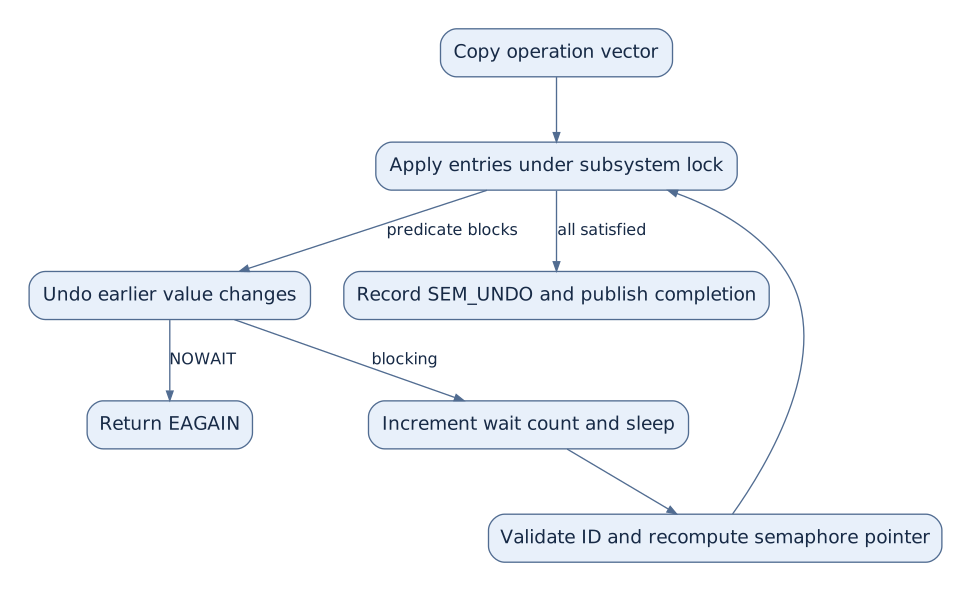
semop copies a bounded array of sembuf operations. Negative values require enough semaphore value to subtract; zero waits for zero; positive values add. It applies entries while holding the subsystem mutex. If an entry cannot proceed, it rolls back earlier changes before returning EAGAIN or sleeping, then retries the vector. The failing predicate determines whether semncnt or semzcnt tracks the waiter. Vector processing.
Mermaid source
flowchart TD
    V[Copy operation vector] --> A[Apply entries under subsystem lock]
    A -->|predicate blocks| R[Undo earlier value changes]
    R -->|NOWAIT| E[Return EAGAIN]
    R -->|blocking| W[Increment wait count and sleep]
    W --> C[Validate ID and recompute semaphore pointer]
    C --> A
    A -->|all satisfied| U[Record SEM_UNDO and publish completion]
Illustrative vector: decrement semaphore 0 by one, then wait for semaphore 1 to become zero. If the second predicate blocks, the first decrement is undone before sleeping. Another process therefore does not observe an indefinitely half-completed vector. SEM_UNDO adds a second transaction: recording undo adjustments can fail, requiring undo/value rollback. Undo registration and rollback.
The invalid-index branch differs from that blocking rollback. This implementation checks each sem_num inside the apply loop; an out-of-range entry jumps directly to semopout with EFBIG. That exit only unlocks and returns. Earlier valid entries in such a malformed vector can therefore already have changed values. The comment's atomicity explanation describes the wait/retry path, not this error exit. Index validation, direct exit.
semexit finds the exiting process's undo entries, applies adjustments to surviving semaphore sets, clamps selected negative adjustment outcomes at zero, wakes waiters and removes the process's undo bookkeeping. semctl value/reset/remove operations also reconcile undo entries, so stale adjustments must not be applied to a reused semaphore ID. Exit undo, undo clearing.
Shared segments and attachments
shmget either checks an existing key/size/permission combination or allocates a segment backed by a chain of Mach memory-entry handles. shmat checks the ID, permission and readonly flag, reserves a per-process attachment slot, rounds/alignment-checks the address using the current map page size, reserves a no-access interval and overlays shared entry mappings. Only after success does it publish the attachment ID, increment shm_nattch and return the virtual address. Creation, attachment.
The failure branch removes its successfully mapped prefix and translates the Mach error; it is not a generic promise to restore prior address-space state. shmdt finds the recorded base address, removes the VM range and decrements attachment count. IPC_RMID changes the key to private and marks removed; final storage release waits for the last attachment. Lookup refuses removed segments, while existing mappings remain usable until detached. Remove, detach and backing release.
shmfork copies attachment bookkeeping and increments segment attachment counts. shmexit removes mappings and records; shmexec uses a variant that performs bookkeeping without redundantly deleting mappings from the old address space. Fork/exit/exec. These kernel bodies are available here; no userspace IPC daemon supplies them.