Advisory byte-range locks and file leases
VFS · Descriptors · UNIX rights · Namespace changes
Advisory locks coordinate owners of file byte ranges. File leases notify a holder when another operation needs conflicting access. Their state, ownership and wakeup protocols are different even though both can make a file operation wait.
Which owner survives dup, fork and close?
fcntl selects POSIX or open-file-description semantics before VNOP_ADVLOCK. POSIX requests use the process as identity; OFD requests derive identity from the fileglob. flock also uses fileglob identity but sets its own whole-file semantics. Duplicated descriptors can therefore share an OFD/flock owner while process locks have a process-based release rule. fcntl dispatch, flock dispatch.
struct lockf records inclusive start/end (-1 means EOF), type, identity, semantics flags, vnode/list backpointers and a queue of requests blocked by this lock. lf_owner is a process only where ownership can be established safely: ordinary POSIX locks, or confined OFD cases. The list hangs from vnode.v_lockf and is protected by v_lock. Structure, admission/owner setup.
Normalize, find conflicts and edit intervals
lf_advlock converts a flock range to inclusive bounds. The caller has already adjusted SEEK_CUR; SEEK_END obtains current vnode size with overflow checks. Zero length extends to EOF, negative length covers bytes before the supplied start, and invalid negative/overflowing ranges fail. It allocates a request and invokes the set/clear/get operation under v_lock. Normalization.
lf_getblock locates overlapping conflicting owners/types. A nonblocking conflicting set frees its request and returns EAGAIN. After conflicts are gone, lf_setlock handles six overlap cases with the same owner's existing ranges: none, exact equality, either containment, and overlap at either end. It can split, replace, shorten or merge intervals and move/wake blocked requests. Unlock uses corresponding interval editing. Conflict and insertion, clear, split.
Illustrative operation: owner A holds write range [0,99], then unlocks [40,59]. Its state becomes [0,39] and [60,99]; a waiter for byte 50 may now proceed while a waiter for byte 70 remains blocked. An interval is not tied to the descriptor number used for that individual request.
Sleep and deadlock checks
A blocking request is linked on the conflicting lock's lf_blkhd, with lf_next identifying the blocker, then sleeps while releasing v_lock. POSIX deadlock detection examines process thread wait channels and related blocking state under lf_dead_lock. If inspecting another vnode would require a conflicting mutex, the code drops locks, pauses and restarts the scan. OFD locks do not implement this same deadlock check. Detection and retry.
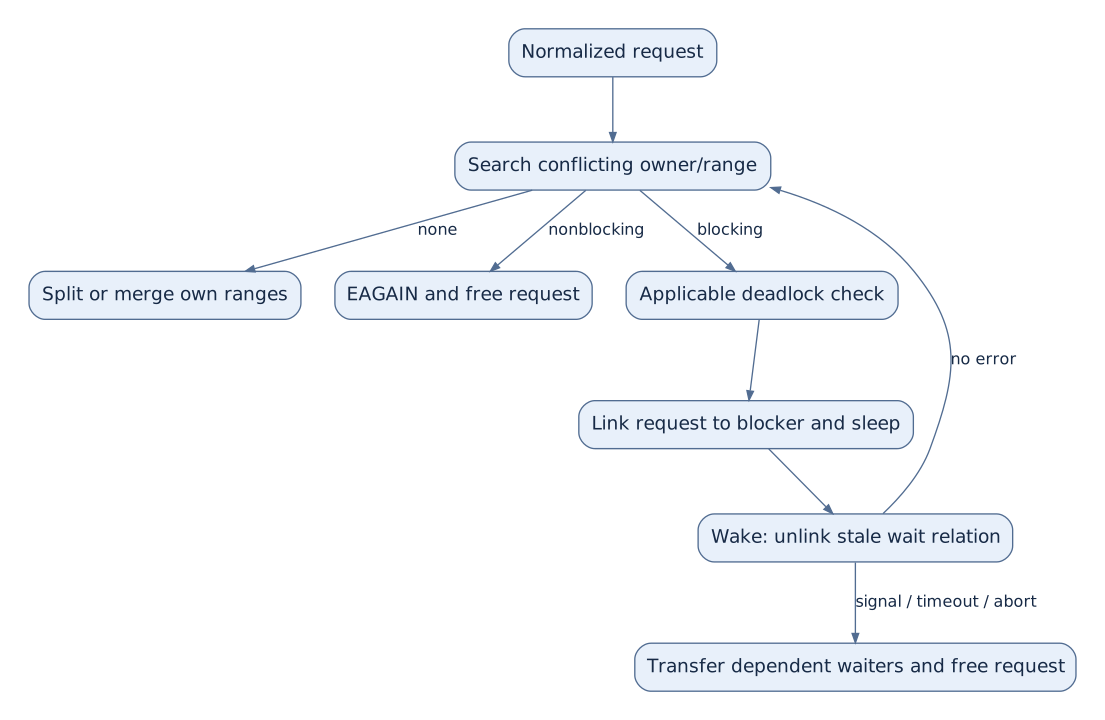
Mermaid source
flowchart TD
    R[Normalized request] --> C[Search conflicting owner/range]
    C -->|none| I[Split or merge own ranges]
    C -->|nonblocking| E[EAGAIN and free request]
    C -->|blocking| D[Applicable deadlock check]
    D --> Q[Link request to blocker and sleep]
    Q --> W[Wake: unlink stale wait relation]
    W -->|no error| C
    W -->|signal / timeout / abort| F[Transfer dependent waiters and free request]
Wakeup is not automatically a grant. A spurious wake must remove the old queue link before retrying, otherwise a second insertion could create a cycle. Interrupted/timed-out requests adjust any donation and transfer/wake requests blocked behind them. F_ABORT becomes EBADF; timeout sleep errors become ETIMEDOUT. Wake cleanup.
bsd/kern/kern_lockf.c, lines 790–797:
			TAILQ_REMOVE(&lock->lf_next->lf_blkhd, lock, lf_block);
#if IMPORTANCE_INHERITANCE
			/*
			 * Adjust the boost on lf_next.
			 */
			lf_adjust_assertion(lock->lf_next);
#endif /* IMPORTANCE_INHERITANCE */
			lock->lf_next = NULL;
Closing a file and disposing a transferred reference
Descriptor close can release POSIX locks for the process even when other references keep the fileglob alive. OFD/flock release belongs to open-file ownership. The process context passed to a drop therefore matters: failed SCM_RIGHTS externalization uses UNP_FG_NOPROC so discarding an undelivered message reference does not accidentally act like the recipient closing an already open file. Process lock cleanup, failed receive disposal. This is a useful example of why reducing every cleanup to “decrement the reference count” loses behavior.
Lease state and break requests
Under CONFIG_FILE_LEASES, each vnode has file_lease records containing fileglob, owning PID, read/write type, pending flags and separate release/downgrade timestamps. vnode_setlease checks admission policy and calls acquisition or release. Leases are not entries in v_lockf. Representation, lease entry.
vnode_breaklease derives access from open flags, applies special dataless/read-context exemptions and checks whether another process holds conflicting lease state. A read can require downgrade of an exclusive lease; a write/truncate can require release. It marks pending state and posts NOTE_LEASE_DOWNGRADE or NOTE_LEASE_RELEASE. A holder can receive both with different start times when later access escalates. Conflict and notification.
For an O_NONBLOCK breaker the event has already been sent when EWOULDBLOCK is returned. A blocking breaker waits for release/downgrade; timeout handling can force the pending change. Success is not unconditional veto power for the original holder. Wait selection, timeout transitions.
Directory mutation calls vnode_breakdirlease and may obtain the parent from cached identity or a filesystem parent-ID lookup. That helper explicitly makes a best-effort parent lookup. Vnode reclaim calls vnode_revokelease, removes all records and wakes breakers. Directory and reclaim. Remote/filesystem-specific lock providers can override VNOP behavior; this chapter explains the local generic lockf implementation and VFS lease protocol rather than an absent network lock manager.