Exclaves services: what an upcall can ask XNU to do
Exclaves overview · Execution and dispatch · Resources and memory
An Exclaves upcall enters a registered XNU handler through the proxy's RPC loop. Its payload is interpreted by a generated server and then by a local handler. The handler may use VFS, IOKit, task lifecycle, VM, or notification machinery before returning a typed completion result. It is not a syscall issued by an ordinary userspace process, and it need not use that process's file-descriptor table or credentials. Upcall-server setup and dispatch.
The local .c files expose the checks and downstream calls. Tightbeam-generated types and transport come from SDK modules; service policy, secure execution, and many hardware providers are external. The build assembles exclaves.tightbeam.h/.c from available modules rather than checking a complete generated server implementation into this tree. Generation.
Storage: a shared data buffer plus a separate file namespace
exclaves_storage_init maps the kernel-domain com.apple.storage.backend segment with write permission and keeps its kernel address as storage_buffer. The defined transfer area is 4 MiB. Restore/recovery/rooted-ramdisk and relaxed-requirement cases can let boot continue without that buffer; later I/O upcalls then fail. This is an explicit degraded mode, not successful initialization of an alternative private buffer. Initialization and boot registration, size.
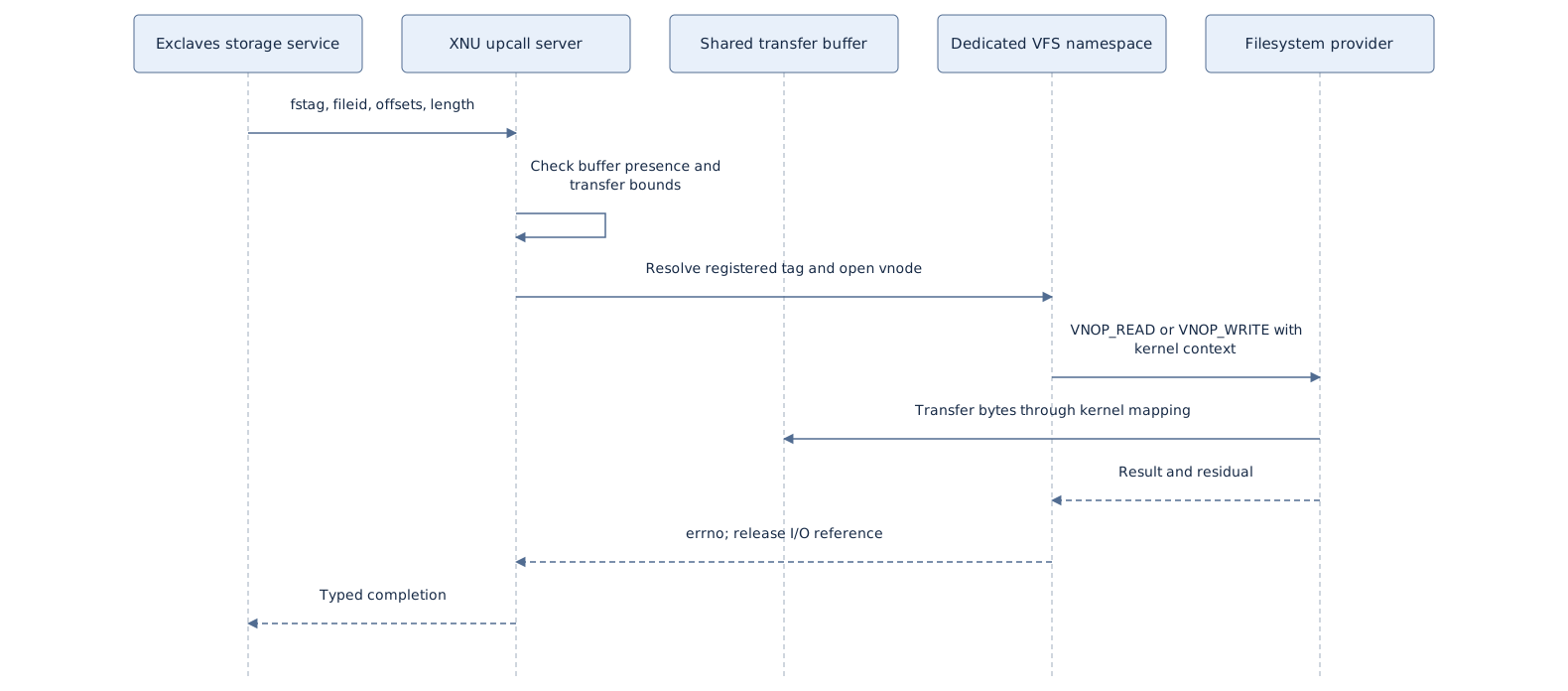
The v2 read/write RPC carries fstag, fileid, and an I/O descriptor containing buffer offset, file offset, and length. XNU checks that the shared buffer exists and that buffer offset plus length fits it without overflow:
Source: storage transfer bounds
static int
verify_storage_buf_offset(uint64_t buf, uint64_t length)
{
	uint64_t off;
	if (__builtin_add_overflow(buf, length, &off)) {
		return ERANGE;
	}

	if (off > STORAGE_EXCLAVE_BUF_SIZE) {
		return ERANGE;
	}

	return 0;
}
It then calls vfs_exclave_fs_read/write with storage_buffer + bufferoffset. Errors are converted into the service's result enumeration and passed to the completion callback. A read places file bytes into the shared buffer; a write consumes bytes from it. The buffer offset is not an arbitrary XNU pointer accepted from the peer. Open/root handlers also require a terminator within their fixed-width string arrays. Read/write handlers, string validation and open, open handler.
The VFS layer defines registered_fs_tag_t and open_vnode records rather than resolving normal BSD file descriptors. Registration requires a started service, an APFS directory, suitable graft behavior, and a held vnode reference. Read-only tags query FSIOC_EVAL_ROOTAUTH to record sealing status. Only EFT_EXCLAVE and EFT_EXCLAVE_MAIN are considered writable by the local predicate. Records, registration, writability.
exclave_fs_open_internal resolves either the registered base or an already-open root vnode. It uses NOCROSSMOUNT, chooses NOFOLLOW for writable tags and FOLLOW otherwise, and sets ni_rootdir, NAMEI_ROOTDIR and USEDVP before vn_open_auth. File creation unlinks an existing non-directory target first and then uses O_EXCL, preventing a concurrent replacement from being silently opened as the intended new file. These are the concrete pathname controls visible in this path; they should not be inflated into a proof of every filesystem/provider behavior. Open path, namei background.
Open-vnode lookup uses the registered filesystem's device and inode/file ID, with graft-ID translation where required. Under open_vnodes_mtx, it acquires an I/O reference using vnode_getwithref. This is not a per-process descriptor lookup or a per-request check against the caller's Unix credentials. Resource-domain/secure-service authorization and this local vnode namespace play different roles. Lookup, open accounting.
The I/O body refuses writes to read-only tags, builds a UIO_SYSSPACE request, and invokes VNOP_READ/VNOP_WRITE with vfs_context_kernel(). A successful VNOP with residual bytes is translated to EIO; the vnode I/O reference is released on exit. Close decrements the tracked open count and calls vn_close. I/O and wrappers, close.
Mermaid source
sequenceDiagram
    participant E as Exclaves storage service
    participant U as XNU upcall server
    participant B as Shared transfer buffer
    participant V as Dedicated VFS namespace
    participant F as Filesystem provider
    E->>U: fstag, fileid, offsets, length
    U->>U: Check buffer presence and transfer bounds
    U->>V: Resolve registered tag and open vnode
    V->>F: VNOP_READ or VNOP_WRITE with kernel context
    F->>B: Transfer bytes through kernel mapping
    F-->>V: Result and residual
    V-->>U: errno#59; release I/O reference
    U-->>E: Typed completion
This path demonstrates why secure execution does not imply that XNU's entire VFS disappears from the service's dependency chain. The local code mediates storage and translates results. APFS implementation and the secure service's decisions about which requests to make are outside this inspection.
Sensors and arbitrated buffers
Sensor use has two accounting layers: r_sensor.s_startcount tracks starts through one named resource record, shared by handles referring to that record, while exclaves_sensor_t.s_startcount tracks use of the underlying sensor. Resource open resolves a named SENSOR resource, initializes it, and retains it; start/stop serialize with its mutex and update the resource count only on success. Last-use cleanup attempts to balance its outstanding starts. Resource operations.
At the underlying layer, the first start calls the Exclaves indicator-controller interface; subsequent starts query status before incrementing the count. Intermediate stops query status and decrement; the last stop calls the controller, clears the underlying count, then queries status. The last status query can fail after the stop already happened, so a failure result does not imply that no state changed. A periodic status thread is awakened after the first start. Sensor state machine, controller request.
These counters record successful API use and controller responses. The indicator hardware and the secure controller's enforcement are not implemented by these counters. Arbitrated sensor/audio buffers add a service copy/arbitration request before copying from an existing read-only shared mapping. That API control is distinct from whether XNU already has readable PTEs for the segment. Arbitrated copyout, mapping permissions.
Driver upcalls resolve an IOKit proxy
The v2 handlers in exclaves_driverkit.c convert generated request fields into local operation structs for interrupts, timers, work loops, asynchronous notifications, mapper activation and ANE/power requests. They pass a registry/service ID into IOKit and translate success/failure back into the generated result. The ID is not a userspace io_connect_t, and these calls do not go through an ordinary IOUserClient::externalMethod. Interrupt handlers, timer handlers, mapper and ANE requests.
getProxyStateFromRegistryID looks up the registered proxy-state wrapper, verifies its dynamic type and nonnull state, and returns the associated service context. Interrupt/timer handlers retain the service during dispatch to its exclave* methods and release it afterward. This is an explicit XNU object-resolution/lifetime layer between the secure RPC and the provider. It does not by itself establish the secure side's authority to choose every registry ID. Proxy lookup, interrupt dispatch, timer dispatch.
Mapper activation obtains the service's provider, selects its IOMapper by index, and calls the platform's DART active-state function. This handler requests device-mapping state changes; it does not contain an IOMMU implementation or a proof that arbitrary secure pages are DMA-accessible. ANE requests similarly dispatch registered callbacks when present. Mapper/ANE boundary, DMA ownership background, SPTM/IOMMU interface.
Notifications leave the secure RPC through ordinary XNU event mechanisms
Kqueue notifications resolve their shared resource identity and call KNOTE under the resource mutex. The knote attach/detach/touch/process operations maintain the local listener state. This changes XNU event readiness; it is not a secure scheduling-context resume. Filter operations, signal.
Daemon notifications instead keep registered Mach send rights. The signal handler honors queue limits, removes inactive destinations, constructs header-only kernel messages with COPY_SEND, and calls kernel_mach_msg_send_kmsg. It logs send failures and continues; the function's KERN_SUCCESS does not guarantee every listener received a message. Removed destinations' resource references are released after unlocking, because final release can reacquire that mutex. Complete signal path.
Thus a secure-side event can follow upcall → resource ID → XNU kqueue/Mach message → ordinary userspace receiver. The Mach delivery path then has its usual queue, rights and receiver-lifetime rules. Driver notification entry points, Mach delivery.
Always-on work is another rendezvous protocol
Always-on Exclaves integration uses aoe_item_t entries on the conclave resource. They hold service IDs, message/messenger and work/worker counts, association state and power-assertion state. Startup creates a client for the named queue proxy when present. Legacy setup enables “free agent” workers; newer paths also select a service explicitly. State, proxy setup, conclave setup.
exclaves_aoe_upcall_work_available currently accepts the conclave-work variant, validates the service identifier, finds its associated initialized conclave, and posts a message. Posting increments a count and wakes threads waiting on that service's rendezvous. The claiming loop checks abort state, takes the resource mutex, consumes a queued message and increments messenger count, or installs an interruptible wait before dropping the lock and blocking. Work upcall, claim/post.
This permits work notification to be separate from the userspace thread that later enters an always-on work loop. The work-loop path marks TH_EXCLAVES_AOE, drives queue-proxy requests, and clears that state on its termination path. It does not create a universal right to run any secure service: setup and rendezvous use the attached conclave and its known services. Worker loop, execution state.
Inspection, panic, and source-navigation tools
Inspection has its own coordinated entry boundary. Initialization selects the available stackshot-server variant, maps a read-only shared output buffer, and starts a collection thread. The collector requests results for scheduling-context IDs and copies bounded output into XNU storage. exclaves_inspection_check_ast can stop a thread from returning to Exclaves while stackshot/kperf inspection is pending, sleeping with the collection thread as inheritor. It is not an arbitrary debugger read of secure memory. Initialization, SCID collection, return-path wait.
The panic service uses a dedicated XNU thread. It resolves com.apple.service.PanicInit, marks a spawn-expected phase, obtains a nonzero panic SCID, sets TH_EXCLAVES_RESUME_PANIC_THREAD, and repeatedly calls exclaves_run. This is a special persistent context and response protocol, not an ordinary user endpoint call or the SPTM panic-lockdown operation. Panic context, thread creation.
For a matching debug kernel, showallconclaves, showexclavesresourcetable -D <domain>, and showesynctable expose XNU task associations, local resource inventory and synchronization state. They do not dump the complete secure kernel. exclaves_tests.c, daemon-notification tests, and stackshot test support provide further entry points for reading expected protocols. None was executed during this documentation work.
Inspection depth
Storage transfer validation, registration/open/I/O/close, resource and underlying sensor counters, representative IOKit dispatch, notification delivery, AOE work notification/claim, and inspection/panic handoffs were inspected. Other storage operations, all generated RPC branches, every provider callback, AOE power-state combinations and complete crash-buffer parsing were not audited exhaustively. The detailed execution guide covers how these handlers return to the secure caller; the resources guide covers the separate capability, mapping and physical-page lifetimes.