Exclaves resources, task attachment, and physical-memory ownership
Exclaves overview · Execution and upcalls · SPTM · Service integration
Exclaves crosses several ownership boundaries at once. A task can be associated with a conclave, a Mach send right can name a resource, a secure service can authorize a shared segment, and SPTM can classify physical pages as secure-owned or shareable. These are separate checks and lifetimes. A resource name is not a physical-memory capability, and keeping a vm_page in an XNU object does not imply XNU is authorized to map its contents.
This page follows the local representations and transitions. The secure kernel, resource-provider implementations, framebank/FrameMint internals, and SPTM's validation code are external. Calls to them are identified at their XNU interface, without reconstructing their missing implementations.
1. Resource identity includes a domain and type
exclaves_resource_init obtains a resource inventory through exclaves_xnuproxy_resource_info. Each record supplies a name, scope/domain, type, numerical ID, and connection state. XNU builds a root domain table and per-domain name/ID tables. Name lookup also checks the resource type, so an identical string with another type is not interchangeable. Table lookup, domain construction.
| Structure | Fields that matter at the boundary |
|---|---|
exclaves_resource_t |
Name, r_type, r_id, atomic r_usecnt, stable kobject port, mutex, active/connected state, and type-specific union |
conclave_resource_t |
Lifecycle state and pending requests, active downcall/stop/detach state, control connection, task and downcall-thread references, permitted service bitmap |
shared_memory_resource_t |
Rounded size, copy direction, XNU address, secure-service mapping handle, and client connection |
| Notification resource state | Knotes or registered Mach send rights; distinct from an endpoint scheduling context |
The exact layouts are in exclaves_resource.h. Resource creation allocates an IKOT_EXCLAVES_RESOURCE port even though its initial use count is zero. The boot inventory and port identity persist independently of one active user's reference. Construction.
The name and ID tables are not identical indexes. Notifications and daemon notifications receive globally indexed IDs in the kernel domain; names in several domains can refer to the same underlying notification resource. Ordinary resources are principally found by name and type. A failed connected-state check normally hides a resource. Conclave-manager/service forwarding resources have a special name-lookup exception, with forwarding defined by IDs greater than EXCLAVES_FORWARDING_RESOURCE_ID_BASE; the local launch path separately rejects such a manager. Index insertion and aliasing, lookup filtering, forwarding predicate, launch gate.
Startup also constructs service-ID bitmaps. For a known conclave manager, eligible services in its domain set bits in c_service_bitmap; forwarding services are skipped. The kernel and Darwin domains contribute to the kernel bitmap. An unknown domain without the expected manager is not automatically granted equivalent access. CONCLAVE_SERVICE_MAX is 768 here. The endpoint-call path checks membership in these bitmaps, whereas buffer/sensor operations can consume resource-port names. Bitmap construction, membership test, endpoint execution.
“Domain” in this resource lookup is a namespace and authorization context. It is not a statement that each domain corresponds to an ARM exception level or one physical page-table root.
2. Resource ports bridge into ordinary Mach capabilities
IPC_KOBJECT_DEFINE declares the resource kobject stable, permits movable send rights, and supplies a no-senders callback. A userspace port name is resolved in its IPC space; the caller cannot substitute a raw kernel resource address.
exclaves_resource_from_port_name rejects invalid names, translates a send right, checks IKOT_EXCLAVES_RESOURCE, and retains the resource while the port remains locked. It then drops the port lock and returns the referenced resource. The operation-specific handler still checks the expected resource type and permissions. Stable kobject identity and a valid send right do not make every resource operation legal.
The inverse helper consumes a use reference. It donates that reference to the first send-right lifetime, or releases the redundant reference if that lifetime is already established:
Source: resource-reference donation
	/*
	 * make a send right and donate our reference for
	 * exclaves_resource_no_senders if this is the first send right
	 */
	if (!ipc_kobject_make_send_lazy_alloc_port(&resource->r_port,
	    resource, IKOT_EXCLAVES_RESOURCE)) {
		exclaves_resource_release(resource);
	}

	*name = ipc_port_copyout_send(resource->r_port, space);
If copyout fails, the IPC helper releases the send right; this can trigger the no-senders callback. That callback releases the donated resource reference. Mach user-reference counts and the resource's active-use count are therefore related through a port lifetime, not equal counters. Copyout cleanup and no-senders, Mach rights background.
exclaves_resource_release decrements atomically first. A nonfinal release needs no resource mutex, which matters to real-time buffer paths. The apparent last release takes the mutex and rechecks the count with acquire ordering: a new user may have arrived before the lock was obtained. Only a still-zero count runs type-specific cleanup, such as sensor reset, shared-memory teardown, or release of registered daemon-notification ports. It does not free the boot inventory entry itself. Release protocol.

Mermaid source
flowchart LR
    N[Domain + name + expected type] --> R[Persistent resource record]
    R --> U[Active use reference]
    U --> P[Mach send-right lifetime]
    P --> L[Locked port lookup + use retain]
    L --> O[Checked resource operation]
    O --> D[Release operation reference]
    P --> S[No senders]
    S --> D
    D --> Z{Use count still zero under mutex?}
    Z -->|yes| C[Type-specific active-state cleanup]
    Z -->|no| R
3. A conclave attaches to a task through a lifecycle protocol
task_add_conclave checks two different authorities: the initiating task needs conclave-spawn privilege, and the target executable vnode/slice must carry host or spawn privilege. It then asks exclaves_conclave_attach to associate the named manager. Inheritance across an exec task replacement separately checks the new executable's host privilege. Attachment checks, inheritance, exec call site.
Under the resource mutex, attachment requires state NONE, takes a task reference, sets task->conclave and c_task, and moves to ATTACHED. There is a deliberate missing-resource case: if the manager cannot be found, attach returns KERN_SUCCESS without setting that association; subsequent launch fails. A successful attach return alone is therefore insufficient evidence that the task has a usable manager. Attachment body.
The logical states are:
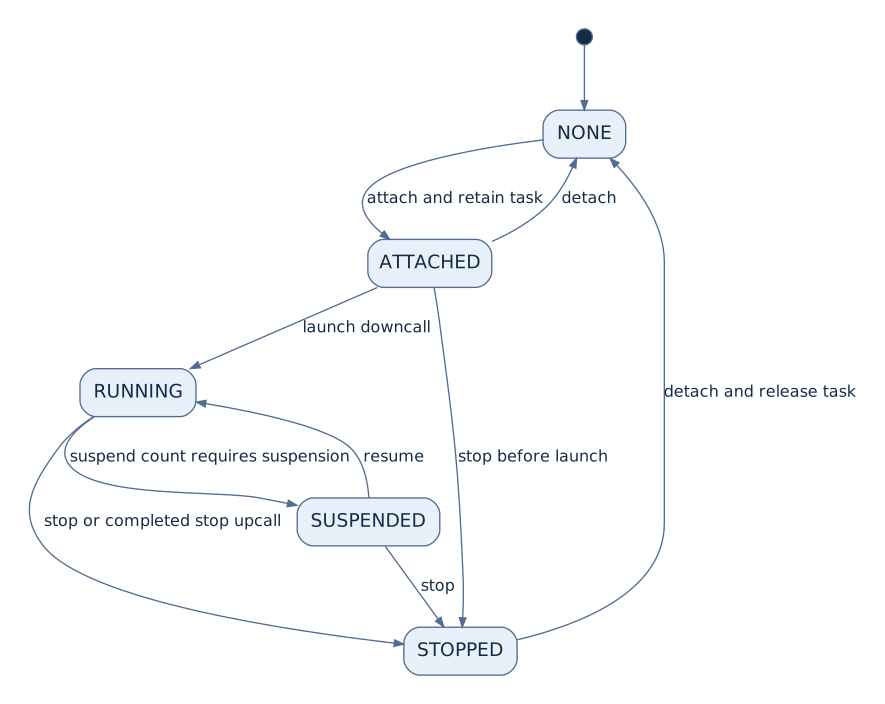
Mermaid source
stateDiagram-v2
    [*] --> NONE
    NONE --> ATTACHED: attach and retain task
    ATTACHED --> RUNNING: launch downcall
    ATTACHED --> STOPPED: stop before launch
    RUNNING --> SUSPENDED: suspend count requires suspension
    SUSPENDED --> RUNNING: resume
    RUNNING --> STOPPED: stop or completed stop upcall
    SUSPENDED --> STOPPED: stop
    ATTACHED --> NONE: detach
    STOPPED --> NONE: detach and release task
This shows stable states. Actual transitions have pending request bits and active-call fields so that XNU can handle an upcall or another task-lifecycle request while a control RPC is outstanding. State fields.
exclaves_conclave_launch waits for the ExclaveKit boot stage and requires ATTACHED with no active downcall/stop call. It sets the launch request and enters exclaves_update_state_machine_locked. That helper records the executing thread and intended next state, then releases the mutex before invoking the external launcher:
		if (conclave->c_request & CONCLAVE_R_LAUNCH_REQUESTED) {
			conclave->c_request &= ~CONCLAVE_R_LAUNCH_REQUESTED;
			assert3u(conclave->c_active_downcall, ==, 0);
			conclave->c_active_downcall = true;
			conclave->c_downcall_thread = current_thread();
			pending_state = CONCLAVE_S_RUNNING;
			lck_mtx_unlock(&resource->r_mutex);

			ret = exclaves_conclave_launcher_launch(conclave->c_control);
			assert3u(ret, ==, KERN_SUCCESS);
The generated conclave_launcher_conclavecontrol_launch/stop/suspend requests use c_control; their wrappers translate transport and typed result failures. Their implementations do not reveal how the manager launches secure-side code. On return, the state-machine helper reacquires the resource mutex, clears active-call bookkeeping, wakes a detacher if necessary, reconciles a concurrent stop, and processes further pending requests. Launch and stop failures are asserted in this helper; suspend's result is not exposed as an ordinary returned error by the state machine, which finishes with KERN_SUCCESS. Control wrappers, reconciliation.
Suspend and resume both set CONCLAVE_R_SUSPEND_REQUESTED. The state machine reads the task's current suspend_count under its task lock to determine the desired direction; the pending bit is not itself an immutable “suspend” command. Stop can queue behind an active downcall, or move an unlaunched ATTACHED resource directly to STOPPED. Suspend/resume/stop.
Detach waits for an active downcall using c_downcall_thread as the priority inheritor. It requires a stopped or never-launched attachment, checks pending-call invariants, tears down residual always-on state, clears both associations, moves back to NONE, and drops the task reference. Inheritance is permitted only before the conclave has started and with no conflicting active calls. Detach, inheritance restrictions.
A stop upcall sets TH_EXCLAVES_STOP_UPCALL_PENDING and defers final process termination. Completion calls exit_with_exclave_exception with EXC_GUARD/GUARD_REASON_EXCLAVES, then settles the resource in STOPPED. This differs from synchronously killing the process in the middle of arbitrary secure RPC state. The execution guide traces the matching unwind/return path. Stop-upcall recording and completion, execution.
XNU's task stop/suspend/resume wrappers temporarily set current_thread()->conclave_stop_task. This identifies the task on whose behalf teardown is running, including memory accounting performed by upcalls. The thread servicing teardown need not have that task's normal ledger as its own. Task wrappers.
4. Physical-page donation keeps bookkeeping but changes authority
exclaves_object and, with MTE, exclaves_object_tagged retain XNU's VM-page bookkeeping. Their special-object initialization uses MEMORY_OBJECT_COPY_NONE; the tagged object also records VM_WIMG_MTE. Their page offsets are physical addresses, not offsets into an application mapping. Object initialization.
Memory upcalls accept at most EXCLAVES_MEMORY_MAX_REQUEST, 64 page numbers per request. The v2 allocation handler explicitly panics on an oversized count and passes a temporary vector to its completion callback; free handlers visit the incoming vector into a bounded local array. These are trusted-service protocol checks, not a user API returning EINVAL for every malformed message. Interface, v2 upcalls.
exclaves_memory_alloc:
- Requests VM pages with
KMA_NOFAIL, selecting tagged allocation only when requested and MTE is actually enabled. - Excludes pages outside the ordinary
vm_pagesarray from this handoff, holding them temporarily and returning them after enough suitable pages are obtained. - Wires each accepted page and inserts it in the selected Exclaves object at
ptoa(ppnum). - Requests SPTM retyping from
XNU_DEFAULTtoSK_DEFAULT. - Returns physical page numbers, then credits the appropriate conclave-memory ledger.
The ownership transition is explicit:
Source: retain VM bookkeeping and hand ownership to SK
			vm_page_lock_queues();
			vm_page_wire(mem, VM_KERN_MEMORY_EXCLAVES, FALSE);
			vm_page_unlock_queues();
			/* Insert the page into the exclaves object */
			vm_page_insert_wired(mem, vm_obj,
			    ptoa(VM_PAGE_GET_PHYS_PAGE(mem)),
			    VM_KERN_MEMORY_EXCLAVES);

			/* Retype via SPTM to SK owned */
			sptm_retype_params_t retype_params = {
				.raw = SPTM_RETYPE_PARAMS_NULL
			};
#if HAS_MTE
			if (kma_flags & KMA_TAG) {
				retype_params.sk_flags |= SPTM_SK_PAGE_FLAGS_TAGGABLE;
				pmap_unmake_tagged_page(VM_PAGE_GET_PHYS_PAGE(mem));
			}
#endif /* HAS_MTE */
			sptm_retype(ptoa(VM_PAGE_GET_PHYS_PAGE(mem)),
			    XNU_DEFAULT, SK_DEFAULT, retype_params);

			pages[p++] = VM_PAGE_GET_PHYS_PAGE(mem);
For tagged pages, it sets SPTM_SK_PAGE_FLAGS_TAGGABLE and adjusts XNU's tagged-page representation before retyping. The source comment explains why the tagged request is conditional on MTE being enabled: the protected domain needs suitable tag storage. The exact SPTM validation and secure-side treatment are external. Allocation setup and loop, SPTM frame ownership.
The accounting choice is orthogonal to the frame type. Root-domain requests charge kernel_task; conclave requests charge conclave_stop_task when present, otherwise the current thread's ledger. The kind must be recognized. The counter records npages * PAGE_SIZE, not a guarantee about which process can map the page. Ledger selection, credit.
The free path does not simply reverse that SPTM call. It looks up each page in the appropriate Exclaves VM object and requires its current SPTM frame type to already be XNU_DEFAULT:
Source: ownership prerequisite before VM free
		/* Find the page in the exclaves object. */
		vm_page_t m;
		m = vm_page_lookup(vm_obj, ptoa(pages[p]));

		/* Assert we found the page */
		assert(m != VM_PAGE_NULL);

		/* Via SPTM, verify the page type is something ownable by xnu. */
		assert3u(sptm_get_frame_type(ptoa(VM_PAGE_GET_PHYS_PAGE(m))),
		    ==, XNU_DEFAULT);
Only then does it restore tagged-page state where applicable, free the vm_page under VM's queue lock, and debit the ledger. The ownership return must have happened before this upcall; this XNU body does not contain the secure-side retype-back implementation. Treating exclaves_memory_free as a way to force reclaim of arbitrary SK_DEFAULT pages would invert its prerequisite. Free body.
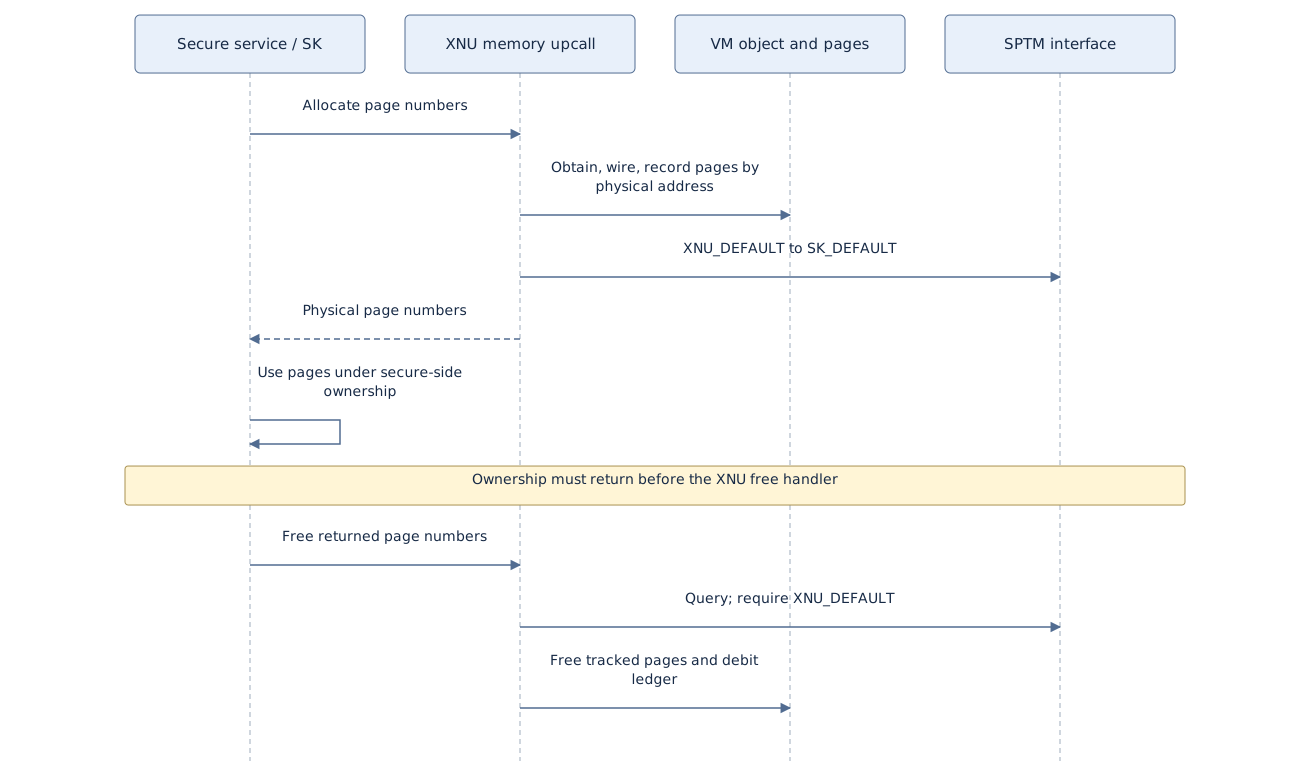
Mermaid source
sequenceDiagram
    participant S as Secure service / SK
    participant X as XNU memory upcall
    participant V as VM object and pages
    participant P as SPTM interface
    S->>X: Allocate page numbers
    X->>V: Obtain, wire, record pages by physical address
    X->>P: XNU_DEFAULT to SK_DEFAULT
    X-->>S: Physical page numbers
    S->>S: Use pages under secure-side ownership
    Note over S,P: Ownership must return before the XNU free handler
    S->>X: Free returned page numbers
    X->>P: Query#59; require XNU_DEFAULT
    X->>V: Free tracked pages and debit ledger
FrameMint is another external-service boundary. exclaves_frame_mint_populate resolves com.apple.service.FrameMint in the kernel resource domain, creates a Tightbeam client, requests populate, and checks transport plus typed success. ExclaveKit boot calls it and handles failure through the FRAMEBANK requirement. There is no FrameMint allocator, capability-minting algorithm, or complete framebank implementation in this wrapper. FrameMint client, boot dependency.
5. Shared memory requires both service permission and a shareable frame type
An SK_DEFAULT donation is not automatically an XNU mapping. Shared-buffer setup first contacts the named segment's access service; separately, XNU checks each returned physical frame's sharing type before constructing a mapping.
shared_memory_map validates nonzero size and overflow-safe page rounding, then takes the resource mutex. If the resource is already active, the existing rounded size must be at least the requested size and the permission must match; it retains the existing mapping. The code's nearby “size must match” comment is broader than this actual inequality. Existing-map check.
For a new mapping, it initializes the client using the resource ID, or the sensor-buffer endpoint for arbitrated memory. Userspace copy directions are translated into mapping permissions:
| Resource permission | Allowed user-buffer operation | Requested XNU mapping |
|---|---|---|
EXCLAVES_BUFFER_PERM_WRITE |
Copy user input into the shared segment | Read/write |
EXCLAVES_BUFFER_PERM_READ |
Copy segment contents to user output | Read-only |
Thus an “inbound/write-only” API does not establish a hardware write-only kernel mapping. Its write-only property belongs to the exposed operation; the kernel mapping is readable and writable. Translation.
The external service preflight requires the reported permission value to equal the requested value, permits XNU access, and checks the requested end page:
Source: access-status validation
		if (perm != result.permissions) {
		        kr = KERN_PROTECTION_FAILURE;
		        return;
		}

		if (!result.xnu) {
		        kr = KERN_FAILURE;
		        return;
		}

		if (endpage > result.segmentstatus.npages) {
		        kr = KERN_FAILURE;
		        return;
		}
createxnumapping then returns a nonzero mapping handle. mappinggetphysicaladdresses enumerates the segment's backing addresses. XNU asserts page alignment, that enumeration fits the expected array, and that the final count matches. Failed enumeration or failed XNU mapping invokes external teardown. A successful path stores the handle, retains the resource and publishes r_active. Service setup, enumeration, publication and unwind.
exclaves_memory_map validates physical frame type against the requested write permission:
validate_for_mapping(uint32_t page, vm_prot_t prot)
{
	const sptm_frame_type_t type = sptm_get_frame_type(ptoa(page));

	// Mapping RW and type is SK_SHARED_RW.
	if (type == SK_SHARED_RW && (prot & VM_PROT_WRITE) != 0) {
		return;
	}

	// Mapping RO and type is SK_SHARED_RW or SH_SHARED_RO
	if ((type == SK_SHARED_RW || type == SK_SHARED_RO) &&
	    (prot & VM_PROT_WRITE) == 0) {
		return;
	}

	// Mismatch of type and prot
	panic("trying to map exclaves memory (prot: %u) "
	    "but memory is of the wrong type (%u)", prot, type);
}
This helper checks whether write access is requested; it is not a general validator for all hypothetical VM protection bits. The resource caller supplies READ or READ|WRITE. It accepts SK_SHARED_RW for write mappings and either shared type for read mappings; other combinations panic.
The mapping itself uses a coherent device pager populated with the supplied physical page numbers. XNU creates a memory-entry port with the intended protection, maps it into kernel_map with matching current/maximum permissions, releases temporary pager/port references, and wires the range to populate it immediately. Failure to wire removes the range. These pages already have the separate wired ownership established by the allocation path. Device-pager mapping does not make them ordinary anonymous fault-created storage. Complete map sequence, pagers and UPL.
6. Copy, unmap, and release are separate transitions
exclaves_resource_shared_memory_copyin/copyout require a live use reference and initialized mapping, reject a null userspace address or zero first length, check both offset-plus-length calculations for overflow and segment bounds, and enforce the resource's direction bit. The two ranges support split transfers from/to consecutive userspace bytes. A successful first copy followed by a failed second copy is not rolled back; the operation is not an atomic transaction over both ranges. Copy bodies.
Arbitrated buffer copyout adds a service-mediated step first: exclaves_sensor_buffer_id_copy determines/authorizes the copy operation and can describe a second range. Only after that succeeds does the ordinary bounds-checked copyout run; status can be copied back separately. Read permission on the existing XNU mapping does not bypass that API-level arbitration. Arbitrated copy, service context.
At last use, shared_memory_resource_unmap requires the mutex and a zero use count. It first unwires/removes the XNU mapping, then calls the external mapping-destroy operation. On success it clears shared-memory state and r_active. On external teardown failure it logs and returns without completing that reset; the local mapping may already have been removed. The earlier “never de-initialised” client comment should therefore not replace the actual successful cleanup body, which zeroes the shared-memory union. No external connection destructor implementation is visible here. Resource cleanup, VM unmap, external mapping destroy.
| Event | What it does not imply |
|---|---|
| Dropping one resource send right | Every use reference or mapping has disappeared |
| Last active-use cleanup | The persistent resource inventory record is freed |
| Removing XNU's shared mapping | Secure-side physical ownership has returned to XNU |
| Receiving a page-free upcall | It is valid to free before verifying XNU ownership |
| Stopping a conclave | Every outstanding control RPC and task reference is already gone |
Sources inspected and limits
Resource table construction, lookup, port references, lifecycle transitions, shared-buffer setup/copy/teardown, and ordinary/extended memory upcalls were read through their allocation and cleanup paths. Task attachment, exec inheritance, stop/suspend context and memory ledgers were connected to those paths. FrameMint was inspected as a client/boot dependency. The allocation/tagging branches are configuration-dependent; no kernel was built, booted, or exercised.
The physical frame's type is queried through SPTM; the secure service's mapping and capability rules are reached through Tightbeam. Their server implementations are not present. This chapter establishes XNU's requests, validations and lifetime obligations, not a proof of the external enforcement or of all concurrent teardown combinations.