Memory descriptors, mappings, and DMA
Subsystem overview · VM pagers and UPLs · VFS I/O
Continue with DMA preparation and mapping ownership for UPL rollback, command prepare failures, sparse/full bounce storage, cached versus command-owned device mappings, segment cursors, and final cleanup.
The DMA segment walkthrough follows genIOVMSegments() through descriptor dispatch, physical-run coalescing, padded mapper allocations, output constraints, continuation, and concrete DriverKit-facing calls.
For CPU access, descriptor composition and mapping lifetimes follows buffer allocation, subranges and composites, named-memory references, mapping reuse, device-pager faults, redirection, and destruction.
For the underlying VM ownership, see objects and resident pages, wiring and memory entries, and pmap mapping lifetimes. A CPU translation, a physical-page hold, and a device-visible mapping each need their own completion and cleanup.
Three addresses and three different objects
A CPU virtual address identifies bytes in a VM map. A physical address identifies backing memory. A DMA address identifies bytes in the address space presented to a device, possibly through an IOMapper. Never infer that equality between two of these on one machine is an interface guarantee. The code explicitly supports both mapper-backed and unmapped transfer paths. IOGeneralMemoryDescriptor::dmaMap, IOMapper::copyMapperForDevice.
| Object | State worth tracking | Meaning |
|---|---|---|
IOMemoryDescriptor / IOGeneralMemoryDescriptor |
Ranges, _task, direction/type flags, _wireCount, memory entries and page information |
Describes the transfer's backing memory and its preparation state. |
IOMemoryMap |
fMemory, fSuperMap, fOffset, fLength, fAddress, fAddressMap |
Describes a CPU mapping of some or all of a descriptor. |
IODMACommand |
fMemory, fMapper, fActive, address/segment/alignment limits, prepared range and temporary mappings |
Describes device-visible segments for a particular transfer configuration. |
See IOGeneralMemoryDescriptor fields, IOMemoryMap fields, and IODMACommand fields.
Descriptor construction can describe task virtual ranges, physical ranges, UPLs, or vnode-related memory. Construction does not universally pin every page. API variants differ: the header explicitly requires preparation even for kernel-task memory passed through withAddressRange, while other convenience paths can describe already prepared memory. Check the constructor contract and flags in the actual caller. descriptor factory methods, withAddressRange contract.
Descriptor preparation acquires VM backing
IOGeneralMemoryDescriptor::prepare returns immediately for physical descriptors. For virtual/UIO/vnode types it calls wireVirtual, using _prepareLock when configured, and increments _wireCount only after success. Nested preparation is tracked; the first preparation performs the expensive page work. Remote descriptors have a different ownership model and are rejected by this local path. prepare.
wireVirtual translates transfer direction into UPL and DMA-access flags. kIODirectionOut means the device reads host memory, so the UPL can be requested with UPL_COPYOUT_FROM and read access. kIODirectionIn means the device writes host memory, so writable/dirty handling is needed. An existing read-only preparation cannot simply be reused as a writable one. Additional flags select no-fault, no-zero-fill, low-address, or coherency behavior. wireVirtual.
For each virtual range, the routine obtains page information with memory_object_iopl_request, a special static-kernel UPL path, or vm_map_create_upl. It records ioPLBlock entries linking descriptor offsets, UPLs, page offsets, and page-list locations. A range can require multiple UPLs. Error cleanup aborts and deallocates a partially constructed UPL before returning. This is the explicit bridge from a driver's byte ranges to VM's page-lifetime rules. UPL creation and recording, UPL ownership.
complete reverses this state. It records error completion, decrements _wireCount, and on the final completion tears down descriptor-owned DMA mappings and commits or aborts created UPLs, then deallocates them. The implementation panics if active DMA references remain when the backing is about to be released. complete is consequently not a generic “free this object” operation: it closes a successful preparation interval and must occur after device use has stopped. complete.
CPU mapping is separate from DMA preparation
createMappingInTask constructs an IOMemoryMap; makeMapping may reuse a compatible mapping, create a unique physical mapping descriptor, or call doMap for a new mapping. Mapping options and compatibility determine which branch runs. The memory-reference map helpers eventually enter named memory objects into a VM map through VM mapping routines. createMappingInTask, makeMapping, memoryReferenceMap.
Physical and UPL-backed references can use device_pager_setup, followed by a named memory entry. Thus an IOKit physical-memory mapping can still appear in VM as an object backed by a pager; “physical memory” does not mean that VM object bookkeeping disappears. The cache mode and contiguous-device flags influence this path. device pager creation, device pager boundary.
Mapping ownership is unusual enough to read explicitly. The descriptor tracks its mappings, while a map retains its descriptor and possibly a supermap. IOMemoryMap::taggedRelease uses a threshold of two to handle the descriptor's mapping-set reference; free unmaps, removes itself from the descriptor, and releases its backing references. unmap also drops the retained vm_map. Task death has its own invalidation path. Applying a simplistic “one reference reaches zero” explanation misses this class's cycle-breaking protocol. The LOCK used around mapping operations is the global recursive gIOMemoryLock, distinct from the optional per-descriptor preparation lock. unmap, taskDied, taggedRelease, free, mapping lock.
DMA commands prepare device mappings, not the source pages
The two prepare methods have different responsibilities. IODMACommand::setMemoryDescriptor retains the descriptor, reads its characteristics, and can automatically prepare the command. It does not replace the caller's obligation to prepare pageable backing. The descriptor's segment walker explicitly panics if nonphysical memory is not wired for the command. setMemoryDescriptor, wired-memory check.
IODMACommand::prepare applies maximum-transfer, range and alignment constraints, tracks fActive, and decides whether it can iterate source segments directly or needs preflight/copy work. It can perform noncoherent cache operations and request an I/O mapping through dmaCommandOperation(kIOMDDMAMap, ...). IOGeneralMemoryDescriptor::dmaMap converts the recorded page list into IODMAMapPageList and calls mapper->iovmMapMemory with direction-derived access. Some full-range system mappings are retained by the descriptor for reuse; command-owned mappings are tracked separately. command prepare, descriptor DMA operations, dmaMap.
Mermaid source
sequenceDiagram
    participant D as Driver
    participant M as Memory descriptor
    participant C as DMA command
    participant V as VM / mapper
    participant H as Hardware
    D->>M: prepare pageable backing
    M->>V: Acquire wired UPL pages
    D->>C: setMemoryDescriptor / prepare
    C->>V: Establish device mapping if needed
    D->>C: genIOVMSegments
    C-->>D: Device addresses and lengths
    D->>H: Submit transfer
    H-->>D: Transfer stopped or completed
    D->>C: complete and clear descriptor
    C->>V: Synchronize and release DMA resources
    D->>M: complete
    M->>V: Commit or abort UPLs, release wires
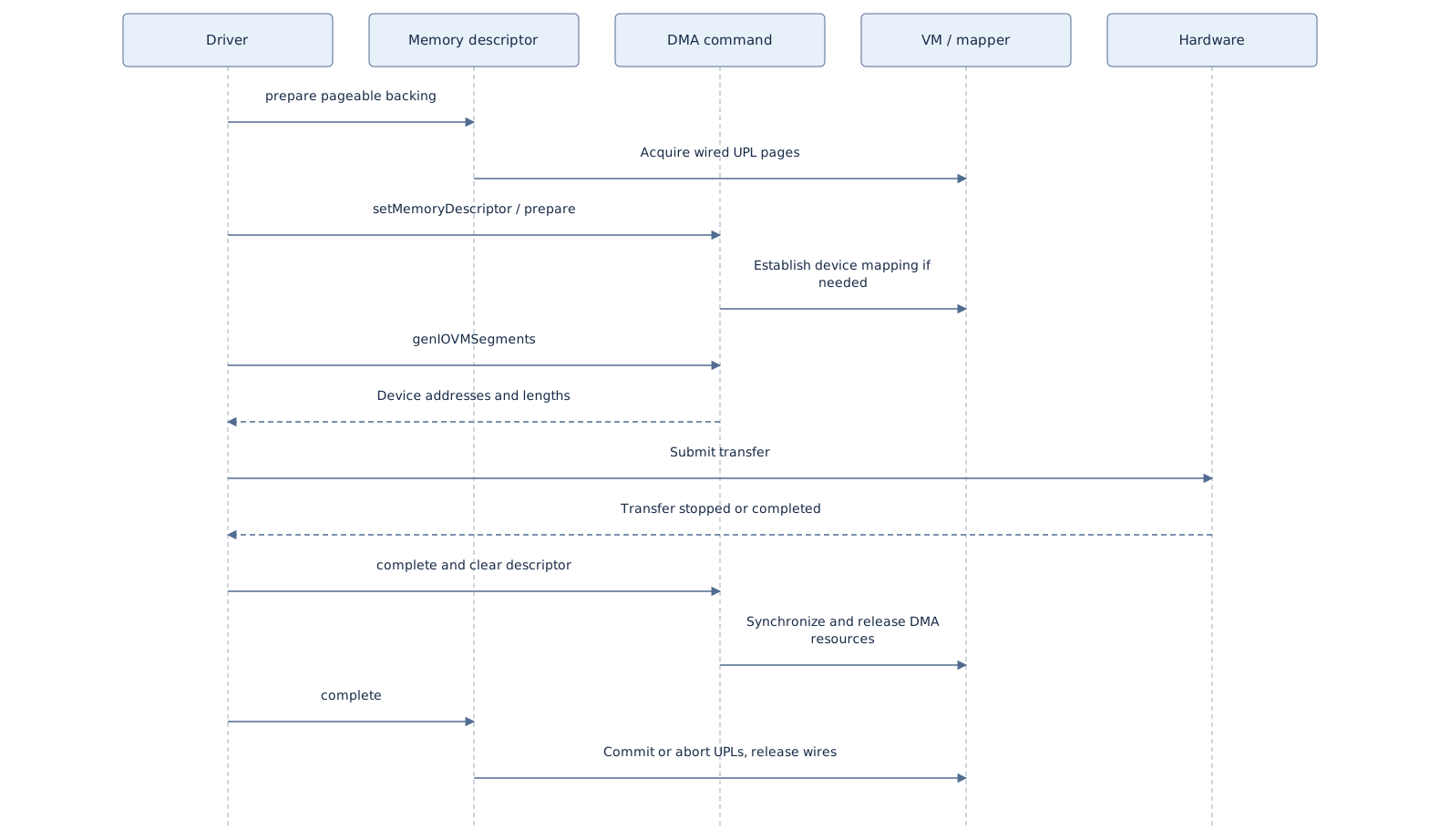
This diagram is the pageable-memory ownership sequence; prewired descriptors and caller-selected automatic options can combine steps. genIOVMSegments requires an active command and walks a bounded prepared range, applying the configured output format and segmentation rules. complete performs needed synchronization/copy-back and unmapping on the final active reference; clearMemoryDescriptor completes outstanding activity when requested and drops the descriptor. genIOVMSegments, complete, clearMemoryDescriptor.
Preparation can allocate and block. The setMemoryDescriptor contract specifically warns against automatic preparation from a gated workloop action; the prepare contract also says the command operation is not thread-safe. The owner must serialize reuse of an individual command and choose a context that may block without holding the gate. The deep DMA chapter follows selected sparse/full bounce-buffer paths and preparation-error cleanup. Concrete IOMMU implementations and device command-ring formats remain beyond these generic paths. IODMACommand preparation contracts.