IPv6 input, extension headers and forwarding
An IPv6 packet entering BSD is an mbuf chain plus receive-interface metadata. The kernel first decides whether the datagram belongs to this host or must be forwarded. For local delivery it walks the next-header chain, allowing each handler to replace the packet, advance a byte offset, or consume the packet entirely. Forwarding has a different path: it processes the leading Hop-by-Hop header but does not run the ordinary local transport/fragment dispatch loop before sending the packet onward.
Return to IPv6 and networking. Read packet and interface delivery for the earlier DLIL path, IPv6 output for local transmission, reassembly and ICMP errors for fragment queues and PMTU feedback, and neighbor messages for the ICMPv6 control path. This chapter follows the common BSD implementation in xnu-12377.121.6; Skywalk has separate flow and fragment processing.
Inspect the live in6_addr, sockaddr_in6, ip6_hdr, ip6_hbh, ip6_dest, ip6_rthdr, ip6_frag layouts for the selected source configuration.
Entry and the objects carried through input
ip6_init() registers ip6_proto_input() for PF_INET6 with proto_register_input(). The wrapper calls ip6_input(); it does not represent a syscall or a transition from userspace. Packet injection and interface input can reach this same family registration. The receive context and serialization established by DLIL/protocol delivery precede this routine; the per-protocol mutex decision described below is an additional layer. See registration and wrapper.
| Object | Meaning during this path |
|---|---|
struct mbuf *m |
Owner of the received packet chain. m_next links storage; it is not a next-header pointer. The first mbuf's packet header carries total length, rcvif, checksum state and flags such as PKTF_HBH_CHKED and PKTF_REASSEMBLED. |
struct ip6_hdr |
The 40-byte wire header: payload length, next protocol, hop limit, source and destination. IPv6 has no base-header checksum; upper-layer validation uses its own checksum rules. |
off, nxt |
Parser state. off is a byte offset from the start of the IPv6 header, initially 40; nxt selects ip6_protox[nxt]. Neither is an mbuf index or an address. |
struct ip6protosw |
Handler registration: pr_input, pr_flags, control input/output and socket operations. Its IPv6 input function receives mbuf **, int *offp, and protocol number. |
Local struct route_in6 rin6 |
A destination and optional retained route used by the local-address check and forwarding. ip6_input() releases this route on its common exit. |
inifp, deliverifp |
The actual receive interface and selected local delivery interface. Weak-host acceptance and loopback routes can make them different. |
Definitions: IPv6 header, protocol switch, and input locals and receive contract. Scope and source selection distinguishes interface indexes in packet metadata, socket scope IDs and optional embedded address scopes.
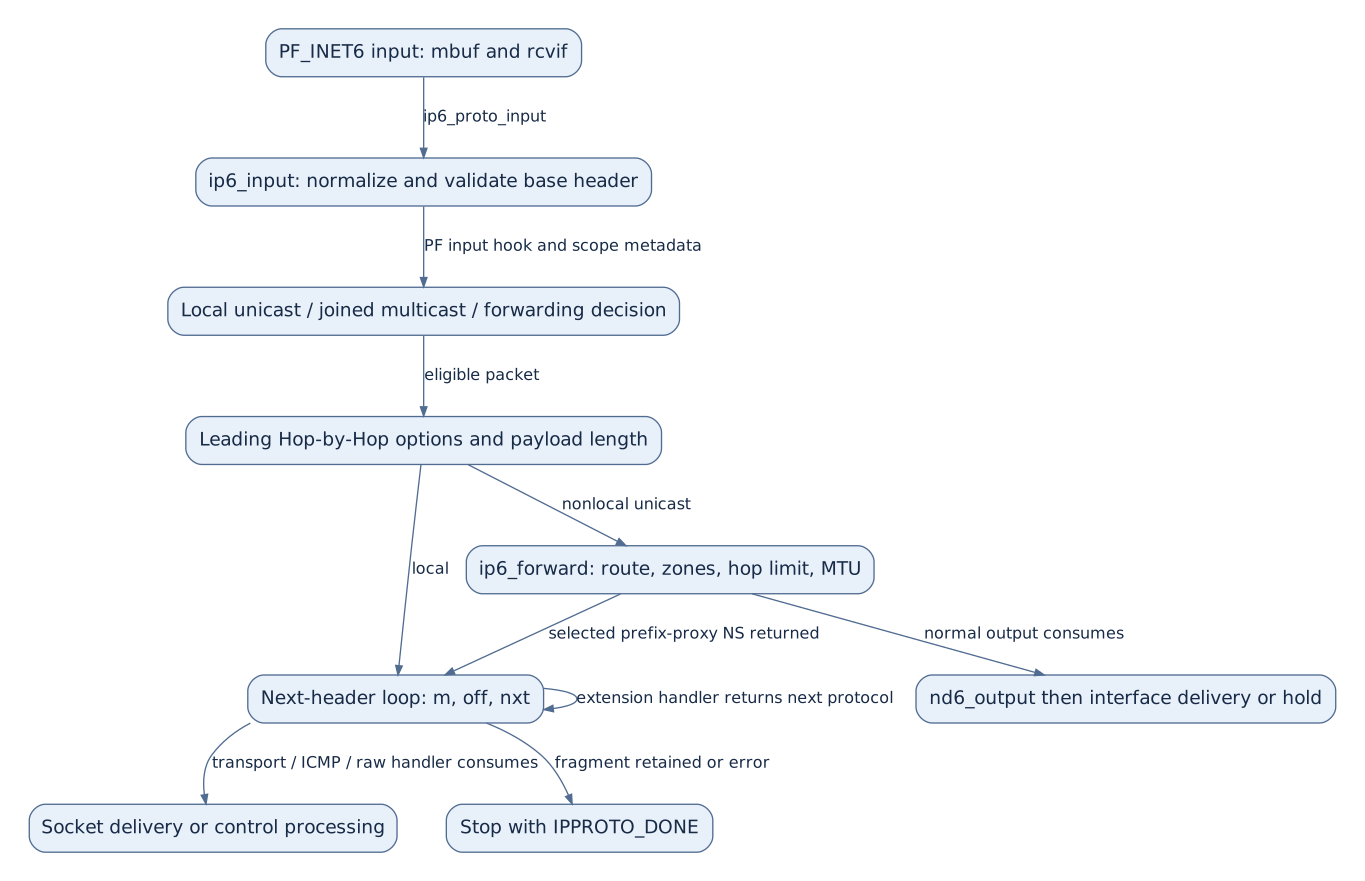
Mermaid source
flowchart TD
    A["PF_INET6 input: mbuf and rcvif"] -->|ip6_proto_input| B["ip6_input: normalize and validate base header"]
    B -->|PF input hook and scope metadata| C["Local unicast / joined multicast / forwarding decision"]
    C -->|eligible packet| D["Leading Hop-by-Hop options and payload length"]
    D -->|local| E["Next-header loop: m, off, nxt"]
    D -->|nonlocal unicast| F["ip6_forward: route, zones, hop limit, MTU"]
    E -->|extension handler returns next protocol| E
    E -->|transport / ICMP / raw handler consumes| G["Socket delivery or control processing"]
    E -->|fragment retained or error| H["Stop with IPPROTO_DONE"]
    F -->|normal output consumes| I["nd6_output then interface delivery or hold"]
    F -->|selected prefix-proxy NS returned| E
The diagram omits individual error exits. The proxy arrow is a specific PKTF_PROXY_DST case, not a general mechanism for retrying arbitrary forwarded traffic locally.
Admission changes packet representation before delivery
Normalize storage and reject invalid base addresses
ip6_input() checks the mbuf input contract, requires a receive interface, fixes header alignment, clears stale forwarded/authentication metadata and discards old IPv6 auxiliary data. Filter reinjection and configured dummynet tags have dedicated continuation paths; they are not fresh wire packets traversing every check again. See entry and reinjection.
On ordinary ingress it rejects an interface with IFEF_IPV6_DISABLED, may copy a short multi-mbuf packet into a header/cluster allocation, checks that the IPv6 header is accessible, and validates the version. Address tests reject a non-looped packet with source ::1, multicast source, unspecified destination, improperly received interface-local multicast, and IPv4-mapped source or destination. Mapped IPv6 socket addresses are an API representation; they are not admitted as such on this native IPv6 wire path. See storage and base header, address tests, and socket mapping.
With PF enabled, the inbound hook runs before scope embedding and destination classification. It receives &m, may replace or consume the packet, and input refreshes its ip6 pointer afterward. The error/consumed branch requires a null packet: input must not free it again. See PF admission. This chapter traces that contract, not the rule/state machine inside PF.
Scope identifiers are internal metadata
For a non-looped physical arrival, link-local/scoped addresses must not already contain an interface identifier in the relevant address word. If in6_embedded_scope is selected, input inserts an interface index from PKTF_IFAINFO metadata or from rcvif. Otherwise the separate scope fields remain important to lookup. The bytes used in kernel address comparison can therefore differ from the address as received on the wire. See wire validation and insertion.
Local acceptance is more than a route lookup
ip6_input_check_interface() first scans the address hash under in6_ifaddr_rwlock, comparing the destination and its zone and excluding IN6_IFF_NOTREADY. A matching address on the arriving interface wins. A match on another interface can be accepted under weak-host behavior; with forwarding disabled, strong checking rejects it, and hybrid checking rejects the specified IPsec/utun-interface case. In this hash-match path, L2 multicast/broadcast framing with an L3 unicast destination also causes rejection. See hash and interface policy.
The slow path retains a destination route. A direct host route to loopback, without RTF_GATEWAY or the prohibited cloned flag, can establish local ownership if its address is ready. If neither path finds local ownership, forwarding configuration chooses forward or drop. A drop performed inside the helper already consumes the packet; the caller's bad label goes to route cleanup rather than blindly freeing m. See route-based acceptance and drop and return.
Multicast instead checks (destination group, receive interface) in the in6_multi list, briefly retaining the group object. A nonmember is dropped unless prefix-proxy handling may still claim a solicitation. This is interface membership admission, not a complete per-socket source-filter decision; see input multicast path and multicast memberships and MLD.
Hop-by-Hop processing and the payload-length contract
The initial Hop-by-Hop header is special: ip6_input() handles it before normal forwarding and before the local next-header loop. It sets PKTF_HBH_CHKED, calls ip6_hopopts_input(), reloads the header pointer, and takes the following protocol from ip6h_nxt. A recognized MLD Router Alert can set ours while forwarding is enabled. The code's comment about passing to a multicast-routing daemon is intent at this branch; it does not establish an arbitrary multicast-forwarding provider. See initial HBH path.
The extension's length is (ip6h_len + 1) * 8, including its first two bytes. ip6_hopopts_input() checks accessibility, then ip6_process_hopopts() handles padding, Router Alert, Jumbo Payload and unknown options. A valid Jumbo Payload requires a zero base-header payload length, a value greater than 65535, and no already accepted jumbo length. If the base length is zero and the first header is HBH but no jumbo value was obtained, input generates a parameter-problem error. See HBH walker, Router Alert and Jumbo decisions, and missing jumbo rejection.
Unknown option types encode the action in their high bits:
| Action | Current body |
|---|---|
| Skip | Return its option-data length so the caller advances past the type/length bytes too. |
| Discard | Consume the packet without an ICMP response. |
| Force ICMP | Invoke icmp6_error() with parameter-problem/option, including for multicast subject to that helper's other suppression rules. |
| ICMP except multicast | Drop when the IPv6 destination or L2 flags indicate multicast/broadcast; otherwise invoke the error helper. |
Source: ip6_unknown_opt(). The error pointer is an offset within the original IPv6 packet; it is not a pointer copied to the peer.
After HBH processing, a buffer shorter than the declared payload is dropped. Excess bytes normally get trimmed, with partial hardware-checksum metadata adjusted or invalidated. ip6_input_adjust() has a conditional branch that retains trailing bytes for direct TCP/UDP partial-checksum handling when adjustment is disabled. Thus m_pkthdr.len == 40 + plen is the normal result, not an invariant of every tunable combination. See length decision and padding/checksum adjustment.
The local next-header loop is a continuation protocol
ip6_init() fills every ip6_protox[] slot with the raw IPv6 handler, then substitutes registered nonzero protocols other than IPPROTO_RAW. Unknown values consequently have a defined raw-delivery route; the table is not a sparse array of only known transports. See table construction.
Each handler can update m and off, then return the next protocol. IPPROTO_DONE terminates the loop after consumption, queueing or final processing. It is not errno == 0, and the caller must not infer that every terminal handler cleared *mp: some consumed-packet branches return without rewriting that caller-visible pointer. The decisive invariant is that input stops using it. See dispatch and common exit and the raw terminal return.
The lock selection is concrete in ip6_input.c, lines 1487–1498:
		if ((pr_input = ip6_protox[nxt]->pr_input) == NULL) {
			m_drop(m, DROPTAP_FLAG_DIR_IN | DROPTAP_FLAG_L2_MISSING, DROP_REASON_IP_NO_PROTO, NULL, 0);
			m = NULL;
			nxt = IPPROTO_DONE;
		} else if (!(ip6_protox[nxt]->pr_flags & PR_PROTOLOCK)) {
			lck_mtx_lock(inet6_domain_mutex);
			nxt = pr_input(&m, &off, nxt);
			lck_mtx_unlock(inet6_domain_mutex);
		} else {
			nxt = pr_input(&m, &off, nxt);
		}
	}
PR_PROTOLOCK means the handler supplies its own synchronization. TCP, UDP, fragments and configured AH/ESP use that flag. Destination options, routing headers, raw IPv6 and ICMPv6 run under inet6_domain_mutex in this dispatcher. It does not mean the whole network stack is protected by one lock. Registrations are in in6_proto.c.
| Next header | Implementation and continuation |
|---|---|
| Destination Options | dest6_input() validates complete header accessibility, walks padding/unknown options, advances off and returns ip6d_nxt. |
| Routing | route6_input() handles the local routing-header decision described below; it does not implement arbitrary source routing. |
| Fragment | frag6_input() may retain the mbuf and end dispatch; completion returns a replacement packet/offset and next protocol. See the dedicated reassembly chapter. |
| UDP / TCP | udp6_input() / tcp6_input() enter PCB lookup, checksum and transport processing; successful IP parsing alone does not establish a socket match. |
| ICMPv6 | icmp6_input() validates checksum and message-specific gates, then processes errors, echo, ND or MLD and eligible socket observation. |
| AH / ESP | Configured registrations invoke ah6_input() / esp6_input(); cryptographic and SA processing are separate from the generic header walker. |
| IPv4 / IPv6 encapsulation | Configured encap6_input() dispatches encapsulation handlers. |
| Unrecognized protocol / No Next Header | The raw fallback can offer data to matching raw PCBs. Without a match, No Next Header is discarded; other unknown protocols generate parameter-problem/next-header. |
Sources: destination handler, routing handler, registration, and raw no-listener decision.
Accessibility checks constrain actual mbuf layout
IP6_EXTHDR_CHECK requires the bytes from the packet start through the requested header to be in the first mbuf. It may pull up an M_LOOP chain; in other multi-mbuf cases a short first mbuf is rejected even when later storage contains enough total bytes. On failure it frees the chain, nulls its local m and executes the caller-supplied action. Reloading header pointers after the macro is necessary because pullup can move storage. This is stricter than merely checking m_pkthdr.len. See macro body.
Destination Options validates each non-Pad1 option's length against remaining bytes. The exact check is dest6.c, lines 106–112:
	for (optlen = 0; dstoptlen > 0; dstoptlen -= optlen, opt += optlen) {
		if (*opt != IP6OPT_PAD1 &&
		    (dstoptlen < IP6OPT_MINLEN || *(opt + 1) + 2 > dstoptlen)) {
			ip6stat.ip6s_toosmall++;
			drop_reason = DROP_REASON_IP_TOO_SMALL;
			goto bad;
		}
The HBH and destination walkers are distinct bodies. Do not infer that every length guard in one also exists in the other.
Header nesting, filter reinjection and IPsec policy
The local loop limits dispatch iterations through ip6_hdrnestlimit, defaulting to 15 in this tree; the counter includes visits to the final transport handler, while the leading HBH processing occurred earlier. It also rejects an offset beyond total length. Its HBH guard tests PKTF_HBH_CHKED; this should not be described as a complete grammar validator for every possible header ordering. See loop checks and default.
With IPsec enabled, PR_LASTHDR triggers policy rejection at this layer. TCP/UDP/raw paths with their own PCB policy processing are deliberately treated separately. IP filters run for each dispatch step with current (m, off, nxt). EJUSTRETURN means ownership was taken; another error causes a drop. Reinjection records which filter injected the packet and resumes traversal after that filter instead of repeating earlier callbacks. See policy and filters and reinjection selection.
Routing headers have no active route-type implementation here
The checked-in route6_input() switch has only a default case. A header with zero segments left is skipped using its advertised extension length. A nonzero value generates an ICMPv6 parameter problem identifying the routing-type field. Definitions such as ip6_rthdr0 in headers do not prove that this kernel executes routing type 0, SRv6 or another routing-header algorithm. See route6.c, lines 109–124:
	switch (rh->ip6r_type) {
	default:
		/* unknown routing type */
		if (rh->ip6r_segleft == 0) {
			rhlen = (rh->ip6r_len + 1) << 3;
			break;  /* Final dst. Just ignore the header. */
		}
		ip6stat.ip6s_badoptions++;
		icmp6_error(m, ICMP6_PARAM_PROB, ICMP6_PARAMPROB_HEADER,
		    (int)((caddr_t)&rh->ip6r_type - (caddr_t)ip6));
		return IPPROTO_DONE;
	}

	*mp = m;
	*offp += rhlen;
	return rh->ip6r_nxt;
The fixed routing header is checked before this branch; the next input-loop visit and handler perform subsequent offset/accessibility checks. The body does not pre-validate every byte of a skipped unknown routing header with the same full-header macro used by dest6_input().
Worked parsing example
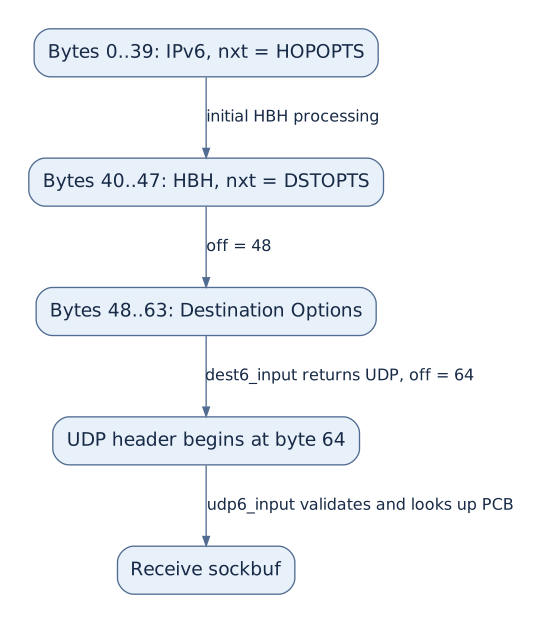
Illustrative local packet: IPv6 base header, an eight-byte HBH header, a sixteen-byte Destination Options header, and UDP. Assume valid options, no fragments/IPsec, ordinary mbuf layout and a matching socket.
Mermaid source
flowchart TD
    A["Bytes 0..39: IPv6, nxt = HOPOPTS"] -->|initial HBH processing| B["Bytes 40..47: HBH, nxt = DSTOPTS"]
    B -->|off = 48| C["Bytes 48..63: Destination Options"]
    C -->|dest6_input returns UDP, off = 64| D["UDP header begins at byte 64"]
    D -->|udp6_input validates and looks up PCB| E["Receive sockbuf"]
The offset is over packet bytes even if payload storage spans multiple mbufs. The HBH value ip6h_len = 0 means eight total bytes; Destination Options ip6d_len = 1 means sixteen. Replacing UDP with a Fragment header changes ownership: frag6_input() can stop the loop while holding only one fragment. See reassembly entry/exit.
Router forwarding is an output transaction with an error copy
Admission, hop limit and prefix proxying
ip6_forward() receives the original packet and the caller's route_in6. It can replace a prefix-proxy route or discard a route inconsistent with PF-selected scope. Configured inbound IPsec policy is checked. L2 multicast/broadcast, multicast destination and unspecified source are rejected; a hop limit at or below one produces Time Exceeded and consumes the packet. See forward entry.
A selected prefix-proxy solicitation can be returned to ip6_input() for local ND processing. That branch avoids decrementing hop limit and skips outbound IPsec forwarding; ordinary forwarding decrements the header then makes a nonblocking bounded mcopy for a later ICMP error or redirect. Failure to allocate this copy does not necessarily prevent forwarding; it removes the saved bytes needed for those later responses. See proxy and copy decision.
The decrement and saved-copy ordering is ip6_forward.c, lines 270–282:
	ip6->ip6_hlim -= IPV6_HLIMDEC;

	/*
	 * Save at most ICMPV6_PLD_MAXLEN (= the min IPv6 MTU -
	 * size of IPv6 + ICMPv6 headers) bytes of the packet in case
	 * we need to generate an ICMP6 message to the src.
	 * Thanks to M_EXT, in most cases copy will not occur.
	 *
	 * It is important to save it before IPsec processing as IPsec
	 * processing may modify the mbuf.
	 */
	mcopy = m_copym_mode(m, 0, imin(m->m_pkthdr.len, ICMPV6_PLD_MAXLEN),
	    M_DONTWAIT, NULL, NULL, M_COPYM_COPY_HDR);
With IPsec selected, outbound policy can discard, bypass or invoke ipsec6_output_tunnel(). That operation can replace/consume the packet and can send a tunneled result over IPv4. Its policy and route references have their own releases. These branches are an explicit boundary of the plain IPv6 forwarding trace; this chapter does not claim a complete SA/transform reconstruction. See policy and tunnel handoff.
Route and zone decisions precede transmission
The routine takes an extra rtentry reference in addition to the caller's route ownership. It validates/relooks up unusable routes, retaining the extra reference across unlocked output. A missing route can produce Destination Unreachable using mcopy; the original is dropped. See route references and retry.
Source and destination addresses are tested against both receiving and outgoing interface zones with in6_setscope() on local copies. A source-zone mismatch normally produces Beyond Scope; a destination-zone mismatch is dropped. These are concrete scope comparisons, not a claim that the stack performs general reverse-path validation of every global source. Prefix-proxy handling has the explicit source-zone exception. See zone checks.
The plain forwarding MTU check compares the effective packet length with the outgoing interface's if_mtu. An oversized datagram yields Packet Too Big if a saved copy exists; the router does not call the normal local-source fragmentation loop to solve this condition. IPsec overhead can reduce the reported MTU, with the implemented lower-bound adjustment. PF can separately hand the routine an already refragmented packet list after its scrub processing, which is a different path. See MTU rejection and PF refragmented output.
Output, redirect and reference release
A gateway route changes the next-hop sockaddr handed to ND. Forwarding on the same interface can request a redirect if configured and the route was not dynamically modified by a redirect; the point-to-point case takes an immediate possible-loop rejection. The later redirect generator independently checks router mode, neighbor reachability of the source, destination and rate limits. See next-hop and redirect selection and redirect validation.
The code clears embedded scopes for transmission, unlocks the route while retaining its reference, marks PKTF_FORWARDED, runs the configured outbound PF hook, and gives the packet to nd6_output(). ND consumes the packet on success and failure; a zero return can mean deferred neighbor resolution rather than a frame already transmitted. The output chapter explains this distinction and the held-list replacement policy. See scope clearing and proxy return, output, and neighbor hold.
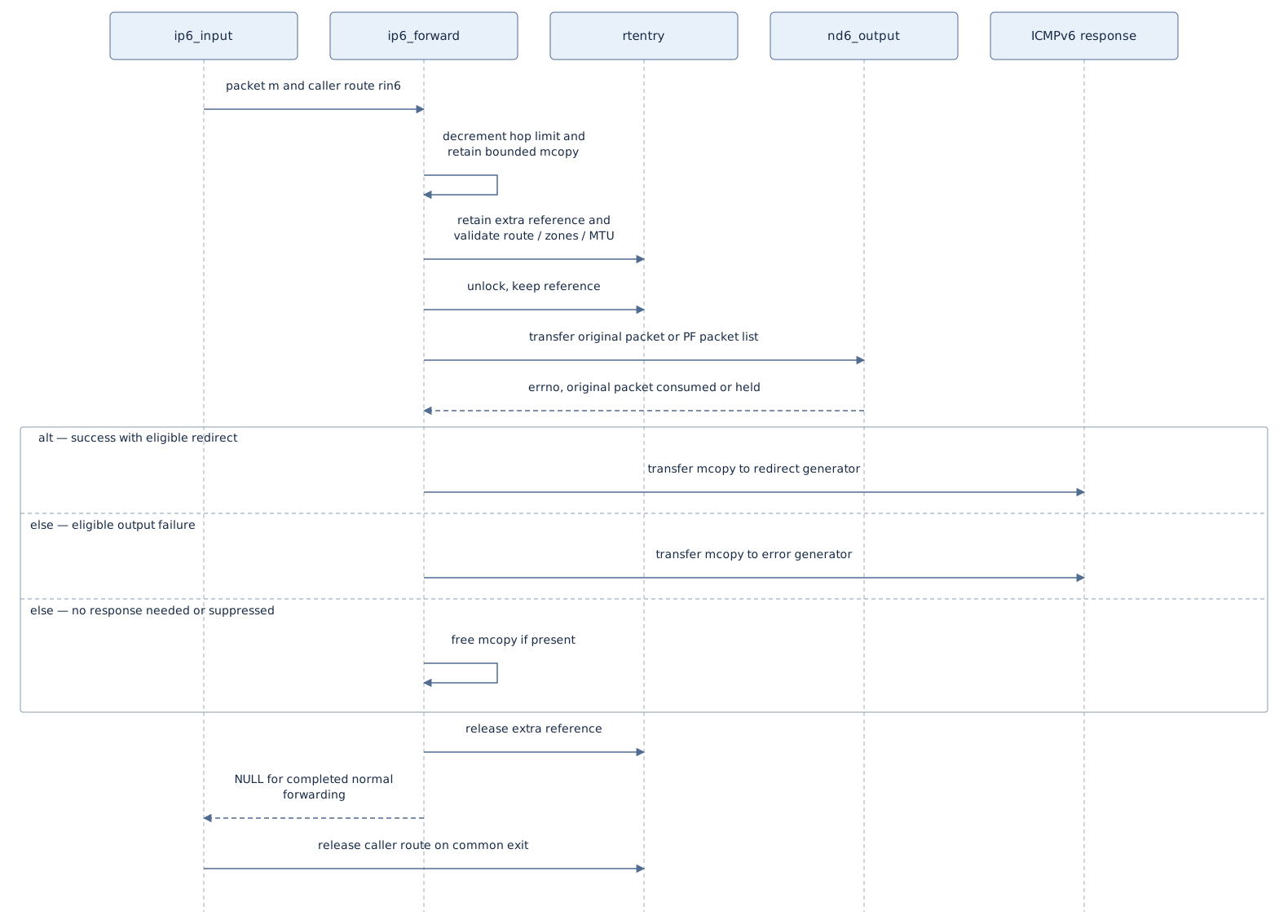
Mermaid source
sequenceDiagram
    participant I as ip6_input
    participant F as ip6_forward
    participant R as rtentry
    participant N as nd6_output
    participant C as ICMPv6 response
    I->>F: packet m and caller route rin6
    F->>F: decrement hop limit and retain bounded mcopy
    F->>R: retain extra reference and validate route / zones / MTU
    F->>R: unlock, keep reference
    F->>N: transfer original packet or PF packet list
    N-->>F: errno, original packet consumed or held
    alt success with eligible redirect
        F->>C: transfer mcopy to redirect generator
    else eligible output failure
        F->>C: transfer mcopy to error generator
    else no response needed or suppressed
        F->>F: free mcopy if present
    end
    F->>R: release extra reference
    F-->>I: NULL for completed normal forwarding
    I->>R: release caller route on common exit
This sequence is the normal post-route path; early rejection, proxy return and IPsec diversion have their own exits. EMSGSIZE and ENOBUFS returned by final output free the saved copy without another error response here. Other reachability/output errors select address-unreachable. On success the copy is either consumed by the redirect generator or freed. See post-output outcomes.
Raw and ICMP delivery boundaries
The raw fallback scans ripcb under its PCB-info shared lock, matches protocol and scoped local/foreign addresses, applies receive restrictions and optional checksum checks, then duplicates packets for earlier matching listeners and gives the final listener the original. It strips bytes through off before appending the data and ancillary information to a receive socket buffer. This is fan-out, not a single global raw receiver. See matching and copying and final append/no-listener handling.
ICMPv6 has a separate icmp6_rip6_input() observation path after kernel message processing. For ND, kernel handling may receive a copy while the original continues to eligible sockets; failure to allocate the copy changes which audience gets the packet. Neighbor messages traces that ownership split. A packet counted as IP-delivered can still fail later checksum, socket policy, buffer or control-message validation.
Evidence and limits
The paths above were read in the checked-in common IPv6 stack, including its actual registration tables and cleanup branches. They are not a claim that every optional filter, IPsec transform, tunnel provider, prefix-proxy topology or device receive path was exercised. Existing IP fragment/ICMP tests include an oversized-HBH fragmentation regression, but that is not a general input/forwarding conformance test. No live network or kernel tests were run for this documentation.