IPv6 output, next-hop resolution and neighbor lifetime
IPv6 · Networking · UDP · Routes and interface lifetime
Choosing a route does not mean that the next hop's link-layer address is known. IPv6 output selects and validates the route/interface, applies packet policy and fragmentation decisions, then transfers packet ownership to neighbor discovery. Neighbor discovery can send immediately, retain a packet list while resolving an address, or discard it. This chapter traces that boundary and its asynchronous completion in xnu-12377.121.6.
Inspect the live route_in6, ip6_exthdrs, ip6_out_args layouts for the selected source configuration.
Addresses, routes and neighbor records
| Object | State used along the path |
|---|---|
inpcb, ip6_pktopts, ip6_out_args |
Endpoint defaults versus per-packet source/interface/options and output restrictions. The option block is not consumed with the packet. |
sockaddr_in6 / in6_addr |
Destination/source address and scope. A link-local address needs a zone; the address bits alone are insufficient to choose a link. |
route_in6, rtentry |
Cached destination route and referenced route entry; the gateway can require a second route lookup. |
ifnet, in6_ifaddr |
Selected interface and source/interface-address objects, independently referenced during output. |
llinfo_nd6 |
Neighbor state, retry count, expiry, held packet list and link-layer reachability association, attached to a route. |
nd_ifinfo |
Per-interface neighbor-discovery parameters such as retransmission and reachable times, with its own lock. |
The ND locking contract places global neighbor-list linkage under rnh_lock, and ln_hold, ln_asked, ln_expire, ln_state and related per-neighbor fields under the route's rt_lock. The neighbor record lives as long as its route entry. Removing a route from the global structure is not immediate destruction of every retained route/neighbor reference.
Source selection precedes the packet-to-link handoff
A native IPv6 UDP send uses in6_selectsrc() through its output path. Explicit packet-info source addresses are validated as usable node addresses with a consistent zone/interface. Otherwise PCB defaults and the source-selection machinery choose among eligible addresses, subject to scope and interface restrictions. Source selection and forwarding-route selection are connected but distinct: the former chooses a local source, the latter chooses where this packet goes.
ip6_output() wraps ip6_output_list(). The latter accepts a skeletal IPv6 header plus options, constructs extension-header state, and owns the packet chain. Its contract says the packet is freed/consumed while the supplied option block is not. It tracks the current packet, remaining input chain and completed send chain separately, so failure must account for all three.
in6_selectroute() is called only once for the selected output route in the packet-list path. It may return a referenced interface even on failure. The caller therefore releases returned references at the common cleanup label rather than assuming nonzero errno implies no ownership. After selection, NECP and output-interface restrictions can still reject the packet.
The outgoing interface must agree with the source/destination zones, except the specified loopback/local cases. origifp preserves the relevant original interface for scope and loopback handling; it is not always the same object as the interface used to transmit. See scope checks. Policy or IPsec tunnel processing can also change the route/address context; the full policy engine is covered separately from this output trace.
Extension headers become an owned mbuf chain
Output copies the borrowed ip6_pktopts header bytes into new mbufs; it does not splice the PCB's allocations into the packet. ip6_exthdrs records pointers to these detached headers while they are assembled. ip6_copyexthdr() uses nonblocking mbuf/cluster allocation and rejects a header exceeding its cluster bound. See construction, scratch layout and copy allocation.
Two lengths serve different purposes. optlen counts extension headers between IPv6 and the upper-layer payload. unfragpartlen includes the base IPv6 header and extensions that precede a Fragment header; final-destination options are counted in optlen but excluded from this unfragmentable prefix. Splitting the base header from payload permits insertion and IPsec transformation. See lengths and split.
The builder inserts final-destination options, then hop-by-hop, pre-routing destination and routing headers, rewriting preceding Next Header fields. m_next links data pieces of one packet. Once exthdrs.merged is set, the scratch pointers alias the packet chain and cannot be freed individually. ip6_output.c:863–868:
	MAKE_CHAIN(exthdrs.ip6e_hbh, mprev, nexthdrp, IPPROTO_HOPOPTS);
	MAKE_CHAIN(exthdrs.ip6e_dest1, mprev, nexthdrp, IPPROTO_DSTOPTS);
	MAKE_CHAIN(exthdrs.ip6e_rthdr, mprev, nexthdrp, IPPROTO_ROUTING);

	/* It is no longer safe to free the pointers in exthdrs. */
	exthdrs.merged = TRUE;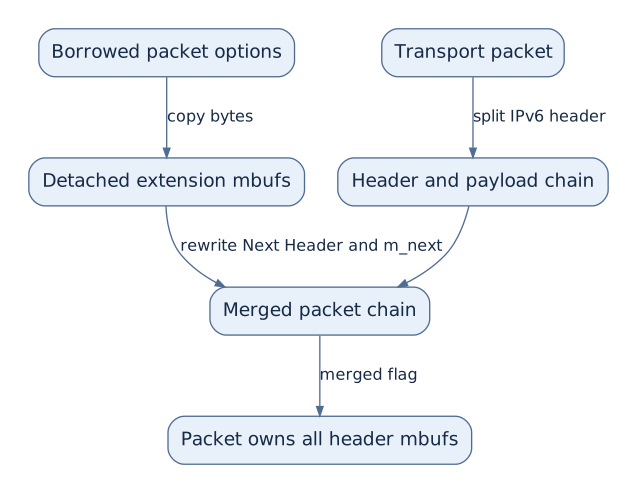
Mermaid source
flowchart TD
    O["Borrowed packet options"] -->|copy bytes| H["Detached extension mbufs"]
    P["Transport packet"] -->|split IPv6 header| B["Header and payload chain"]
    H -->|rewrite Next Header and m_next| M["Merged packet chain"]
    B --> M
    M -->|merged flag| F["Packet owns all header mbufs"]
The historical composition machinery is broader than supported transmission: any routing header triggers EINVAL after the IPsec stage. Its accepted setter format does not make type-0 routing operational. Jumbo-payload handling inserts a jumbo option and sets ip6_plen = 0; that representation later prohibits ordinary fragmentation. See jumbo insertion, routing-header rejection and socket-option decisions.
MTU, checksum and fragments are explicit decisions
ip6_getpmtu() resolves the applicable path MTU. ip6_fragment_packet() then considers per-packet do-not-fragment flags, forwarding, packet length, link/path MTU and supported checksum/segmentation offload. Forwarded packets are forced into the nonfragmenting branch. The bypass also includes supported TSO and CSUM_FRAGMENT_IPV6 hardware fragmentation. The selected behavior is not simply “fragment every packet larger than the route MTU.”
bsd/netinet6/ip6_output.c:1780–1789:
	/* Access without acquiring nd_ifinfo lock for performance */
	if (dontfrag && tlen > IN6_LINKMTU(ifp)) {      /* case 2-b */
		/*
		 * We do not notify the connection in the same outbound path
		 * to avoid lock ordering issues.
		 * The returned error should imply that the packet is too big
		 * and the application should query the PMTU for a given destination.
		 */
		return EMSGSIZE;
	}
A nonfragmenting packet larger than the link MTU returns EMSGSIZE. Otherwise the implementation can finish output checksums and pass through, or construct a new m_nextpkt list of fragments through ip6_do_fragmentation(). Packet-chain linkage and each packet's m_next data-fragment linkage have different meanings. The original packet can be replaced/consumed during fragmentation, so the caller passes its address (&m) and uses the returned representation.
After filtering, checksum and fragmentation work, ip6_output_list() gathers completed packets and calls nd6_output_list(). It deliberately falls through to reference cleanup even on error because ND consumes the send chain in both outcomes. See handoff. IP output cannot then free that chain again.
Path MTU, link MTU and minimum-MTU policy
ip6_getpmtu() can distinguish a next-hop route from the final destination's PMTU route. It validates/rebuilds that cache, reads rt_rmx.rmx_mtu, and clamps a zero or excessive value to IN6_LINKMTU(ifp). If RTV_MTU does not lock the route MTU, the corrected value is written back. These performance-path accesses intentionally omit the ordinary route/ND-info locks. With only an interface it uses that interface's MTU; with neither route nor interface it returns EHOSTUNREACH. See the helper.
Minimum-MTU policy is another step: an explicit flag or IP6PO_MINMTU_ALL caps the selected value at 1280, and multicast uses that cap unless disabled. This differs from prohibiting fragmentation. The dontfrag rejection compares length against link MTU; a packet above path MTU but within link MTU can follow the nonfragmenting branch and receive later network feedback. Forwarded packets force dontfrag and discard inappropriate inherited partial-checksum transmit state. See policy cap, decision and ICMPv6 feedback.
Checksums describe unfinished work
UDP/TCP can seed the transport checksum and record delayed work in m_pkthdr.csum_flags/csum_data. ip6_output_checksum() compares requested work with if_hwassist. Disabling transmit offload causes software completion; extension headers also force completion of this delayed transport work in software. Without extensions, partial offload can specify start/stuff offsets; the partial-offload branch requires packet length within MTU, and UDP additionally needs zero-inversion capability on both the interface and packet metadata. See the full decision.
For plain IPv6/UDP, that partial-offload representation starts at the 40-byte IPv6 boundary and places the checksum at that start plus the UDP checksum-field offset. These are packet offsets, not DMA addresses. Before software fragmentation, in6_delayed_cksum_offset() completes the checksum over the original datagram, so the fragments carry portions of already checksummed data. See pre-fragment completion and delayed checksum calculation. Device execution remains a provider boundary.
Software fragmentation replaces one packet with a list
ip6_do_fragmentation() rejects an outstanding TSO packet, MTU below 1280 and jumbo payload. It clamps excessive MTU to IPV6_MAXPACKET, checks that the unfragmentable prefix, 8-byte Fragment header and at least 8 payload bytes fit, then subtracts and aligns the data budget. The guard precedes unsigned subtraction. ip6_output.c:1894–1904:
#define IPV6_FRAG_UNIT  8       /* fragment offset granularity (octets) */
		if ((hlen + sizeof(struct ip6_frag) + IPV6_FRAG_UNIT) > mtu) {
			in6_ifstat_inc(ifp, ifs6_out_fragfail);
			return EMSGSIZE;
		}

		len = (mtu - hlen - sizeof(struct ip6_frag)) & ~(IPV6_FRAG_UNIT - 1);
		if (len < IPV6_FRAG_UNIT) {
			in6_ifstat_inc(ifp, ifs6_out_fragfail);
			return EMSGSIZE;
		}
The last unfragmentable header's Next Header becomes IPPROTO_FRAGMENT; each new Fragment header preserves the previous next protocol. Each iteration allocates a packet-header mbuf, copies unfragmentable headers, writes offset/more-fragments/identification, copies the corresponding data portion, and transfers classifier/PF/NECP metadata. m_next describes one fragment's pieces; m_nextpkt links complete fragments. All fragments share the identification passed to this operation. See construction.
Worked example, illustrative values: native UDP, 3000 application bytes, no extension headers or offload, MTU 1500, fragmentation allowed. The original is 40 + 8 + 3000 = 3048 bytes. The fragmentable part is 3008 bytes, including UDP. The data budget is (1500 - 40 - 8) & ~7 = 1448 bytes.
| Fragment | Byte offset within fragmentable part | Encoded offset units | Fragment data | Whole packet | More flag |
|---|---|---|---|---|---|
| First | 0 | 0 | 1448 | 1496 | Set |
| Second | 1448 | 181 | 1448 | 1496 | Set |
| Third | 2896 | 362 | 112 | 160 | Clear |
Only the first fragment starts with the UDP header. The Fragment header layout uses the low three bits for two reserved bits and the More flag, giving the 8-byte-unit offset interpretation above. Reassembly restores the upper-layer datagram before UDP delivery.
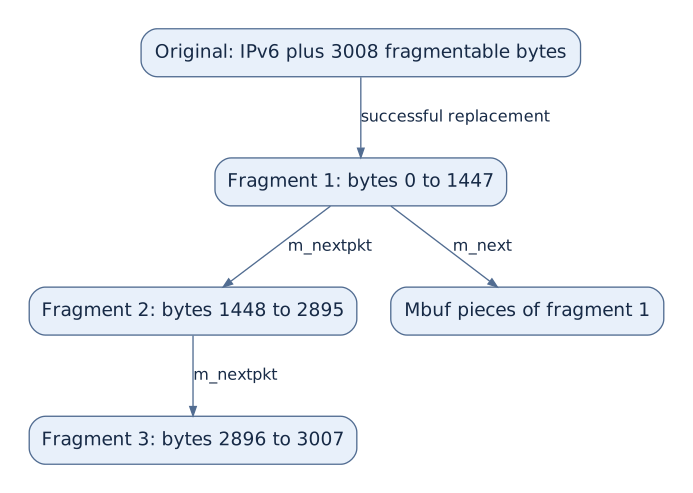
Mermaid source
flowchart TD
    O["Original: IPv6 plus 3008 fragmentable bytes"] -->|successful replacement| A["Fragment 1: bytes 0 to 1447"]
    A -->|m_nextpkt| B["Fragment 2: bytes 1448 to 2895"]
    B -->|m_nextpkt| C["Fragment 3: bytes 2896 to 3007"]
    A -->|m_next| D["Mbuf pieces of fragment 1"]
Construction failure frees all newly created fragments; the original remains owned by the caller's error path. Its header may already have changed, so it is not a pristine retry buffer. Success frees the original and replaces *mptr with the fragment list. No fragment is submitted to the interface from this loop. See failure and replacement.
Packet-list cleanup has three owners
ip6_output_list() tracks remaining inputchain, current m and completed sendchain. A fragmented m can contain several packets, so gathering walks to its last m_nextpkt. The next input resets extension/IPsec scratch state, including merged. The normal path hands the gathered chain to ND after processing the list; ND consumes it on both outcomes. See gather and handoff.
Before merging, freehdrs releases detached header allocations. Its guards panic if asked to separately free a merged header. After merging the packet owns those headers. The bad path frees remaining inputs, gathered outputs and the current packet, then done releases local routes, addresses, interfaces and conditional policy references. See cleanup.
Neighbor lookup can change which route is held
nd6_output_list() first takes an extra reference on the supplied route. Multicast and interfaces that do not need an ND cache bypass ordinary neighbor resolution. For unicast it checks whether the route remains up, resolves gateway routes where needed, and validates that the gateway is an appropriate neighbor. Point-to-point exceptions have their own checks.
The function sometimes drops rt_lock before calls that take rnh_lock; after acquiring global routing protection or doing a lookup, it verifies that the route remains up and that its gateway has not changed. The gateway lookup/revalidation branch rejects a missing or circular gateway route rather than following stale pointers. Route references preserve storage across the unlocked interval; they do not freeze route contents.
Once a usable neighbor record is found, known link-layer state can send immediately. A stale entry is moved toward delayed reachability probing while still allowing output. A missing address instead enters the incomplete-resolution path.
The held packet is replaced, not appended forever
The unresolved path assigns the latest packet list to ln_hold. If another list is already held, that list is freed first. The list can contain multiple packets produced by batching/fragmentation, but repeated sends do not grow an unlimited per-neighbor queue.
	if (ln->ln_state == ND6_LLINFO_NOSTATE) {
		ND6_CACHE_STATE_TRANSITION(ln, ND6_LLINFO_INCOMPLETE);
	}
	if (ln->ln_hold) {
		m_freem_list(ln->ln_hold);
	}
	ln->ln_hold = m0;
The first attempt increments ln_asked, sets expiry from the interface retransmission interval, drops the route lock while retaining the route, and sends a neighbor solicitation. The code schedules ND service under routing protection. Its zero return records accepted/retained work; the payload has not necessarily reached the interface or another host. See solicitation and timer setup.
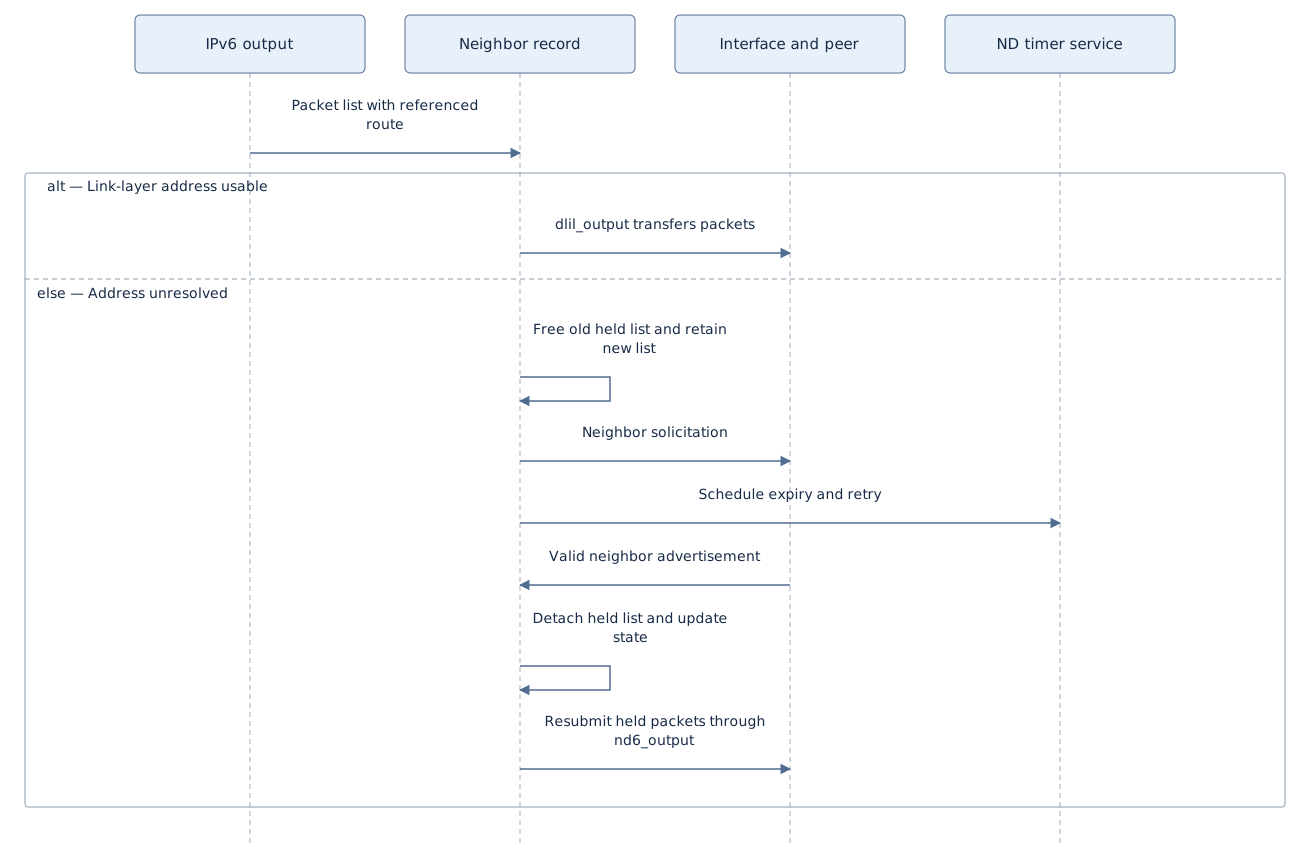
Mermaid source
sequenceDiagram
    participant IP as IPv6 output
    participant ND as Neighbor record
    participant Peer as Interface and peer
    participant T as ND timer service
    IP->>ND: Packet list with referenced route
    alt Link-layer address usable
        ND->>Peer: dlil_output transfers packets
    else Address unresolved
        ND->>ND: Free old held list and retain new list
        ND->>Peer: Neighbor solicitation
        ND->>T: Schedule expiry and retry
        Peer->>ND: Valid neighbor advertisement
        ND->>ND: Detach held list and update state
        ND->>Peer: Resubmit held packets through nd6_output
    end
Advertisement validation and release of held packets
nd6_na_input() checks the required hop limit, target address, solicited/multicast combination and option lengths before using link-layer information. It invokes duplicate-address-detection handling where applicable. It does not blindly create a neighbor entry for every unsolicited advertisement: absent-cache/proxy conditions have explicit branches.
For an incomplete entry, link-layer information can resolve it. For existing entries, solicited and override flags plus whether the link-layer address changed decide whether to replace the address and mark reachable or stale. An advertisement without override that conflicts with a reachable address may mark it stale without replacing it. See update decisions.
The final path resets retries, removes ln_hold from the record before sending, splits the held packet list, and calls nd6_output() with rt_lock dropped around each submission. Clearing the owner pointer before the call prevents two paths from treating the same list as still retained by the neighbor. The route remains referenced until this operation finishes.
bsd/netinet6/nd6_nbr.c:1395–1407:
		m_hold = ln->ln_hold;
		ln->ln_hold = NULL;
		for (; m_hold; m_hold = m_hold_next) {
			m_hold_next = m_hold->m_nextpkt;
			m_hold->m_nextpkt = NULL;
			/*
			 * we assume ifp is not a loopback here, so just set
			 * the 2nd argument as the 1st one.
			 */
			RT_UNLOCK(rt);
			nd6_output(ifp, ifp, m_hold, &sin6, rt, NULL);
			RT_LOCK_SPIN(rt);
		}
nd6_ns_input() is the corresponding solicitation receive entry, including address validation, local-target/DAD/proxy decisions and advertisement generation. The neighbor-message companion expands the NS/NA flags, cache-learning predicates, NUD and redirects; address/DAD and RA/prefix lifetime follow their separate state changes.
Timer transitions, failed resolution and teardown
nd6_service_neighbor_cache() implements the cache-aging work. The useful simplified transition map is:
| State | Relevant transition and ownership effect |
|---|---|
INCOMPLETE |
Retransmit solicitations up to the configured maximum; on exhaustion, detach ln_hold, produce eligible ICMPv6 unreachable responses, notify route consumers and free the neighbor route. |
REACHABLE |
Expiry makes it STALE, with route notification and later collection scheduling. |
STALE |
Output can move toward DELAY; aging can remove expired unused entries. |
DELAY |
If neighbor-unreachability detection applies, start PROBE with unicast solicitation; otherwise return to stale handling. |
PROBE |
Retry unicast solicitation up to its own limit, then invalidate unreachable state. |
The timer code takes route references before dropping locks for packet generation or notification, then reacquires global routing state and restarts traversal when entries may have changed. See retry and failure and reachable/delay/probe. A textbook state diagram without these retained references would miss the mechanism that makes unlocked calls safe.
nd6_purge() coordinates interface-related purge helpers; nd6_purge_interface_llinfo() removes neighbor information for an interface. The final transmit branch also checks IFEF_IPV6_DISABLED, rejects loopback addresses escaping onto a physical link, and calls DLIL with the correct original interface for loopback delivery. See final send checks.
Scope of this reconstruction
This path explains packet ownership, route/scope/MTU decisions, ND resolution and asynchronous reclamation. The IP reassembly and ICMP companion follows incoming fragments, dirty-queue lifetime and quoted-header PMTU feedback. The expanded IPv6 guide connects source-address ranking, DAD, router/prefix lifetimes, input/forwarding, redirects and multicast membership to their detailed companions. External routers, hardware neighbor offloads and device providers are not reconstructed from these call sites. Neighbor lookup tests provide an in-tree follow-up route; no network test was executed for this chapter.