IPv6 scopes, source-address selection and route-cache ownership
An IPv6 send needs both a local source address and a usable outgoing interface. They are related decisions, but neither an address nor a route alone identifies all the state needed to send. This chapter follows the scoped-address representations, candidate ranking and reference transfers in in6_src.c and scope6.c for xnu-12377.121.6.
Start with the IPv6 guide and networking overview. Address creation and validity are covered in address configuration and DAD; the selected router and prefix relationships come from router advertisements. Continue into socket operations and packet output.
Three different meanings of interface selection
| Representation | What it answers | Source |
|---|---|---|
sockaddr_in6.sin6_scope_id |
Which zone disambiguates a scoped address supplied through the socket API? | sa6_embedscope() |
scope6_id.s6id_list[] attached to an interface |
Which zone does this interface belong to for a particular address scope? Interface-local and link-local entries start with the interface index. | scope6_ifattach() |
inp_lifscope, inp_fifscope |
Separate local/foreign address scope identifiers in the shared Internet PCB, used when scoped address bytes do not contain the zone. | struct inpcb |
ip6_out_args.ip6oa_boundif and IP6OAF_BOUND_IF |
Which interface constrains route lookup for this operation? This can constrain a global destination too. | in6_selectsrc() |
in6_pktinfo.ipi6_ifindex |
Per-packet or sticky outgoing-interface selection, also used to interpret an explicitly supplied source. | selectroute() |
route_in6 and its ro_rt/ro_srcia |
Cached forwarding result and retained source-interface address used to validate that result. | cache validation and publication |
For example, fe80::1234 on interface 7 and the same bytes on interface 9 are different link-local endpoints. A global destination does not need this link-local zone distinction, but a bound interface can still constrain which route reaches it. Do not treat sin6_scope_id as a universal replacement for socket interface binding.
Embedded and separate scope representations
in6_embedded_scope is initialized to 1 in this tree. In this mode, link-local/interface-local addresses use the second 16-bit address word to carry an internal zone. sa6_embedscope() validates a supplied/default zone against the interface table, writes that word, and clears the external sin6_scope_id; sa6_recoverscope() performs the reverse conversion. When embedded mode is disabled, code must carry and compare a separate scope identifier. See configuration, embedding and recovery.
Illustrative example, with interface index 7: external fe80::1234 plus sin6_scope_id = 7 becomes internal fe80:7::1234 in embedded mode. This is an internal lookup representation, not an address to transmit. in6_clearscope() removes the internal word before output; the wire header again contains fe80::1234. The exact output calls are here.
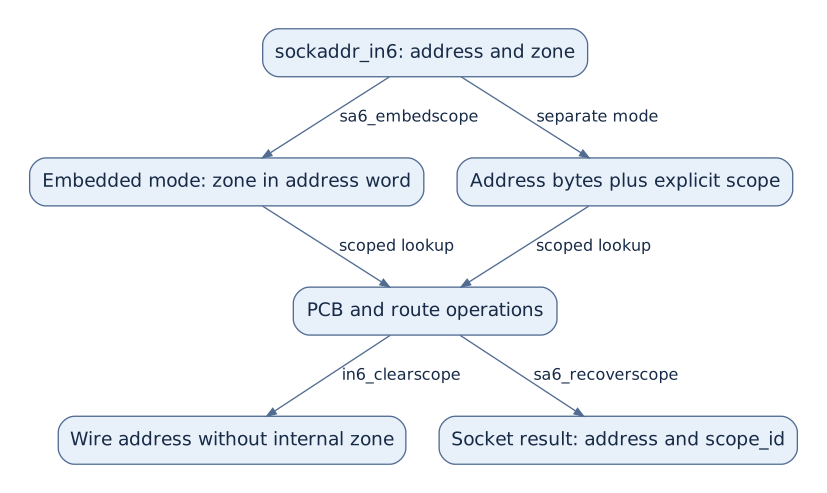
Mermaid source
flowchart TD
    U["sockaddr_in6: address and zone"] -->|sa6_embedscope| E["Embedded mode: zone in address word"]
    U -->|separate mode| S["Address bytes plus explicit scope"]
    E -->|scoped lookup| K["PCB and route operations"]
    S -->|scoped lookup| K
    K -->|in6_clearscope| W["Wire address without internal zone"]
    K -->|sa6_recoverscope| R["Socket result: address and scope_id"]
The equality helper makes the two representations explicit. scope6.c:475–484:
in6_are_addr_equal_scoped(const struct in6_addr *addr_a, const struct in6_addr *addr_b, uint32_t ifscope_a, uint32_t ifscope_b)
{
	if (!IN6_ARE_ADDR_EQUAL(addr_a, addr_b)) {
		return false;
	} else if (IN6_IS_SCOPE_EMBED(addr_a) && !in6_embedded_scope) {
		return ifscope_a == ifscope_b;
	}

	return true;
}
in6_setscope() derives a zone using the chosen interface; it rejects loopback address ::1 on a non-loopback interface and checks the interface's IPv6 state before using its scope table. This is separate from in6_embedscope(), the transport helper that resolves competing API inputs: a packet-info interface takes precedence, followed by the multicast interface when applicable, then a supplied destination zone. Read interface-to-zone conversion and transport input normalization. A non-NULL interface returned by the latter is referenced; callers must release it.
Source selection has three entry cases
in6_selectsrc() accepts destination sockaddr, packet options, optional PCB, route cache, optional returned interface, caller-owned source storage and a bound-interface index. It can return a pointer into the supplied storage or into the PCB. A caller must not free the returned address pointer or assume its lifetime is independent of the socket. The three cases are visible in the implementation:
- Explicit nonzero packet-info source. Select an outgoing interface, apply its zone to the requested address, and look up a real local interface-address object. Reject anycast, not-ready or CLAT46 addresses and a prohibited socket/interface combination. Copy the accepted address to the caller's storage, then release the address reference.
- Already-bound PCB source. Return
&inp->in6p_laddr. This path does not rerun the general candidate-ranking loop. Later route/output checks can still reject the send. - No source yet. Find an outgoing interface with
in6_selectif(), choose the temporary-address preference from the per-packet option or system setting, and runin6_selectsrc_core(). The returned source interface is checked against socket restrictions before the result is accepted.
The bound-source branch is deliberately short. in6_src.c:852–858:
	/*
	 * Otherwise, if the socket has already bound the source, just use it.
	 */
	if (inp != NULL && !IN6_IS_ADDR_UNSPECIFIED(&inp->in6p_laddr)) {
		src_storage = &inp->in6p_laddr;
		goto done;
The explicit-source and automatically ranked paths have different eligibility predicates; do not substitute one for the other when explaining deprecated, detached or optimistic addresses. The general loop's filters are here, whereas the explicit-source check is here.
in6_selectif() can use a temporary route if the caller has none. It rejects reject/blackhole routes even during source selection and translates a loopback route to the interface owning the route's address when appropriate. It releases the temporary route before returning while preserving the separate returned interface reference. A returned interface can be non-NULL on error, so the error path must release it too. See the wrapper and cleanup.
The candidate loop is an ordered decision procedure
in6_selectsrc_core() scans the global in6_ifaddrhead under in6_ifaddr_rwlock, taking each address's ifa_lock to inspect its fields. It retains the current best candidate across iteration. It first excludes addresses that cannot serve the request: mismatched CLAT46 purpose, incompatible source/destination zones, not-ready/anycast/detached addresses, disallowed deprecated addresses, and disallowed optimistic DAD candidates. See setup and admission.
ip6_select_src_strong_end defaults to 1, restricting candidates to the outgoing interface before ranking. When it is disabled, eligible addresses from other interfaces can reach the ranking rules. This switch changes the candidate set; it is not merely a small preference adjustment. See the tunable and the filter.
| Order in the body | Decision and consequence |
|---|---|
| Same address | An eligible source identical to the destination wins immediately. |
| Appropriate scope | Prefer a source whose scope is sufficient for the destination; compare broader/narrower choices according to the destination's scope. |
| Avoid deprecated, then optimistic | Prefer a usable preferred address over a deprecated one, then a non-optimistic address over an optimistic one. These are distinct tests. |
| Home-address rule | Appears as an unimplemented TODO; do not invent a Mobile IPv6 selection step. |
| Outgoing interface | Matters when strong-end filtering was disabled and more than one interface supplied candidates. |
| Advertising next-hop prefix | Prefer an address whose prefix is associated with the selected default router, when the router/prefix comparison is applicable. |
| Matching policy label | Compare the source and destination labels obtained from the address-policy table. |
| Temporary-address preference | Apply the system or packet-specific temporary-versus-public preference. This does not override earlier decisions. |
| Alive interface | Apply the interface liveness preference in the implementation. |
| Longest matching prefix | Break remaining ties by source/destination common-prefix length. |
These are ordered comparisons with jumps to retain/replace the best candidate, not a summed numerical score. The code and source-rule counters are in6_src.c:397–646. The optional expensive-secondary-interface policy is applied in later replacement/final-selection branches; the immediate same-address winner bypasses that later path. It should not be described as an unconditional early eligibility filter. See replacement and final return.
Worked source-choice example
Assume strong-end mode, outgoing interface 7, a global destination, and three valid same-scope addresses on interface 7: a deprecated stable address A, a preferred stable address B and a preferred temporary address C. If earlier router-prefix and policy-label comparisons tie, A loses to a preferred address; the temporary-address preference chooses between B and C before the longest-prefix comparison. Changing the socket's explicit source to A takes the explicit-source path instead, with that path's validation, rather than asking the general ranking loop to choose A.
This is an illustrative ordering example, not a claim that every deployed configuration has these three addresses or that a temporary address always wins. Address creation, deprecation and validity come from the address-lifetime chapter; source selection consumes those flags.
Router-prefix comparison must drop locks and restart
Rule 5.5 needs ND router/prefix objects while iterating interface addresses. The code copies the relevant prefix keys, drops the address locks, takes the ND locks and references, checks pfxrtr_lookup(), releases the prefix references and ND locks, then reacquires the address-list lock. It compares in6_ifaddrlist_genid because a retained best-address reference does not guarantee that the list being traversed stayed unchanged. The selected router reference remains held until the core function's final cleanup. On a generation change, it drops the best address reference and restarts. See the full handoff.
			lck_rw_lock_shared(&in6_ifaddr_rwlock);
			if (genid != os_atomic_load(&in6_ifaddrlist_genid, acquire)) {
				SASEL_LOG("Address list seems to have changed. Restarting source "
				    "address selection.\n");
				genid = in6_ifaddrlist_genid;
				/*
				 * We are starting from scratch. Free up the reference
				 * on ia_best and also reset it to NULL.
				 */
				ifa_remref(&ia_best->ia_ifa);
				ia_best = NULL;
				goto addrloop;
			}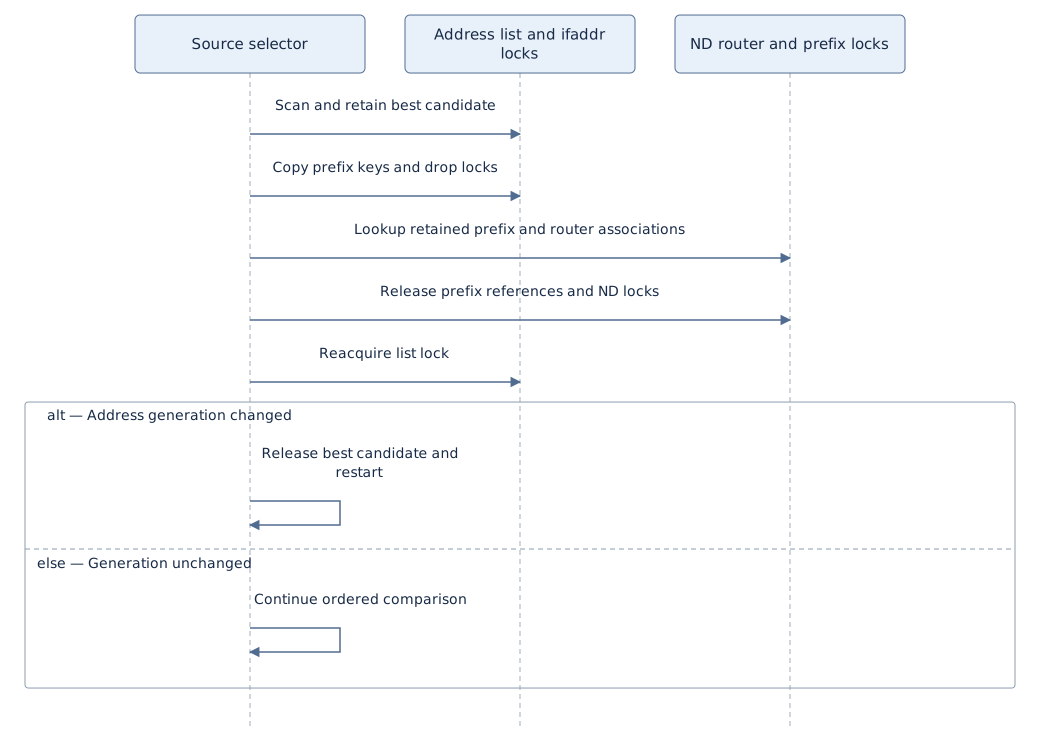
Mermaid source
sequenceDiagram
    participant S as Source selector
    participant A as Address list and ifaddr locks
    participant N as ND router and prefix locks
    S->>A: Scan and retain best candidate
    S->>A: Copy prefix keys and drop locks
    S->>N: Lookup retained prefix and router associations
    S->>N: Release prefix references and ND locks
    S->>A: Reacquire list lock
    alt Address generation changed
        S->>S: Release best candidate and restart
    else Generation unchanged
        S->>S: Continue ordered comparison
    end
Policy labels are not a user-space destination sort
addrsel_policy_init() builds entries including loopback, the default IPv6 prefix, mapped IPv4, 6to4 and other classified prefixes. in6_addrsel_lookup_policy() calls a longest-mask-prefix matcher and increments the selected entry's use counter. The source selector uses the label relation between a candidate and its destination; the table's preced member is not a general destination-ordering implementation inside this loop. See initialization and lookup.
The policy ioctl names do not establish a working mutation API. in6_src_ioctl() validates the command, label and mask, normalizes trailing prefix bits, then returns ENOTSUP for both add and delete. That boundary matters when tracing an ioctl catalog into its implementation. See the complete handler.
Route selection reuses state only after validation
in6_selectroute() is a wrapper around selectroute(). The same internal routine serves in6_selectif(), with a flag allowing certain interface-only results without a full forwarding route. The source file explicitly assumes serialized output per PCB when changing route-cache flags; it is not a lock-free cache. See contract and wrappers.
The major decisions are:
- Reject an unspecified destination. Interpret an explicit packet-info interface, multicast interface, bound-interface scope and destination scope. Some interface-only multicast requests can finish here.
- If source-interface selection is requested, find an address object owning the source. Reuse
ro_srciaonly with a usable cache and the matching source-selection state; otherwise perform a scoped lookup. Explicitly bound global routes have special cases, including the NAT66 rationale in the source, so ownership is not a universal one-line equality check. - If
IPV6_NEXTHOPsupplied a next hop, require an IPv6, directly usable neighbor route (RTF_LLINFO) and use the option's own next-hop route cache. A next-hop override is not permission to supply an arbitrary recursive gateway. - Validate the destination route against family, scoped destination, interface, source selection and route generation. IPv4 and IPv6 share a PCB route union, so an old IPv4 cache entry must not be interpreted as a valid IPv6 sockaddr.
- Release unusable cached references, look up an appropriate scoped route, recheck interface/source ownership and publish retained source-address state plus the generation used for validation.
- Apply the helper's interface restrictions and IPv6-disabled check, returning an interface-denied indication or error where appropriate.
These branches are input/interface choice, source and explicit-next-hop handling, destination-cache replacement, and final restrictions/returns.
Read CHECK_RESTRICTIONS literally in this snapshot: cellular, expensive, constrained and internal-coprocessor terms are joined by ||, while the final AWDL, management and ultra-constrained terms are joined by &&. It must not be summarized as seven independent OR-ed denials or silently replaced with another helper's policy predicate. This is a source-level observation, not a runtime claim about which interface flag combinations a product creates. See the exact macro.
References returned by these helpers
| Result | Ownership rule |
|---|---|
retifp from selectroute() / ifpp from source selection |
Non-NULL carries an interface reference, including certain error returns. Release with ifnet_release(). |
retsrcia from route selection |
Optional separate retained address reference; caller releases it. |
retrt |
Returned only on success, borrowed from the route-cache ownership established by the operation; this assignment does not itself acquire another route reference. |
ro->ro_rt, ro->ro_srcia |
Cache-owned references, released/replaced by route-cache operations. |
Best candidate in in6_selectsrc_core() |
Retained during comparison; released at return unless explicitly transferred through the address-result variant. The ordinary API copies its address bytes. |
The decisive cleanup/assignment code is in6_src.c:1460–1517, with core return ownership. UDP uses in6p_route_copyout() / in6p_route_copyin() around output while the socket lock is dropped. A route reference keeps storage alive; generation and content checks establish whether it remains a suitable forwarding result.
Boundaries and useful follow-up checks
This chapter reconstructs selection and lifetime from local code. It does not claim an RFC conformance test, a product's sysctl defaults beyond the initializers shown, or complete behavior of NECP, translators and external interface providers. The in-tree in6_selectsrc test is a connect/setsockopt lifetime regression exercise; its name does not make it an assertion suite for the ranking rules. No network test was run for this documentation.