Corpses, crash information and process core files
Observability overview · Stackshot and kcdata · Process lifecycle · Exception delivery
A corpse preserves inspectable state and exposes kernel objects through Mach rights. A process core file serializes selected mappings and thread state into a file through VFS. Both may describe a failing process, but their storage, permissions, cleanup and output formats differ. This chapter covers the common/ARM64-relevant implementation and does not cover kernel core dumps or KDP.
1. Separate the artifact from the event that produced it
| Artifact | Representation and consumer boundary |
|---|---|
| Full corpse | A task marked as a corpse, duplicated map/thread state and a kcdata crash-information descriptor |
| Lightweight corpse | Backtrace/crash information wrapped in a kcdata_object; no equivalent full task/map clone in this branch |
| Process core | Mach-O header, segment/thread commands, notes and selected bytes written to a regular file |
| User crash report | A later interpretation of captured state by external reporting software |
The explicit Mach entry task_generate_corpse rejects null, kernel and already corpse-fork tasks, calls the internal creation path, waits for the new task's threads to terminate, resets applicable thread ports, and converts the task reference to a port with a no-senders request. The exception path task_enqueue_exception_with_corpse can instead choose lightweight capture when the registered exception behavior permits it.
2. Corpse admission reserves resources before building objects
inflight_corpses is an atomic gate containing total corpse and user-fault counts. task_crashinfo_get_ref updates the coupled counters with compare-exchange and rejects configured limits. It does not allocate a task merely because a crash occurred. CORPSE_CRASHINFO_HAS_REF records responsibility for returning this admission slot; a user-fault flag adds its separate accounting. gate and limits, reservation, release.
task_generate_corpse_internal additionally checks global enablement and per-task corpse-fork policy. A task reference does not guarantee a BSD process reference: it separately performs proc_find and holds that process while gathering process-derived information. A source task can therefore fail corpse creation even after the caller obtained a valid task reference. admission and process hold.
3. Full corpse construction transfers several kinds of ownership
The internal sequence is:
- Allocate the combined process/task backing storage and initialize a task with
TF_CORPSE_FORK,TF_PENDING_CORPSEandTFRO_CORPSE. - Set up its map and enable its task IPC interfaces.
- Duplicate the source map and threads through
task_duplicate_map_and_threads; retain the exception-thread result and temporary user-data buffer as applicable. - Create crash-information storage and transfer the admission accounting flags into its descriptor.
- Begin halting the new task and terminate its IPC namespace.
- Populate the crash-information blob using the original process's identity and exception/reason information.
- Publish the corpse in the global corpse-task list and return owned task/thread references.
The body and error path are in task_generate_corpse_internal. This is a diagnostic clone, not a new process that returns from fork and runs application code. Terminating its IPC namespace also does not mean destroying the external task inspection right.
The admission-reference transfer prevents successful creation and failure cleanup from both releasing the same slot. transfer and halt:
	new_task->corpse_info->kcd_user_flags = kc_u_flags;
	kc_u_flags = 0;

	kr = task_start_halt(new_task);
	if (kr != KERN_SUCCESS) {
		os_log(OS_LOG_DEFAULT, "Failed to generate corpse for %s[%d]: \
			task_start_halt returned %#x\n", proc_name, pid, kr);
		goto error_task_generate_corpse;
	}

	/* terminate the ipc space */
	ipc_space_terminate(new_task->itk_space);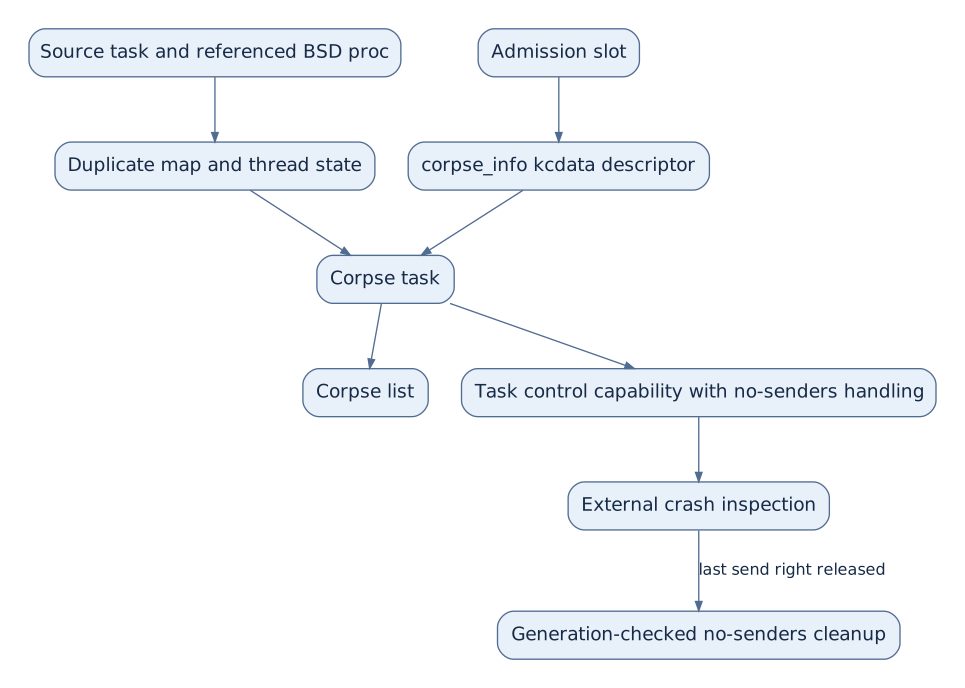
Mermaid source
flowchart TD
    S["Source task and referenced BSD proc"] --> D["Duplicate map and thread state"]
    G["Admission slot"] --> C["corpse_info kcdata descriptor"]
    D --> T["Corpse task"]
    C --> T
    T --> L["Corpse list"]
    T --> P["Task control capability with no-senders handling"]
    P --> R["External crash inspection"]
    R -->|last send right released| N["Generation-checked no-senders cleanup"]
convert_corpse_to_port_and_nsrequest() uses the corpse's task control port, makes its send right under itk_lock, and consumes the caller's task reference. The type registers task_port_no_senders as its kobject callback; the helper's historical name does not mean its current body installs an ordinary userspace notification port. Conversion, kobject operation registration.
No-senders processing must revalidate the make-send generation. The callback first checks the port/object and retains the corpse task, then acquires itk_lock and the port lock for the decisive second check. A task-identity-token operation may have minted another send right meanwhile. Only if the generation is still current does it disable the kobject, remove the corpse from its list, clear corpse state/source-map bookkeeping and terminate the task. Releasing one observer's right is therefore insufficient when other rights remain, and a stale queued no-senders event must not destroy a revived capability generation. Callback and race handling, generation predicate, port lifetime.
On construction failure, the routine releases its process and label references, frees still-unadopted task storage, terminates/waits for any partially created threads, clears corpse state, terminates/releases the task, returns any still-owned admission slot, and frees the temporary user-data buffer. Merely jumping to the error label is not sufficient: cleanup depends on which ownership transfers already happened. failure unwind.
4. Lightweight capture owns a data object and exception rights
task_should_generate_lightweight_corpse examines thread, task and host exception registration for EXC_CORPSE_NOTIFY with the expected backtrace behavior, retaining send rights for later delivery. It applies to the current task and a configured lightweight mode.
The selected branch reserves a lightweight-object throttle slot, collects current-thread backtrace information, creates a kcdata_object, and enqueues it with the captured exception ports. Object creation adopts the descriptor and throttle responsibility; successful enqueue consumes the object reference and send rights. On an earlier failure, the branch returns the throttle slot when appropriate and releases retained exception rights. lightweight ownership.
This distinction matters when interpreting a report: a backtrace notification is not evidence that a complete frozen address space remains available. The full branch instead invokes corpse creation and queues a corpse/thread exception. The observer's registration and the kernel's admission policy affect which artifact can exist.
5. Process core creation starts with the current execution context
coredump explicitly obtains vfs_context_current(), current_map() and current_task(). Its core_proc argument must be understood with those assumptions; it is not a general API for dumping an arbitrary task solely by passing another proc_t.
After the eligibility check, it chooses the data-model-dependent Mach-O sizes, selects the output naming policy, checks the map size against RLIMIT_CORE unless the internal ignore flag is set, and requests task suspension. This call explicitly discards task_suspend_internal()'s return value; the description should not turn that invocation into a separately checked successful barrier. MTE-enabled capture has an explicit tag-checking adjustment before reading process memory. limits and suspension.
It opens the destination with no-follow semantics and checks that it is a regular file with one link. It prepares file attributes, considers free-space reserve, calculates header/command sizes with overflow checks, and allocates a kernel header buffer. A driver task can use different naming and IOKit-memory inclusion rules. file creation and layout sizing.
These gates precede much of the output, but later failure can leave a file created, truncated or partially populated. The operation is not an atomic “all mappings or no file” transaction.
6. VM regions become segment commands and file bytes
The writer recursively walks submaps with mach_vm_region_recurse. For each leaf region it records virtual-address geometry and protections, skips entirely inaccessible regions, and may attempt to add read permission. Eligibility to write contents also checks maximum read permission, the IOKit-memory policy and coredumpok. A segment can describe virtual memory without including all of its bytes in the file. region selection.
The transfer uses vn_rdwr_64 with UIO_USERSPACE64 for a 64-bit source process. The source address is still a process virtual address; foffset is a file byte offset. The VFS/uio path performs the actual read from user memory while writing file data. segment transfer:
		if (fsize) {
			int64_t resid = 0;
			const enum uio_seg sflg = IS_64BIT_PROCESS(core_proc) ?
			    UIO_USERSPACE64 : UIO_USERSPACE32;

			error = vn_rdwr_64(UIO_WRITE, vp, vmoffset, fsize,
			    foffset, sflg, IO_NODELOCKED | IO_UNIT,
			    cred, &resid, core_proc);

			if (error) {
				/*
				 * Mark segment as empty
				 */
				fsize = 0;
				COREDUMPLOG("failed to write segment %llx->%llx: error %d", vmoffset, vmoffset + vmsize, error);
			} else if (resid) {
				/*
				 * Partial write. Extend the file size so
				 * that the segment command contains a valid
				 * range of offsets, possibly creating a hole.
				 */
				VATTR_INIT(vap);
				VATTR_SET(vap, va_data_size, foffset + fsize);
				vnode_setattr(vp, vap, ctx);
				COREDUMPLOG("partially wrote segment %llx->%llx, resid %lld", vmoffset, vmoffset + vmsize, resid);
			}
		} else {
			COREDUMPLOG("skipping unreadable segment %llx->%llx", vmoffset, vmoffset + vmsize);
		}
On a write error, the segment's file size is marked zero. A residual byte count without an error can cause the file to be extended so the segment's declared range remains within the file, potentially with a hole. Later writes and the final header affect the returned error: do not infer that a successful final return proves every mapped byte was captured.
Illustrative mapping:
process VA 0x100000000..0x100003fff
    -> LC_SEGMENT_64: vmaddr/vmsize describe that virtual range
    -> fileoff/filesize describe its retained payload in the core file
process thread saved state
    -> LC_THREAD records with architecture state flavors
addressability metadata
    -> LC_NOTE command and separately written payload
These values are hypothetical. Actual file offsets depend on the header, notes and earlier included segments. The writer gathers thread state through task_act_iterate_wth_args, then writes the Mach-O header at file offset zero. Notes have callbacks and their payloads are written separately from note commands. notes, thread/header completion.
7. Completion is not identical to persistence or crash reporting
COREDUMP_FULLFSYNC requests a final F_FULLFSYNC only after successful header output. Cleanup frees header/attribute/name storage, closes the vnode, records the audit outcome and preserves a close error if no earlier error remains. It does not convert the result into a symbolic crash report or repair omitted mappings. completion.
A useful source-reading exercise is to follow a failed second-segment write through fsize = 0, command creation, later header output and vnode close. Compare that with a corpse-construction failure after the admission slot moved into corpse_info. The former manages a partially written external file; the latter unwinds a graph of kernel objects and transferred references.
Inspection boundary
The creation, admission, lightweight selection, principal ownership transfers and process-core writer were inspected. Detailed map/thread duplication internals, every crash-information field and all exception consumer policies are broader mechanisms. Filesystem persistence, external crash reporters and symbolication are separate implementations. No crash was induced or core file collected.