Process code-signing controls and ARM64 CSR policy
csops observes or changes code-signing state attached to a process and its executable. csrctl exposes a separate boot-derived configuration used by selected policy checks. Neither interface installs a signature, authenticates a trust cache, or independently authorizes every executable mapping. This chapter traces the dispatch, identities, buffers, mutations and consumers implemented in xnu-12377.121.6, with ARM64 Device Tree CSR behavior. Syscall entries, CSR entry.
Security guide · Code-signing overview · Trust-cache control. Continue to executable signature policy, page integrity, task capabilities and credential/policy lifetimes for the mechanisms these controls interact with.
1. State exists in the process, executable blob, task and VM map
The API does not return one universal security object. Its operations read different state:
| Object/field | Role in this chapter |
|---|---|
proc and its PID/version |
Referenced target process; PID alone is reusable, version distinguishes incarnations. |
proc_ro.p_csflags |
Stored 32-bit process signing flags. proc_getcsflags() returns them; update helpers use zalloc_ro_update_field() on ZONE_ID_PROC_RO. |
p_textvp, p_textoff |
Executable vnode and selected Mach-O slice offset. They locate the relevant UBC signature blob. |
cs_blob |
CodeDirectory hash/type, signature storage, identity/team identifier, interpreted entitlements and platform/validation-category state. |
task |
Process-associated execution object; platform status can be changed by the development-only platform-clear command. |
vm_map.cs_enforcement, pmap enforcement field |
Address-space enforcement state explicitly synchronized when SET_STATUS newly enables CS_ENFORCEMENT. |
Sources: process protected fields, flag access/update, blob selection, VM enforcement, platform helper.
csproc_get_blob() requires a process, a text vnode and CS_SIGNED, then calls ubc_cs_blob_get(p_textvp, -1, -1, p_textoff). This selects an already-attached signature. The API does not synthesize one when the executable is unsigned. CS_VALID, CS_SIGNED and CS_DEBUGGED have different roles: a process can retain signature metadata after invalidation, while selected queries permit a debugged process that no longer has CS_VALID. Blob helper, flag definitions, query gate.
2. Syscall admission: identify the process before operating on it
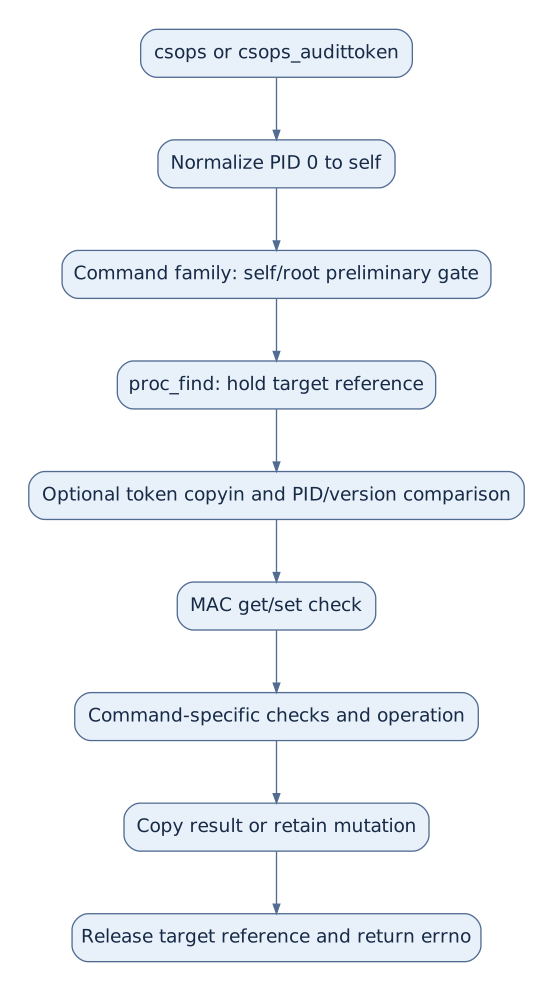
Syscall 169 is csops(pid, ops, useraddr, usersize); syscall 170 adds a user pointer to audit_token_t. Both reach csops_internal(). The audit-token variant rejects a null token pointer at its wrapper. PID zero is normalized to the caller's PID, and a matching PID sets forself and the local mark_invalid_allowed flag. Declarations, wrappers and normalization, common entry.
Admission has three layers:
- Coarse operation gate. Status, hash, offset, blob, entitlement, identity, team ID, validation-category queries and
CLEAR_LVdo not require root at this step. Other commands require either self or superuser credentials. This is not the final authorization rule. - Target and optional incarnation check.
proc_find(pid)acquires a process reference or returnsESRCH. If a token was supplied,copyinreads it and comparesval[5]with PID andval[7]withproc_pidversion(). Mismatch returnsESRCH. - MAC operation check and command-specific gate. With
CONFIG_MACF, mutators callmac_proc_check_set_cs_info, while the other commands callmac_proc_check_get_cs_info. The helpers pass caller credentials, target and operation to registered policies. Additional self/entitlement/build/state checks remain inside the command implementation.
Sources: coarse gate and reference, token and MAC dispatch, MAC helpers.
bsd/kern/kern_proc.c, lines 3740–3757.
	pt = proc_find(pid);
	if (pt == PROC_NULL) {
		return ESRCH;
	}

	upid = proc_getpid(pt);
	uidversion = proc_pidversion(pt);
	if (uaudittoken != USER_ADDR_NULL) {
		error = copyin(uaudittoken, &token, sizeof(audit_token_t));
		if (error != 0) {
			goto out;
		}
		/* verify the audit token pid/idversion matches with proc */
		if ((token.val[5] != upid) || (token.val[7] != uidversion)) {
			error = ESRCH;
			goto out;
		}
	}
Only two token fields are compared here. The token supplies target identity evidence, not a transferable authorization credential; its UID/other fields are not used to replace the caller's credentials. A stale token protects against using a recycled PID, but it does not freeze the target's signing state across later calls or turn a size probe plus data fetch into one transaction.
Mermaid source
flowchart TD
    U["csops or csops_audittoken"] --> P["Normalize PID 0 to self"]
    P --> G["Command family: self/root preliminary gate"]
    G --> F["proc_find: hold target reference"]
    F --> I["Optional token copyin and PID/version comparison"]
    I --> M["MAC get/set check"]
    M --> C["Command-specific checks and operation"]
    C --> O["Copy result or retain mutation"]
    O --> R["Release target reference and return errno"]
Each failed gate exits at that stage; the diagram shows the successful admission route. Most commands release the target through out:. Offset/hash commands explicitly release after obtaining their kernel-local result and before final copyout. Process flags are protected by proc_lock() around the relevant reads/updates; copyout happens after dropping that lock. The process reference and individual lock regions are not a whole-call snapshot lock. Offset/hash release paths, common cleanup.
3. The complete command surface in this checkout
The table lists every defined CS_OPS_* command. Slot 4 is the retired PIDPATH comment, not an implemented case. An unknown operation reaches the default EINVAL only after applicable earlier gates; a caller can therefore receive EPERM, ESRCH, a copy fault or a MAC error first. Command definitions, default case.
Queries and buffer representations
| ID / command | Result and input-size rule | Additional behavior |
|---|---|---|
0 STATUS |
Copies a native uint32_t if useraddr is non-null. This branch does not check usersize. |
Synthesizes effective enforcement and blob platform flags; hides CS_REQUIRE_LV when CS_FORCED_LV is present. Null output still permits successful admission/status computation. |
5 CDHASH |
Exactly sizeof(hash), currently CS_CDHASH_LEN bytes, required; otherwise EINVAL. |
Requires text vnode; vn_getcdhash() supplies the selected vnode/slice hash. |
6 PIDOFFSET |
Native off_t from p_textoff; no size check in this branch. |
Releases target before copying this local value to user memory. |
7 ENTITLEMENTS_BLOB |
XML generic-blob bytes through the variable-length token protocol. | Requires CS_VALID or CS_DEBUGGED and a signature blob; XML is obtained from AMFI's entitlement object, then the returned allocation is freed. Missing entitlement object/provider result can return success without writing output. |
10 BLOB |
Raw retained signature-storage bytes, using csb_mem_size, through the token protocol. |
Requires valid or debugged state. No text vnode is EINVAL; no matching blob produces the protocol's zero header. |
11 IDENTITY |
Synthetic 8-byte header plus NUL-terminated signing identity. | Requires valid or debugged state; no identity is ENOENT. Header is published before short-buffer ERANGE. |
14 TEAMID |
Same synthetic header protocol for team identifier. | Same validity gate; no team identifier is ENOENT. |
16 DER_ENTITLEMENTS_BLOB |
DER generic-blob bytes through token protocol. | Verifies stored DER against its special-slot hash, then may fall back to AMFI-transmuted entitlements. No fallback does not necessarily write a zero header. |
17 VALIDATION_CATEGORY |
Native unsigned int; no size check in dispatch branch. |
Helper requires valid or debugged state and a blob, returning EINVAL/EBADEXEC otherwise. |
18 CDHASH_WITH_INFO |
Exactly sizeof(csops_cdhash_t) required. |
Returns the hash bytes plus a one-byte hash-type discriminator. |
Sources: status, offset/hash, entitlements/category, blob/identity/team, category helper, raw blob helper.
The hash-with-info result has a concrete, small representation:
osfmk/kern/cs_blobs.h, lines 324–327.
typedef struct _csops_cdhash {
	uint8_t hash[CS_CDHASH_LEN];
	uint8_t type;
} csops_cdhash_t;
The status word is not a literal copy of p_csflags: cs_process_enforcement() can report global enforcement even when the stored per-process flag is clear, and the platform bits can come from the selected cs_blob. The CS_FORCED_LV adjustment deliberately reports forced validation separately from explicitly requested validation. Consequently copying a status result into SET_STATUS cannot reproduce all observed state. Status construction, effective enforcement helper.
Mutations and their extra gates
| ID / command | State transition | Gate or result that matters |
|---|---|---|
1 MARKINVALID |
If currently valid, clear CS_VALID, notify MAC, and if CS_KILL is set also set CS_KILLED and send SIGKILL after unlocking. |
Self only, even if a non-self caller passed the initial root gate. Already-invalid state is a no-op. |
2 MARKHARD |
Set CS_HARD. |
If CS_VALID is clear, return EINVAL after retaining the new bit. |
3 MARKKILL |
Set CS_KILL. |
If already invalid, send SIGKILL after unlocking. This branch does not itself set CS_KILLED. |
8 MARKRESTRICT |
Set CS_RESTRICT. |
No validity check in this command body; initial and MAC gates still apply. |
9 SET_STATUS |
OR an allowed subset into process flags; newly enabled enforcement also updates map/pmap. | At least 4 input bytes; copyin must succeed; target must have CS_VALID. Unsupported requested bits are masked away. |
12 CLEARINSTALLER |
Clear CS_INSTALLER, CS_DATAVAULT_CONTROLLER and CS_EXEC_INHERIT_SIP. |
Non-self caller must pass the initial root gate and possess CS_INSTALLER itself. Self can clear these flags without that extra privilege. |
13 CLEARPLATFORM |
Clear process platform flags; if a selected blob exists, helper also clears its platform fields and task platform state. | Development/debug only, global process enforcement must be off, and with CSR the Apple-internal allowance must pass. Otherwise ENOTSUP. |
15 CLEAR_LV |
Clear CS_REQUIRE_LV and CS_FORCED_LV. |
macOS only; self plus clear-library-validation entitlement; reject installer state and non-null subsystem root. Other platforms return ENOTSUP. |
Sources: invalid/hard/kill, restrict/set, clear LV, installer/platform, entitlement string.
4. Variable-length queries: an error can publish useful bytes
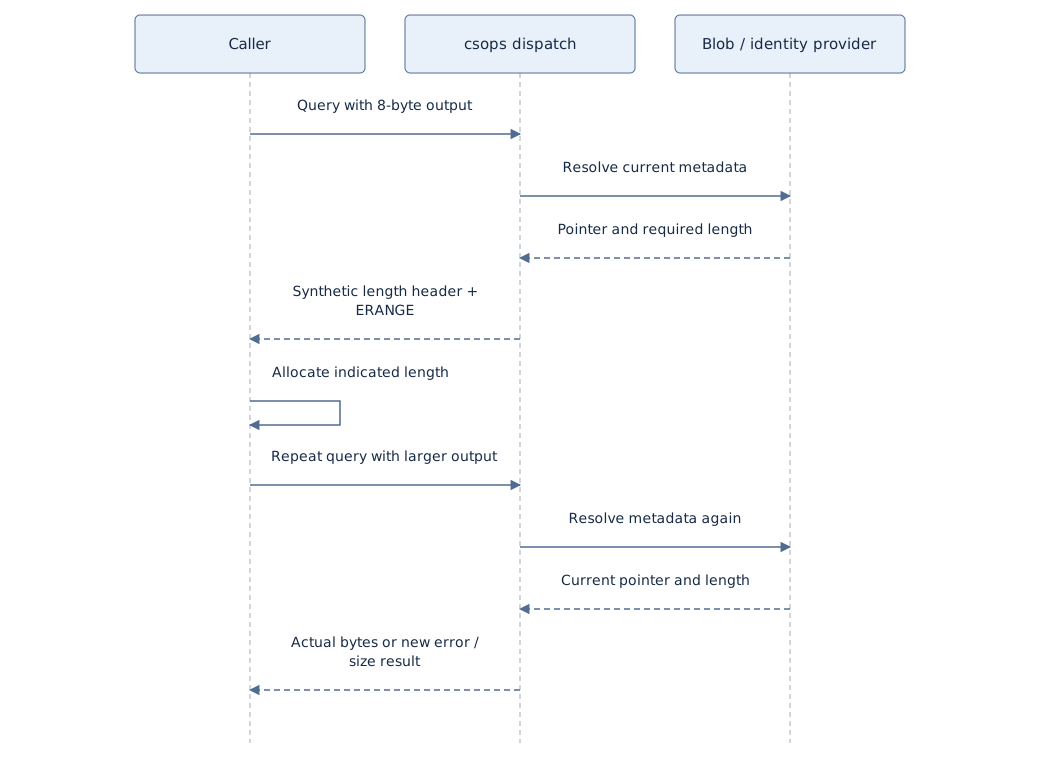
csops_copy_token() is shared by raw blob and entitlement outputs. It uses an 8-byte generic-blob-shaped header: the first word is zero for a synthetic response; the second word stores the required total byte length in network byte order. It does not return a native size_t and it does not allocate the caller's output buffer. Helper.
bsd/kern/kern_proc.c, lines 3674–3693.
	if (usize < sizeof(fakeheader)) {
		return ERANGE;
	}

	/* if no blob, fill in zero header */
	if (NULL == start) {
		start = fakeheader;
		length = sizeof(fakeheader);
	} else if (usize < length) {
		/* ... if input too short, copy out length of entitlement */
		uint32_t length32 = htonl((uint32_t)length);
		memcpy(&fakeheader[4], &length32, sizeof(length32));

		error = copyout(fakeheader, uaddr, sizeof(fakeheader));
		if (error == 0) {
			return ERANGE; /* input buffer to short, ERANGE signals that */
		}
		return error;
	}
	return copyout(start, uaddr, length);
The three cases are:
- Fewer than 8 supplied bytes: return
ERANGEbefore writing. - At least 8, but less than the real blob length: write a synthetic header carrying that length, then return
ERANGEif copyout succeeded. A copy fault takes precedence over that size result. - Enough space: copy exactly the selected length. If called with a null blob, copy an all-zero 8-byte header instead.
A worked example uses an illustrative 100-byte blob. A query with an 8-byte output gets bytes 00 00 00 00 00 00 00 64 and ERANGE; a 100-byte retry gets the actual blob and success, assuming the object/policy did not change. A 7-byte query gets ERANGE without a header. An invalid output mapping can yield a copy error, and copyout itself is not an atomic transaction that promises an untouched destination. The helper's header is a size-probe result, not a valid signature magic value.
Identity/team queries implement a related protocol directly: compute strlen(identity)+1, add 8, write the synthetic header, then decide whether to return ERANGE or copy the NUL-terminated string. If the string copy faults, the header may already be visible. Raw BLOB queries report the retained storage length, which can exceed the serialized blob's own internal length; clients must distinguish the size needed by this API from a nested blob header. Identity implementation, raw storage return, test documenting the distinction.
Mermaid source
sequenceDiagram
    participant U as Caller
    participant K as csops dispatch
    participant B as Blob / identity provider
    U->>K: Query with 8-byte output
    K->>B: Resolve current metadata
    B-->>K: Pointer and required length
    K-->>U: Synthetic length header + ERANGE
    U->>U: Allocate indicated length
    U->>K: Repeat query with larger output
    K->>B: Resolve metadata again
    B-->>K: Current pointer and length
    K-->>U: Actual bytes or new error / size result
This is two independent admitted operations. The API does not pin a result across them. The token-based PID/version check can prevent targeting a reused PID in either call, but cannot make them one snapshot.
5. XML and DER entitlement ownership differs
For XML, dispatch takes the process lock, checks valid/debugged state, obtains a blob, unlocks and fetches its OS entitlement object. If no blob exists it returns EBADEXEC; if no entitlement object exists or the AMFI XML conversion returns false, it goes to cleanup with the current zero error and does not call csops_copy_token(). Therefore the helper's null-blob zero-header behavior is not a guarantee for every “no entitlements” result. On XML success, AMFI supplies an allocated CS_GenericBlob, its length is decoded with ntohl(), dispatch copies it, and kfree_data() frees it even if copyout failed. XML path.
DER first calls csblob_get_der_entitlements(). That helper initializes outputs to null/zero, checks hash-function availability, finds the DER special slot, distinguishes absent content from a nonzero expected hash, hashes present bytes, and compares the selected digest. The metadata result is not simply an unvalidated pointer returned from csb_der_entitlements_blob. DER helper.
If that helper returns an error or a null pointer, dispatch can ask AMFI for a transmuted blob through the OS entitlement object. A successful fallback reaches csops_copy_token() and overwrites error with the copy result. If fallback is unavailable/false, the existing helper error is preserved; a successful absence result can instead return zero without output. DER pointers in this branch are borrowed; unlike XML conversion, dispatch has no matching kfree_data() for them. DER fallback.
These bodies expose ownership and error semantics, but the AMFI entitlement-object implementation and the reason it transmuted a specific entitlement representation are external. See signature layout for generic-blob and special-slot formats and vnode lifetime for protected blob publication.
6. Mutations are not uniformly transactional
MARKHARD is a compact example of why an error does not mean “nothing changed”:
bsd/kern/kern_proc.c, lines 3834–3845.
	case CS_OPS_MARKHARD:
		proc_lock(pt);
		proc_csflags_set(pt, CS_HARD);
		if ((proc_getcsflags(pt) & CS_VALID) == 0) {
			/* @@@ allow? reject? kill? @@@ */
			proc_unlock(pt);
			error = EINVAL;
			goto out;
		} else {
			proc_unlock(pt);
		}
		break;
MARKINVALID has a different transition: only a valid self target is changed; clearing validity and invoking cs_process_invalidated() happen under the process lock, while SIGKILL is sent after releasing it. The notification helper dispatches mac_proc_notify_cs_invalidated() under CONFIG_MACF. The operation does not delete the vnode's cs_blob or erase its bytes. Invalidation branch, notification.
SET_STATUS copies a 32-bit input, then keeps only CS_HARD, CS_EXEC_SET_HARD, CS_KILL, CS_EXEC_SET_KILL, CS_RESTRICT, CS_REQUIRE_LV, CS_ENFORCEMENT and CS_EXEC_SET_ENFORCEMENT. It requires CS_VALID under the process lock and ORs these bits into existing state. It cannot set CS_VALID, confer platform status or clear arbitrary existing bits. Mask and publication.
If enforcement is newly requested, vm_map_cs_enforcement_set() takes the map interlock, sets map->cs_enforcement, and calls pmap_set_vm_map_cs_enforced(). The SPTM pmap implementation validates mutable pmap state and writes pmap_vm_map_cs_enforced; the ordinary/PPL implementation selects its protected wrapper as configured. This is an explicit address-space update, not only a process flag change, and it does not walk all existing mappings to rehash them inside this setter. Map operation, SPTM pmap setter, PPL/common setter.
The CS_EXEC_SET_* bits defer selected effects to exec: the loader copies them into ip_csflags as CS_HARD, CS_KILL or CS_ENFORCEMENT on the new image. They differ from changing the current map immediately. Exec inheritance.
CLEAR_LV removes only the two per-process library-validation bits after its gates. The local cs_require_lv() still reports true when global cs_library_val_enable is set, and MAC/monitor mapping checks have separate decisions. Clearing this state is not a promise that every future library will be accepted. CLEARPLATFORM reaches further: its helper updates the selected shared vnode blob's platform fields through the read-only zone API and updates task platform state. The helper returns immediately when no selected blob exists: process bits have already been cleared, but it does not update task platform state in that branch. When a blob exists, the side effect is broader than a private status word and is confined to the explicitly admitted development path. LV helper, platform helper.
7. CSR on ARM64: initialize a boot policy, then consult it
CSR uses a different state object: a SECURITY_READ_ONLY_LATE(csr_config_t) global. csr_config_t and csr_op_t are 32-bit values. ARM64 macOS configuration includes both CONFIG_CSR and CONFIG_CSR_FROM_DT; other builds must be read according to their selected configuration. This chapter follows the Device Tree implementation and common syscall wrappers, not the legacy architecture branch. Types/flags, ARM64 macOS configuration, state.
csr_bootstrap() is registered at STARTUP(TUNABLES, STARTUP_RANK_FIRST, ...). Its comment explains why it runs before normal VM/pmap initialization and before consumers such as panic initialization: it may use stack, Device Tree and boot-argument parsing, but must not depend on dynamic allocation. The stored policy is then made read-only-late with the other protected globals. Initialization contract and registration. See ARM64 bootstrap and lockdown for the surrounding memory transitions.
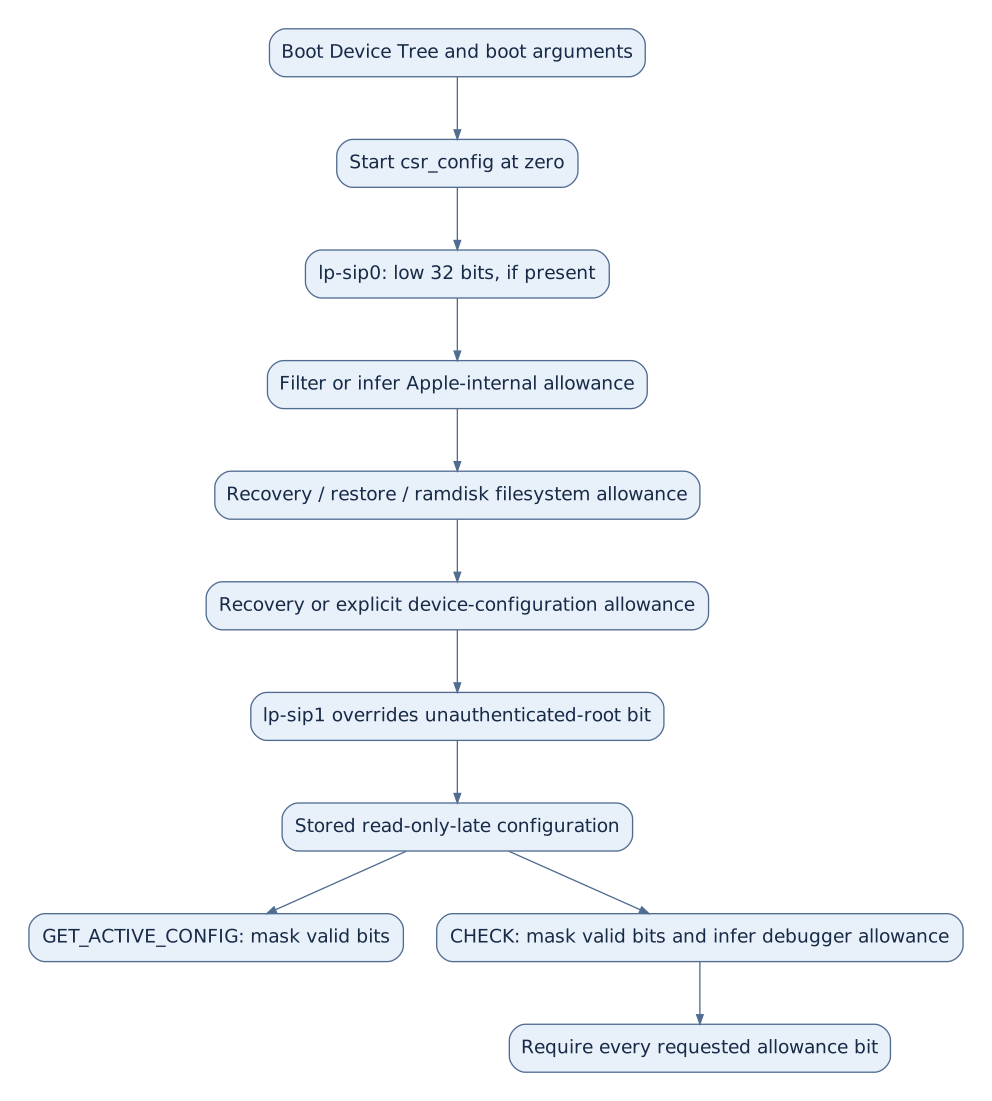
On the normal path with /chosen/asmb available, derivation is ordered:
- Start with zero allowance bits. Read the 64-bit
lp-sip0property and retain its low 32 bits; remember whether a custom configuration was supplied. - Determine internal hardware/software status from
/chosen/internal-use-only-unitor/chosen/manifest-properties/iuos. RemoveCSR_ALLOW_APPLE_INTERNALon other systems. For an internal system without customlp-sip0, infer that bit; with custom configuration, preserve its chosen value. - Add
CSR_ALLOW_UNRESTRICTED_FSin recovery (osenvironment == "recoveryos"), restore (-restoreboot argument) ordarwinos-ramdiskenvironments. - Add
CSR_ALLOW_DEVICE_CONFIGURATIONwhen the helper returns true: recovery environment or explicit/chosen/csr-allow-device-configurationproperty. - Set or clear
CSR_ALLOW_UNAUTHENTICATED_ROOTfrom the booleanlp-sip1property of the saved/chosen/asmbentry. This overrides the corresponding bit that might have come fromlp-sip0.
Sources: environment helpers, derivation.
There are two details worth reading literally. The device-configuration helper comment says “restore”, but its body tests recovery, not the -restore helper. Also, entry is uninitialized at declaration and later reused unconditionally for lp-sip1; the earlier /chosen/asmb lookup does not guard that final call. SecureDTLookupEntry() writes its output only on success. Thus this body assumes the boot entry is available there; it does not demonstrate a safe missing-/chosen/asmb fallback merely because configuration starts at zero. Helper discrepancy, entry reuse, Device Tree lookup.
Boolean Device Tree properties must be exactly 4 bytes; the policy integer must be exactly 8. A present property of the wrong size panics. String comparisons require the exact NUL-inclusive property length. These are early trusted-boot-input contracts, not user-space parser error returns. Property readers.
Mermaid source
flowchart TD
    D["Boot Device Tree and boot arguments"] --> Z["Start csr_config at zero"]
    Z --> P["lp-sip0: low 32 bits, if present"]
    P --> I["Filter or infer Apple-internal allowance"]
    I --> F["Recovery / restore / ramdisk filesystem allowance"]
    F --> C["Recovery or explicit device-configuration allowance"]
    C --> R["lp-sip1 overrides unauthenticated-root bit"]
    R --> S["Stored read-only-late configuration"]
    S --> G["GET_ACTIVE_CONFIG: mask valid bits"]
    S --> K["CHECK: mask valid bits and infer debugger allowance"]
    K --> A["Require every requested allowance bit"]
The diagram assumes valid property sizes and the /chosen/asmb entry; it does not assert successful handling of malformed or missing bootstrap inputs.
8. Allowance bits, reported configuration and effective checks
A set CSR_ALLOW_* bit relaxes a particular restriction. Zero is restrictive. The current valid mask contains these 13 bits; their names are an ABI vocabulary, not proof that all associated policy implementations live in this repository. Definitions and valid mask.
| Bit | Allowance name | Local interpretation or boundary |
|---|---|---|
| 0 | UNTRUSTED_KEXTS |
Also makes csr_check() infer kernel-debugger allowance. Full kext approval policy is broader than this bit. |
| 1 | UNRESTRICTED_FS |
Used by shared-cache/KC protected-file checks and selected filesystem-facing controls. |
| 2 | TASK_FOR_PID |
Defined policy input; task acquisition still has its own credential, MAC and task-port conversion path. |
| 3 | KERNEL_DEBUGGER |
Can be effective in checks without being present in the reported stored mask. |
| 4 | APPLE_INTERNAL |
Filtered/inferred from boot inputs; consumed by development process controls and NVRAM/DTrace helpers. |
| 5 | UNRESTRICTED_DTRACE |
DESTRUCTIVE_DTRACE is a deprecated alias for the same bit; also consulted for restricted-process environment readout. |
| 6 | UNRESTRICTED_NVRAM |
Defined allowance; actual NVRAM permission logic combines variable policy, task entitlements and other state. |
| 7 | DEVICE_CONFIGURATION |
Added by the recovery/explicit-property helper in the DT bootstrap path. |
| 8 | ANY_RECOVERY_OS |
Consulted by local recovery-image setup and chunklist failure handling. |
| 9 | UNAPPROVED_KEXTS |
Defined policy input; no complete approval-provider implementation is inferred here. |
| 10 | EXECUTABLE_POLICY_OVERRIDE |
Defined policy input; does not itself implement an exec or signature bypass in csr_check(). |
| 11 | UNAUTHENTICATED_ROOT |
Synthesized from lp-sip1; root-volume authentication policy is not fully present here. |
| 12 | RESEARCH_GUESTS |
Defined policy input; guest policy/provider implementation is outside this chapter. |
CSR_DISABLE_FLAGS contains only bits 0–6; it is not an alias for all valid allowances. CSR_ALWAYS_ENFORCED_FLAGS and booter capability definitions are also in the header, but the DT csr_check() body does not use them as an additional shortcut. Do not import behavior from another backend based on a shared macro name. Additional masks.
csr_get_active_config() masks csr_config with CSR_VALID_FLAGS. csr_check(mask) then operates on that local copy, inferring the debugger allowance when either untrusted-kext or Apple-internal allowance is set:
bsd/kern/kern_csr.c, lines 250–259.
	// CSR_ALLOW_KERNEL_DEBUGGER needs to be allowed when SIP is disabled
	// to allow 3rd-party developers to debug their kexts.  Use
	// CSR_ALLOW_UNTRUSTED_KEXTS as a proxy for "SIP is disabled" on the
	// grounds that you can do the same damage with a kernel debugger as
	// you can with an untrusted kext.
	if ((config & (CSR_ALLOW_UNTRUSTED_KEXTS | CSR_ALLOW_APPLE_INTERNAL)) != 0) {
		config |= CSR_ALLOW_KERNEL_DEBUGGER;
	}

	return ((config & mask) == mask) ? 0 : EPERM;
The final comparison requires all requested bits. Requesting zero succeeds. Requesting an unknown bit fails because that bit was removed from the effective configuration. A request combining FS and DTrace allowances fails if only FS is allowed; this is not an “any bit” query. As another illustrative case, stored UNTRUSTED_KEXTS alone causes GET_ACTIVE_CONFIG to report bit 0, while CHECK(KERNEL_DEBUGGER) succeeds through inference without modifying stored state. Mask/read implementation.
9. csrctl is a read/check surface, not a setter
The syscall has two operations: CSR_SYSCALL_CHECK and CSR_SYSCALL_GET_ACTIVE_CONFIG. Both require a non-null user address and exactly sizeof(csr_config_t) bytes. CHECK copies in the requested mask and returns csr_check()'s result; GET obtains the stored valid mask and copies it out. Unknown operation returns ENOSYS. These wrappers contain no root gate, MAC hook or mutable-config operation. Operation enum, syscall bodies.
The libsyscall csr_check() and csr_get_active_config() functions are thin wrappers over __csrctl, supplying the exact size. They expose the syscall convention to applications; the kernel's internal helpers return integer error codes directly. Neither wrapper edits Device Tree properties or persists a policy change for the next boot. User-space wrappers.
10. Follow a bit into a real consumer
The useful question is what a caller does after csr_check() returns, because the check itself only compares bits.
| Consumer | Decision taken in the local body | Independent restrictions remain |
|---|---|---|
| Shared-cache file mapping | Without UNRESTRICTED_FS, fetch vnode flags and require SF_RESTRICTED. |
MAC mmap, signature and other mapping checks are separate; trust-cache membership only affected the preceding owner check. |
vm.enforce_shared_cache_dir handler |
With CSR enabled, fail EPERM when UNRESTRICTED_FS is absent before calling the integer handler. |
Sysctl dispatch and shared-region admission have their own checks. |
OSKext::mapKCFileSet caller |
Without UNRESTRICTED_FS, reject a KC vnode lacking SF_RESTRICTED before mapping the fileset. |
KC format, signature and mapping policy do not disappear merely because this filesystem condition is relaxed. |
| Process argument/environment readout | UNRESTRICTED_DTRACE is one condition allowing environment variables from a restricted target to be included. |
Self, development build, target restriction and entitlement checks form the other branches. |
| DTrace helpers | UNRESTRICTED_DTRACE controls dtrace_is_restricted; Apple-internal allowance can relax another helper. |
FBT restriction still checks ml_unsafe_kernel_text() separately. |
CLEARPLATFORM |
Apple-internal allowance is required when CSR is enabled. | Development/debug build, global enforcement, coarse syscall and MAC gates still apply. |
IODTNVRAM::init |
On CSR-enabled macOS, derive gInternalBuild from Apple-internal allowance. |
Per-variable internal-only checks and system entitlements also participate in subsequent NVRAM authorization. |
| Recovery setup / chunklist failure | ANY_RECOVERY_OS sets skip-signature/rooted-image choices; chunklist failure handling can clear the error and report not enforced. |
This is the displayed recovery-image path, not a universal runtime signed-volume policy implementation. |
Sources: shared-cache protection, shared-cache sysctl, KC vnode requirement, process environment, DTrace helpers, platform command, NVRAM initialization, NVRAM permission branches, recovery setup, chunklist error handling.
For example, an accepted static trust-cache entry can let an ARM64 macOS shared cache skip the root-owner requirement; it then reaches the CSR-controlled SF_RESTRICTED requirement. A csops STATUS platform bit is neither of those checks. This concrete chain keeps cache membership, process metadata and boot policy separate while showing where they meet. Trust-cache caller, CSR continuation.
11. Tests, inspection scope and unresolved policy
The supplied tests/codesigntests.c exercises variable-length probing, complete/oversized buffers, self/PID-zero routes, restricted status setting, both hash forms, invalidation-dependent behavior and the extra non-self installer privilege check. The test explicitly notes that raw signature storage can be larger than the internal serialized blob length. Its invalidation-test comment says “not HARD” while the body tests CS_KILL; the body is the evidence for which case is skipped. These tests were read, not run. Buffer tests, command tests, installer privilege test.
The platform-clear helper test treats ENOTSUP as a supported inability to perform that development operation. The exec-notification test probes when a parent's csops STATUS can observe its child; it is not a proof that multiple independent queries form a snapshot. No dedicated CSR DT-derivation test was located in the supplied test sources.
Reviewed mechanisms are the full csops_internal command switch, shared copy protocol, selected signing/blob/VM helpers, ARM64 DT CSR derivation, common CSR syscall wrappers and the concrete consumers above. AMFI MAC policy bodies, OS entitlement construction/transmutation, firmware's derivation/authentication of local policy, and complete external kext/filesystem/root-volume policy implementations are absent or outside the inspected paths. No x86 path, kernel boot, signing-policy mutation or runtime security test was performed for this documentation.