Boot to PID 1
Platform overview · CPU execution · CPU power lifecycle
For the memory-ownership path beneath this sequence, read ARM64 bootstrap memory and lockdown: early physical/virtual cursors, temporary tables/stacks, VM-page creation and delayed publication of released boot storage.
For boot-derived security configuration, read process signing controls and CSR. Its ARM64 path follows Device Tree properties through the early tunables phase into stored allowance bits and later csr_check() decisions.
Choose the compiled entry path first
osfmk/conf/files.arm64 selects arm64/start.s, arm/arm_init.c, and arm64/arm_vm_init.c for config_pmap_ppl; config_sptm selects arm64/sptm/start_sptm.s and arm_init_sptm.c. Both define architecture startup symbols and converge on machine_startup() and then kernel_bootstrap(). Read one branch end to end before comparing them. files.arm64, machine_startup().
boot_args provides virtBase, physBase, memory sizes, topOfKernelData, video information, flattened device-tree pointer/length, command line, and flags. These are inputs from the previous boot stage, not objects constructed by normal Mach VM allocation. Bootloader code is outside this checkout. arm64/boot.h.
In the PPL-selected assembly, _start reaches start_first_cpu(). The cold path masks interrupts, reads boot arguments, initializes thread-pointer registers and exception/interrupt stacks, constructs bootstrap translation tables, and reaches common_start to establish translation and branch to C. Initial identity and kernel-virtual mappings allow execution to cross the physical-to-virtual transition. The source contains integrity/hardware-specific register paths; these are not one fixed register sequence for every ARM64 target. start.s, entry, cold initialization, common_start.
The SPTM _start instead receives a reason sentinel, ordinary boot arguments, and SPTM bootstrap arguments. It distinguishes cold, warm/secondary/hibernate, and monitor-panic entry. Cold entry establishes stacks, rebases/signs the image, initializes static branches, installs XNU exception vectors, and signals SPTM_FUNCTIONID_FIXUPS_COMPLETE before entering arm_init() (or the KASAN preinitializer). The executable-region transition is a monitor contract described by the XNU caller; its monitor implementation is absent. start_sptm.s.
C initialization builds the environment for ordinary kernel code
Both arm_init() implementations preserve boot arguments, initialize BootCpuData, and call PE_init_platform(FALSE, args) to establish early platform/device-tree access. They parse CPU topology, identify the boot CPU, attach a bootstrap thread to its CPU data, establish early timekeeping, run kernel_startup_bootstrap(), initialize timer calls and CPU/processor state, and call arm_vm_init(). The boot CPU's logical number is discovered; it is not assumed to be zero. arm_init.c, arm_init_sptm.c.
SPTM initialization also preserves monitor arguments and uses their first_avail_phys, rather than the bootloader's topOfKernelData, because preceding components have consumed pages. Its VM initialization adopts the monitor-provided root-table physical address and physical-aperture range. The legacy implementation establishes its own later kernel mappings. After VM setup, both paths initialize console/platform interrupts, timebase/CPU facilities, optional hibernation support, and the stack guard, then call machine_startup(). SPTM argument adoption, SPTM arm_vm_init(), legacy late initialization.
STARTUP is an ordered registry, interleaved with explicit calls
STARTUP(subsystem, rank, function) emits a startup_entry containing subsystem, rank, callback, and argument in a linker section. kernel_startup_bootstrap() sorts entries by subsystem and rank and runs through STARTUP_SUB_LOCKS, covering tunables/timeouts/locks. Later kernel_startup_initialize_upto() calls advance a single cursor through successive phases. Equal subsystem/rank entries compare equal: do not infer a dependency order between them from source-file order. startup.h, startup_entry, sorting, phase execution.
kernel_bootstrap() first calls vm_mem_bootstrap(), advances startup through logging and Mach IPC, activates the kernel pmap, initializes machine and clocks, and creates task/thread/runtime facilities. Conditional calls include MAC policy, thread groups, coalitions, sanitizers, and scheduler features. It then creates kernel_bootstrap_thread, marks it runnable, and calls load_context(). This is the transition from the special early execution environment to a normal kernel thread and stack. startup.c, load_context().
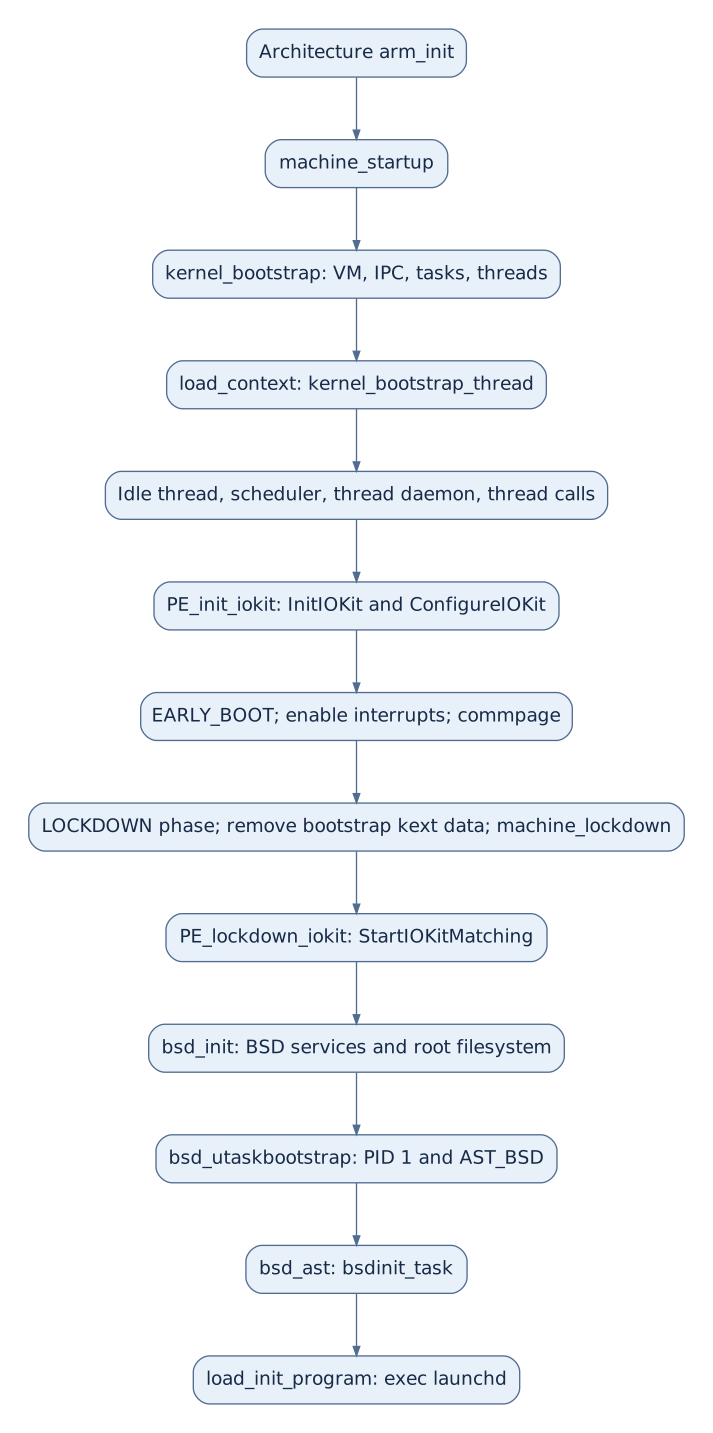
Mermaid source
flowchart TD
    A[Architecture arm_init] --> B[machine_startup]
    B --> C[kernel_bootstrap: VM, IPC, tasks, threads]
    C --> D[load_context: kernel_bootstrap_thread]
    D --> E[Idle thread, scheduler, thread daemon, thread calls]
    E --> F[PE_init_iokit: InitIOKit and ConfigureIOKit]
    F --> G[EARLY_BOOT; enable interrupts; commpage]
    G --> H[LOCKDOWN phase; remove bootstrap kext data; machine_lockdown]
    H --> I[PE_lockdown_iokit: StartIOKitMatching]
    I --> J[bsd_init: BSD services and root filesystem]
    J --> K[bsd_utaskbootstrap: PID 1 and AST_BSD]
    K --> L[bsd_ast: bsdinit_task]
    L --> M[load_init_program: exec launchd]
The diagram is the ARM64 path with IOKIT and MACH_BSD enabled; additional conditional stages are omitted. kernel_bootstrap_thread() creates the boot processor's idle thread, starts scheduler services and thread maintenance, runs thread-call initialization, binds to the boot processor during CPU startup, and creates clock/device services. I/O Kit initialization occurs before spllo() enables interrupts. General driver matching is deliberately delayed until after machine_lockdown() on ARM. startup.c, PE_init_iokit(), PE_lockdown_iokit().
InitIOKit() initializes I/O Kit/libkern infrastructure, creates the IOPlatformExpertDevice root nub from the device tree, and attaches it. ConfigureIOKit() applies defaults; StartIOKitMatching() starts its matching process. These distinct stages explain why “I/O Kit initialized” does not imply all devices have matched or started. Continue with drivers for those asynchronous lifecycles. IOStartIOKit.cpp.
BSD and the first userspace process
bsd_init() links kernel_task to kernproc, establishes process-zero credentials and state, initializes VFS/networking and other configured BSD facilities, performs autoconfiguration, mounts the root filesystem, and establishes its root vnode. It initializes signal state and calls bsd_utaskbootstrap(). Root selection and optional image/netboot branches precede process-one creation. bsd_init.c, initial state, root mount, bootstrap call.
bsd_utaskbootstrap() calls cloneproc(TASK_NULL, NULL, kernproc, CLONEPROC_INITPROC), obtains the reference to PID 1, clears transition locks, and sets AST_BSD on the new thread. It sets up the map/control-port defaults, enables task IPC, and clears the task's return wait. On that thread's BSD AST, the one-time bsd_init_done branch invokes bsdinit_task(). That routine names the process init, installs exception-to-signal reflection, performs pre-launchd VM initialization, and invokes load_init_program(). Creation and executable loading therefore occur at distinct execution points. bsd_utaskbootstrap(), bsd_ast() tail, bsdinit_task().
load_init_program() allocates scratch user memory and tries configured executable candidates. Release selection reaches /sbin/launchd; debug/development builds can try internal variants or launchdsuffix. A successful load_init_program_at_path() returns after loading the program; exhaustion panics. See process lifecycle and VFS for executable loading and path resolution. kern_exec.c.
x86_64 comparison
The x86 bootstrap includes a 32-bit protected-mode entry that establishes page tables and transitions to long mode, then enters vstart(). vstart() separates boot and secondary CPUs, performs early table/CPU setup, and invokes i386_init() or i386_init_slave() on the selected stack. i386_init() establishes clocks/CPU state, calls i386_vm_init(), attaches a bootstrap thread, and enters its architecture machine_startup(), which also calls common kernel_bootstrap(). Do not apply ARM's monitor arguments, exception stacks, or TTBR setup to this path. x86 start.s, vstart(), i386_init(), machine_startup().
The I/O Kit timing differs too: x86 PE_init_iokit() starts matching immediately because pre-lockdown work needs CPU enumeration through the ACPI stack. Its later PE_lockdown_iokit() waits for the CPU count to be established. The ARM matching-after-lockdown diagram above must not be applied unchanged to x86. pexpert/i386/pe_init.c.