ARM64 exception entry: from a vector to a kernel operation
Execution overview · Exception return · Exception levels and monitors
An exception does not directly call a C handler with a ready-made register structure. XNU first establishes which stack it can use, preserves registers before using them as temporaries, builds or locates an arm_context, and then calls a handler. The context and the stack on which the handler runs are often different allocations. Follow both pointers through locore.s and exception_asm.h.
This trace covers the AArch64 EL0-to-EL1 path and same-EL kernel exceptions in this checkout. EL1-to-monitor or hypervisor transitions have separate entry contracts, described in exception levels and monitors. Configuration macros below describe source alternatives; they do not identify the build configuration of an arbitrary Apple device.
How the CPU finds these vectors
The non-SPTM bootstrap installs ExceptionVectorsBase in VBAR_EL1, using the MSR_VBAR_EL1_X0 wrapper where protected-register configurations require it. With __ARM_KERNEL_PROTECT__, the first boot initially uses the kernelcache mapping; subsequent CPU resets can use the prepared fixed exception mapping. Later, arm_vm_prepare_kernel_el0_mappings() maps the pages spanning ExceptionVectorsBase through ExceptionVectorsEnd at ARM_KERNEL_PROTECT_EXCEPTION_START and updates the boot CPU's VBAR. The mapping is an execution bridge retained when the broader kernel mappings are removed; “EL0 mapping” here does not mean the vector instructions execute at EL0. start.s, VBAR wrapper, arm_vm_init.c.
The SPTM cold-start path instead writes ExceptionVectorsBase after rebasing/signing the image and before the FIXUPS_COMPLETE call. The adjacent comment says SPTM validates and locks VBAR after that call. The externally supplied domain-entry macro and monitor implementation are not present here. start_sptm.s.
ExceptionVectorsBase is aligned to 16 KiB with kernel protection and 4 KiB otherwise. Each implemented vector slot is aligned to 128 bytes. There are four categories for each of EL1 using SP0, EL1 using SP1, and lower-EL AArch64 execution: synchronous, IRQ, FIQ, and SError. The source does not implement a fourth group of lower-EL AArch32 entry handlers in this table; remaining space is padded. locore.s, table.
EL0 synchronous and IRQ vector slots
Lel0_synchronous_vector_64:
	MAP_KERNEL
	BRANCH_TO_KVA_VECTOR el0_synchronous_vector_64_long, 8

	.text
	.align 7
Lel0_irq_vector_64:
	MAP_KERNEL
BRANCH_TO_KVA_VECTOR el0_irq_vector_64_long, 9| Origin and selected stack | Synchronous | IRQ | FIQ | SError |
|---|---|---|---|---|
| EL1, SP0 | +0x000 |
+0x080 |
+0x100 |
+0x180 |
| EL1, SP1 | +0x200 |
+0x280 |
+0x300 |
+0x380 |
| Lower EL, AArch64 | +0x400 |
+0x480 |
+0x500 |
+0x580 |
Offsets follow the ordered .align 7 slots in ExceptionVectorsBase. The vector identifies the broad category before C runs. ESR decoding is needed to subdivide synchronous exceptions, not to decide whether this was an IRQ or FIQ. In a protected-kernel build the EL0 slots first execute MAP_KERNEL: set the low ASID bit in TTBR0_EL1, load TCR_EL1_BOOT, and execute the specified barriers. This changes the kernel-accessible translation configuration while preserving the task's translation-root relationship. MAP_KERNEL.
MAP_KERNEL: select the kernel ASID
	/* Switch to the kernel ASID (low bit set) for the task. */
	mrs		x18, TTBR0_EL1
	orr		x18, x18, #(1 << TTBR_ASID_SHIFT)
	msr		TTBR0_EL1, x18
BRANCH_TO_KVA_VECTOR then obtains thread → machine.CpuDatap → cpu_exc_vectors, indexes the long-handler address, and branches into the kernelcache mapping. cpu_data_init() supplies the address of exc_vectors_table; without kernel protection the macro uses a direct branch. HAS_MTE first clears PSTATE.TCO, restoring tag checking disabled by hardware on exception entry. branch macro, vector pointer initialization.
Structures and registers that carry the interrupted execution
| Object or register | Relevant contents | Meaning on this path |
|---|---|---|
TPIDR_EL1 |
Current thread * |
Used before calling C to find PCB, CPU data, and stack pointers; updated by set_thread_registers during context switch. |
thread.machine.upcb |
Pointer to arm_saved_state_t inside contextData |
Persistent user GPR state. Non-kernel threads get a separately allocated arm_context_t; kernel-task threads have no user PCB. |
thread.machine.kstackptr |
Authenticated kernel-stack top | Stack used for the user synchronous/SError handler and later user-return work. |
cpu_data.istackptr, excepstackptr |
Authenticated interrupt/exception-stack pointers | Per-CPU storage; separate from the thread's kernel stack and user PCB. |
arm_context.ss, .ns |
Integer/exception state, NEON state | Container consumed by assembly offsets and C handlers. |
arm_saved_state64 |
x[29], fp, lr, sp, pc, cpsr, far, esr, optional jophash |
Full integer register snapshot plus syndrome/address and a signature over selected control-flow state. |
ELR_EL1, SPSR_EL1 |
Exception return PC and interrupted PSTATE | Captured into pc and cpsr; later restored to hardware for eret. |
ESR_EL1, FAR_EL1 |
Syndrome and fault address | Interpretation depends on exception class; FAR is not a valid fault address for every exception. |
Definitions and setup: machine_thread, cpu_data, arm_saved_state64, arm_context, machine_thread_create, set_thread_registers. genassym.c derives TH_UPCB, ACT_CPUDATAP, ARM_CONTEXT_SIZE, and SS64_* from these C definitions; assembly offsets are not a second manually maintained layout. genassym.c.
There are also smaller arm_kernel_context/arm_kernel_saved_state structures for scheduler context switching. Do not confuse those callee-preserved kernel registers with the full asynchronous exception snapshot. thread_status.h, cswitch.s.
EL0 entry: preserve the user stack pointer, then stop using it
The lower-EL vector starts on the exception stack. EL0_64_VECTOR briefly saves x0/x1 there, authenticates and loads the current thread's PCB pointer, records SP_EL0 into the PCB, and temporarily makes SP0 point at that PCB. Once SPSel selects SP0, stores through sp write saved registers into the PCB; they do not write to the userspace stack. x0/x1 are restored from the exception stack before SP0 is selected. With kernel protection x18 has already been used as scratch and is zeroed before spilling. EL0_64_VECTOR, LOAD_USER_PCB.
EL0_64_VECTOR: save the user SP and select PCB storage
	stp		x0, x1, [sp, #-16]!					// Save x0 and x1 to the exception stack
#if __ARM_KERNEL_PROTECT__
	mov		x18, #0 						// Zero x18 to avoid leaking data to user SS
#endif
	mrs		x0, TPIDR_EL1						// Load the thread register
	LOAD_USER_PCB	dst=x0, src=x0, tmp=x1		// Load the user context pointer
	mrs		x1, SP_EL0							// Load the user stack pointer
	str		x1, [x0, SS64_SP]					// Store the user stack pointer in the user PCB
	msr		SP_EL0, x0							// Copy the user PCB pointer to SP0
	ldp		x0, x1, [sp], #16					// Restore x0 and x1 from the exception stack
	msr		SPSel, #0							// Switch to SP0
	stp		x0, x1, [sp, SS64_X0]				// Save x0, x1 to the user PCB
	stp		x2, x3, [sp, SS64_X2]				// Save x2, x3 to the user PCB
	mrs		x1, TPIDR_EL1						// Load the thread register
Next, the macro leaves the context address in x0 and the thread pointer in x1. The synchronous and SError vectors load the thread's kernel-stack top into the active SP; IRQ/FIQ vectors load the per-CPU interrupt-stack top. In both cases x0 still names the PCB. These pointer-loading macros authenticate the pointers when pointer authentication is compiled in, using the field's address and discriminator. stack selection, pointer authentication macros.
The synchronous long vector selects a kernel stack and handler
el0_synchronous_vector_64_long:
	EL0_64_VECTOR	sync
	EL0_64_VECTOR_SWITCH_TO_KERN_STACK
	adrp	x1, EXT(fleh_synchronous)@page			// Load address for fleh
	add		x1, x1, EXT(fleh_synchronous)@pageoff
	mov		x2, #(FLEH_DISPATCH64_OPTION_SYNC_EXCEPTION)
	b		fleh_dispatch64
fleh_dispatch64 receives x0=context, x1=first-level handler, x2=spill options. SPILL_REGISTERS KERNEL_MODE saves the remaining GPRs and q0–q31, FPSR, and FPCR, then captures ELR/SPSR/ESR/FAR. The early vector has already saved x0–x3 and SP. The name KERNEL_MODE selects the spill macro's calling convention; it does not mean the interrupted instruction necessarily ran in the kernel. dispatcher, spill implementation.
The default syndrome/return-state publication ends as follows. The option is intended to defer the two address stores, but the PAC path reuses its register before this test; see the configuration-sensitive spill-option caveat. The later explicit stores in fleh_synchronous remain visible in the SPTM path:
SPILL_REGISTERS: conditional PC/FAR publication
.ifnb \options_register
	tbnz	\options_register, SPILL_REGISTERS_OPTION_DONT_SPILL_ELR_FAR_SHIFT, Lspill_registers_skip_elr_far_\@
.endif /* options_register != NONE */

	str		x20, [x0, SS64_FAR]
	str		x22, [x0, SS64_PC]

.ifnb \options_register
Lspill_registers_skip_elr_far_\@:
.endif /* options_register != NONE */
	str		x21, [x0, SS64_ESR]
	str		w23, [x0, SS64_CPSR]
Under HAS_APPLE_PAC, the spill calls ml_sign_thread_state to populate jophash from selected control-flow values. Fatal spill options poison that signature. This is separate from authenticating the PCB pointer or the first-level-handler address. fleh_dispatch64 signs the handler address against the stack pointer and uses braa where enabled. After a user-origin snapshot it sanitizes FPCR and clears unused live GPRs, preventing arbitrary incoming values from becoming incidental kernel register state. It preserves the context in x21 and handler in x22, performs configured user/kernel accounting, and branches to the handler. signature and spill options, dispatcher sanitization, final dispatch.
HAS_ARM_FEAT_SME adds separate matrix-state handling. The EL0 macro saves SVCR and, when streaming mode is active, Z/P state before stopping streaming mode; ZA is handled during context switch. The NEON snapshot alone is therefore not the entire machine state on those configurations. SME entry.
Same-EL entry: the interrupted kernel stack stays meaningful
A kernel exception is still an EL1 exception even though execution jumps through a vector and may change stacks. Normal kernel execution here uses SP0; the initial exception-stack staging lets the entry path examine a potentially corrupt kernel SP before trusting it. EL1_SP0_VECTOR selects SP0, allocates ARM_CONTEXT_SIZE below the interrupted SP, saves x0–x3, records the original SP, initializes flavors, and gives x0 the frame address. Thus the full context is on the interrupted kernel stack, unlike the persistent user PCB. EL1_SP0_VECTOR.
EL1_SP0_VECTOR: allocate a context on the interrupted kernel stack
.macro EL1_SP0_VECTOR
	msr		SPSel, #0							// Switch to SP0
	sub		sp, sp, ARM_CONTEXT_SIZE			// Create exception frame
	stp		x0, x1, [sp, SS64_X0]				// Save x0, x1 to exception frame
	stp		x2, x3, [sp, SS64_X2]				// Save x2, x3 to exception frame
	add		x0, sp, ARM_CONTEXT_SIZE			// Calculate the original stack pointer
	str		x0, [sp, SS64_SP]					// Save stack pointer to exception frame
	INIT_SAVED_STATE_FLAVORS sp, w0, w1
	mov		x0, sp								// Copy saved state pointer to x0
.endmacro
For synchronous exceptions, the entry checks ESR classes that might indicate stack corruption, then CHECK_KERNEL_STACK validates SP_EL0 against the thread kernel stack or CPU interrupt stack. Failure constructs a fatal context on the exception stack and routes to fleh_invalid_stack. IRQ/FIQ paths first build the kernel frame and then switch handler execution to the interrupt stack. SPTM variants add a redzone check and a slow path that can map a stack redzone page after preserving registers. stack validation, synchronous entry, redzone handling, IRQ/FIQ entry.
SP1 vectors describe an exception while already using the exception stack. They are not the ordinary syscall path. Before its first potentially faulting memory access, the SP1 synchronous path checks whether ELR points back into its own critical spilling region and validates exception-stack bounds. If spilling cannot safely proceed it initiates configured lockdown and waits for the watchdog, with a special XNUPOST recovery path. Successful spilling normally reaches fatal handling; KTRR's narrowly recognized MMU-enable instruction-abort case and development debugger/test paths are explicit exceptions. IRQ/FIQ/SError on SP1 directly select panic handlers. SP1 vector, KTRR exception, SP1 C handler, SP1 panic handlers.
First-level synchronous handling and SPTM ordering
fleh_synchronous reads live ESR, FAR, and ELR, builds an unwindable frame, and calls sleh_synchronous(context, esr, far, did_initiate_panic_lockdown). The extra fourth argument matters on SPTM builds. There, FLEH_DISPATCH64_OPTION_SYNC_EXCEPTION requests deferred ELR/FAR spilling, subject to the option-register caveat. A kernel-origin exception passes the stackless lockdown eligibility check; user-origin entry checks whether lockdown is already active. The handler then explicitly stores PC/FAR into the context; the request alone does not prove that every configured earlier spill omitted those stores. spill option, SPTM synchronous entry, kernel check.
Synchronous handler: release PC/FAR after the SPTM gate
Lfleh_synchronous_continue:
	/* We've had our chance to lockdown, release PC/FAR */
	str		x25, [x0, SS64_PC]
	str		x2,  [x0, SS64_FAR]
After lockdown, new user synchronous exceptions wait for debugger synchronization instead of continuing ordinary handling. These are visible XNU-side control-flow rules; they do not expose SPTM's own implementation. Legacy PPL dispatch fragments have missing transition pieces and deliberate configuration-error directives in this public tree. See exception levels and monitors before trying to assemble a complete monitor crossing from these labels. blocked_user_sync_exception, PPL return fragment.
C dispatch: an SVC, a page fault, and a debug trap are different routes
sleh_synchronous extracts ESR_EC(esr) and independently checks the saved CPSR to determine whether the interrupted context was user or kernel. It validates the context, records tracing/accounting, handles platform errors before possible CPU migration, and inherits interrupt masks from the saved state before ordinary dispatch. For user exceptions it sanitizes the saved FAR: it is retained only for classes where it is meaningful, and cleared for synchronous external aborts where validity cannot be trusted. sleh_synchronous.
| Syndrome class or vector | Next operation | Relevant distinction |
|---|---|---|
ESR_EC_SVC_64 |
handle_svc |
Requires a 64-bit user state. The software call number comes from x16, not the ESR immediate. |
DABORT_EL0, IABORT_EL0 |
handle_abort → handle_user_abort |
Separate syndrome inspectors derive access type, then VM or user exception policy decides the result. |
DABORT_EL1 |
handle_kernel_abort |
May resolve kernel paging or recover from a protected copy; unresolved faults can panic. |
IABORT_EL1 |
Kernel instruction-fetch panic | Apart from explicit expected-fault testing, not the normal user-page-fault route. |
BRK_AARCH64 |
Kernel breakpoint handler or user breakpoint exception | Saved execution mode selects the policy. |
| Debug step/watchpoint classes | Class-specific handlers | Kernel watchpoints may disable debug state and resume; not every debug event becomes a user breakpoint RPC. |
| IRQ/FIQ vector | sleh_irq / sleh_fiq |
Dispatch is selected by the vector, outside this synchronous class switch. |
| SError vector | sleh_serror → arm64_platform_error |
Asynchronous platform-error path, separate from a synchronous VM abort. |
Sources: class switch, SVC-number accessor, x16 register definition, IRQ/FIQ, SError.
handle_svc first handles the platform trap and updates cached credentials. Negative call numbers select Mach traps, with absolute/continuous time handled directly; nonnegative numbers select BSD syscall handling. mach_syscall negates the number, validates mach_trap_table, gathers arguments, runs configured filters, calls the selected function, and places its result in saved x0. An IPC request can enter through mach_msg2_trap, but its Mach message ID is decoded later by the destination server. handle_svc, mach_syscall, Mach IPC.
handle_svc: Mach and BSD dispatch
	if (trap_no < 0) {
		switch (trap_no) {
		case MACH_ARM_TRAP_ABSTIME:
			handle_mach_absolute_time_trap(state);
			return;
		case MACH_ARM_TRAP_CONTTIME:
			handle_mach_continuous_time_trap(state);
			return;
		}

		/* Counting perhaps better in the handler, but this is how it's been done */
		thread->syscalls_mach++;
		mach_syscall(state);
	} else {
		/* Counting perhaps better in the handler, but this is how it's been done */
		thread->syscalls_unix++;
		p = get_bsdthreadtask_info(thread);

		assert(p);

		unix_syscall(state, thread, p);
	}
BSD unix_syscall uses sysent, with an indirect-call case when x16 is zero and the syscall number is in x0. Its return encoder handles success, errno/carry, instruction restart, and already-prepared state. Those modifications are important to the authenticated return. systemcalls.c, number decoding, return encoding.
For aborts, handle_abort separates decoding from policy: instruction faults request read/execute; data faults inspect WnR and cache-maintenance semantics to choose read or read/write. On a serviceable user VM fault, handle_user_abort strips top-byte tags for non-execute access, tries arm_fast_fault for non-translation faults, then calls vm_fault with THREAD_ABORTSAFE. KERN_SUCCESS or KERN_ABORTED returns to the exception-return path; other results continue into configured fatal policies or Mach exception triage. No pc += 4 is applied to a resolved page fault: resuming the saved state retries the instruction. inspectors, user abort.
handle_user_abort: the VM call and successful return
		if (result != KERN_SUCCESS) {

			{
				/* We have to fault the page in */
				result = vm_fault(map, vm_fault_addr, fault_type,
				    /* change_wiring */ FALSE, VM_KERN_MEMORY_NONE, THREAD_ABORTSAFE,
				    /* caller_pmap */ NULL, /* caller_pmap_addr */ 0);
			}
		}
		if (thread->t_rr_state.trr_fault_state != TRR_FAULT_NONE) {
			thread_reset_pcs_done_faulting(thread);
		}
		if (result == KERN_SUCCESS || result == KERN_ABORTED) {
			return;
		}
Kernel data aborts choose kernel_map if the address is kernel, no thread exists, or there is no recovery entry; a permitted user-address copy uses the thread map. A recovery entry can cause handle_kernel_abort_recover to write an error into x0 and replace the saved PC with a validated copyio recovery address. This remains an EL1 return to kernel code. It is not a user Mach exception. kernel abort, map selection, recovery-state update. The VM guide explains paging; the IPC exception guide follows failures that reach exception_triage.
Interrupt bookkeeping before the C callback
BEGIN_INTERRUPT_HANDLER increments per-CPU interrupt counters and the current thread's preemption count, then publishes the saved context in cpu_int_state. The context may be a user PCB or a kernel-stack frame; the handler stack is the CPU interrupt stack in either case. This publication allows interrupt-time code to identify the interrupted state without pretending an interrupt owns a new thread. locore.s.
Interrupt prologue: preemption and interrupted-context publication
	/* Increment preempt count */
	ldr		w1, [x22, ACT_PREEMPT_CNT]
	add		w1, w1, #1
	str		w1, [x22, ACT_PREEMPT_CNT]
	/* Store context in int state */
	str		x0, [x23, CPU_INT_STATE] 			// Saved context in cpu_int_state
.endmacro
sleh_irq calls PE_handle_ext_interrupt on USE_APPLEARMSMP, otherwise the registered IOInterruptHandler with its target/refCon/nub/source. sleh_fiq checks configured fast IPI, timer, then performance-monitor sources; the fast-IPI branch acknowledges the pending bit and executes ISB before cpu_signal_handler to close a lost-notification window. Its residual path calls rtclock_intr(TRUE) while explicitly acknowledging that not every residual FIQ is known to be a timer. IRQ dispatch, FIQ classification and acknowledgment.
The C epilogue finishes accounting and tracing. Assembly END_INTERRUPT_HANDLER clears cpu_int_state, decrements preemption count, returns to the thread kernel-stack top, and issues sevl for a CPU-local wake event. IRQ/FIQ then set x28 to request a commpage PFZ check on user return; synchronous/SError returns clear it. The saved CPSR chooses whether the common dispatcher resumes EL0 or EL1. epilogue, return dispatcher.
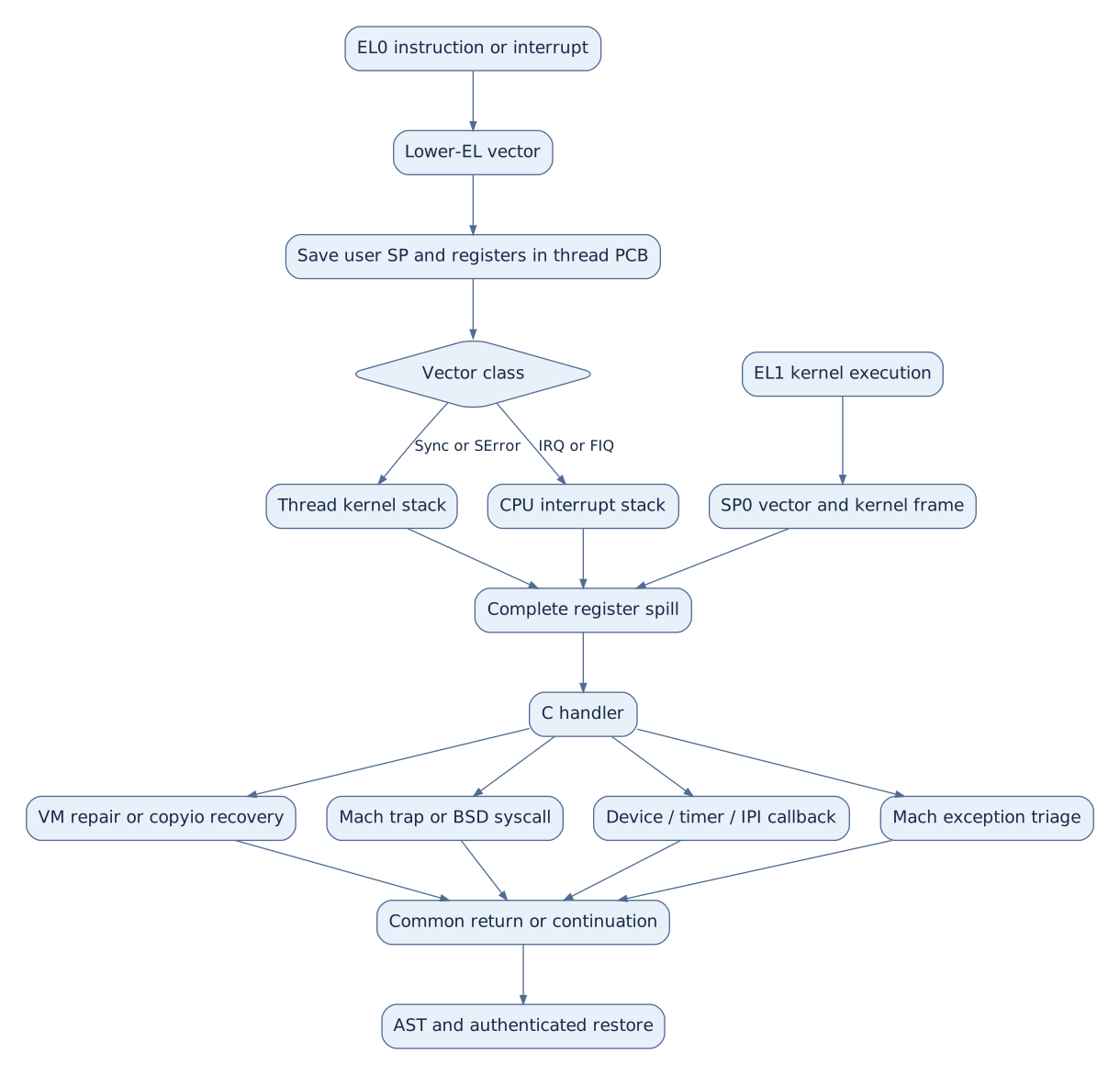
Mermaid source
flowchart TD
    U[EL0 instruction or interrupt] --> V[Lower-EL vector]
    K[EL1 kernel execution] --> KV[SP0 vector and kernel frame]
    V --> P[Save user SP and registers in thread PCB]
    P --> S{Vector class}
    S -->|Sync or SError| KS[Thread kernel stack]
    S -->|IRQ or FIQ| IS[CPU interrupt stack]
    KV --> SP[Complete register spill]
    KS --> SP
    IS --> SP
    SP --> C[C handler]
    C --> VM[VM repair or copyio recovery]
    C --> Trap[Mach trap or BSD syscall]
    C --> IRQ[Device / timer / IPI callback]
    C --> Exc[Mach exception triage]
    VM --> R[Common return or continuation]
    Trap --> R
    IRQ --> R
    Exc --> R
    R --> AST[AST and authenticated restore]
Sources inspected and limits
The trace follows vector bodies, spill/pointer-authentication macros, selected boot installation, PCB allocation, synchronous dispatch, abort handling, IRQ/FIQ bookkeeping, and the corresponding return path. Excerpts preserve actual source lines; they are not pseudocode. It does not audit every syndrome, every SoC register workaround, matrix-state lifecycle, panic-lockdown policy, or external monitor code, and it was not validated by booting a kernel. For a reproducible reading route start at EL0_64_VECTOR, follow x0 and sp independently through fleh_dispatch64, then select one branch of sleh_synchronous before reading exception return.