Coverage instrumentation: device, thread and buffer lifetime
Guide index · Observability · Build selection and tests · Completion and failure · Sanitizer runtime
KCOV dispatches compiler-inserted coverage callbacks; KSANCOV connects selected callbacks from one kernel thread to shared buffers exposed through /dev/ksancov. Opening the device, configuring a buffer, attaching a thread, enabling recording, and closing the descriptor are different operations. This chapter follows their implementation in xnu-12377.121.6, including what a trace can omit and how close stops a callback from retaining a freed device.
The discussion is source based. It does not build or run an instrumented kernel, infer coverage in a release image, or describe a campaign for generating inputs. Its concrete observation path is the supplied test that records around getppid() and then reads the trace.
1. Runtime availability and compiler instrumentation are separate
CONFIG_KCOV, CONFIG_KSANCOV and CONFIG_STKSZ select the dispatcher, device collector and stack-size support independently in the sanitizer source list. config/MASTER declares the corresponding options and the ksancov_init_dev pseudo-device initializer. The build's KCOV_RUNTIME list contains KASAN, and explicitly rejects adding RELEASE to that runtime list. These are source/build selection facts, not a statement that every kernel named KASAN has identical instrumentation. Source selection, configuration declarations, runtime selection.
The separate KSANCOV=1 build setting adds -fsanitize-coverage=trace-pc-guard,trace-cmp and an architecture-specific coverage ignorelist to XNU's compiler flags. Coverage runtime exports are also selected by kernel configuration. The runtime can consequently exist for instrumented modules without the kernel itself having those compiler hooks. Compiler flags, runtime exports, coverage symbol products.
The code exposes kern.kcov.available from the runtime and a separate kern.kcov.sancov_compiled determined by __has_feature(coverage_sanitizer). The first supplied test requires both values to be one; the module tests instead require on-demand support. Reading one availability bit is not evidence that every source file contains callbacks. Sysctls, test prerequisites.
Initialization also has runtime gates. An early-boot startup routine initializes KSANCOV and enables the boot CPU's coverage data; kcov_start_cpu() enables the per-CPU field for subsequent CPUs. Newly created threads initialize their recursion-disable count and collector/stack state. Global callback dispatch starts with kcov_enabled == 0 until a consumer enables it. Boot and global state, thread initialization, thread creation caller, CPU startup caller.
2. The device is a control endpoint, not the trace itself
ksancov_init_dev() registers a character-device switch and creates a cloned ksancov node owned by root/wheel with mode 0666. The ksancov_open() body does not impose a separate root-UID or entitlement check. Ordinary device-node access and the presence of this configured runtime remain distinct from that body. The node's root owner must not be mistaken for a root-only mode. Registration and mode, open body.
The clone helper searches up to KSANCOV_MAX_DEV == 128 minor slots. Open validates the minor, takes the global device-table lock exclusively, rejects an occupied slot, allocates a zeroed ksancov_dev, and publishes it in ksancov_devs[minor]. The new object has mode NONE, its own mutex, a default capacity field and no attached thread. Clone selection, device creation, open publication.
The first open also creates the global edge-to-PC map with KMA_PERMANENT. Its size and ke_nedges capture the current nedges; it is shared across device instances. The edge map is not allocated separately for each attached thread, and the shown path does not resize it on every later guard registration. On this allocation's failure, open returns ENOMEM after having assigned the device-table slot; the body has no local unpublication rollback in that branch. First-open map construction.
The character-device switch provides ioctl control. Its read/write and mmap entries are unsupported stubs; buffer mapping is performed by a mapping ioctl that calls VM directly. Calling the interface “an mmap file” would hide the implemented dispatch. Device operations.
| Object or field | State and ownership |
|---|---|
ksancov_devs[minor] |
Discoverable device pointer, protected by ksancov_devs_lck |
ksancov_dev.lock |
Serializes configuration, mapping and attachment operations on this device |
Device mode, buffer pointer, sz, maxpcs |
Kernel-side recording configuration and allocation extent |
Thread kcov_data.ktd_device |
Callback's route to the attached device; initially null |
Device thread |
Referenced attached thread, released during detach |
Shared kh_enabled |
User-controlled recording switch for a specific buffer |
Shared kt_head, kt_entries |
Trace reservation position and records |
Global ksancov_edgemap |
Guard-index-to-PC observations, exposed read-only |
Device layout, per-CPU/thread data.
Mermaid source
flowchart LR
    F["Open device minor"] -->|"global table lookup under rw lock"| D["ksancov_dev"]
    D -->|"owns kernel allocation"| B["Trace or counters buffer"]
    U["Caller VM map"] -->|"shared mapping"| B
    D -->|"holds thread reference"| T["Attached thread"]
    T -->|"ktd_device callback route"| D
    D -->|"optional second allocation"| C["Comparison buffer"]
    U -->|"read-only mapping"| E["Global edge map"]
    G["Instrumented guard"] -->|"first observed PC"| E
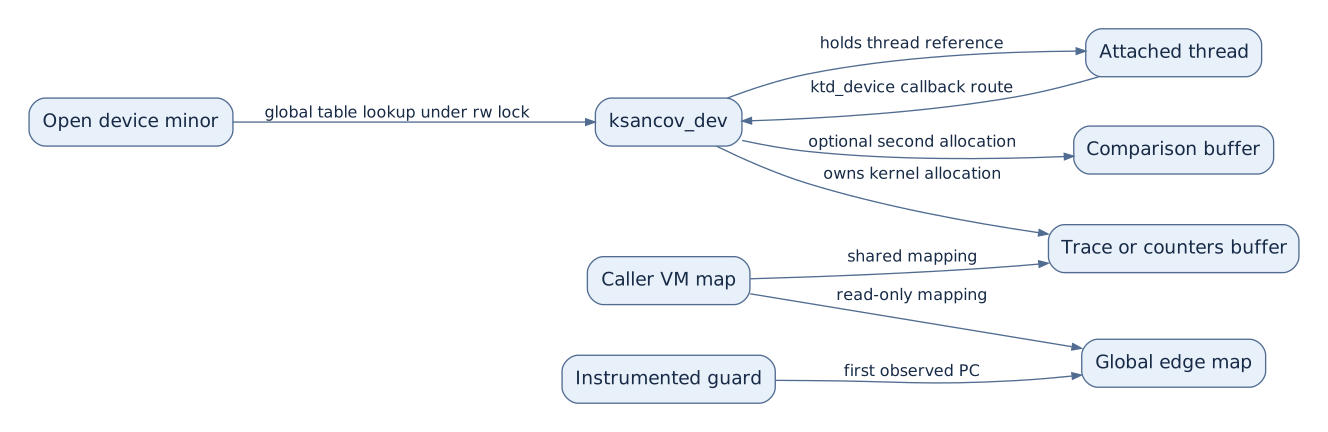
The arrows distinguish device/thread references from VM aliases. The trace buffer's address in the kernel and its mapped address in the caller are different virtual addresses for shared storage; neither is a device DMA address.
3. Configuration selects one primary representation
ksancov_ioctl() holds the global device-table lock shared from lookup through command completion. Commands changing a device's primary mode, mapping or attachment additionally take d->lock. Close must acquire the global lock exclusively before removing a device, so it cannot remove that instance while one of these shared-lock ioctl bodies is using it. Lookup and mode commands, unlock tail.
| Primary mode | Allocation and record meaning |
|---|---|
KS_MODE_TRACE |
Trace header plus requested count of uintptr_t PCs |
KS_MODE_COUNTERS |
Counter header plus one byte per edge in the global map's recorded edge count |
KS_MODE_STKSIZE |
Trace header plus PC/stack-size records; actual recording case requires CONFIG_STKSZ |
KS_MODE_NONE |
Newly opened, not yet configured; attachment and ordinary mapping reject it |
Trace allocation checks multiplication-plus-header addition for overflow, then calls kmem_alloc(KMA_DATA_SHARED | KMA_ZERO). It sets the magic, zero head, disabled header, requested capacity and kernel-side mode/extent. A second primary configuration returns EBUSY. Counter allocation follows the same single-primary-mode rule and initializes disabled, zeroed hit storage. Trace allocation, counter allocation.
The common trace representation makes the mutable header and records visible together:
Source: san/coverage/kcov_ksancov_data.h, lines 60–68
typedef struct ksancov_trace {
	ksancov_header_t kt_hdr;         /* header (must be always first) */
	uint32_t         kt_maxent;      /* Maximum entries in this shared buffer. */
	_Atomic uint32_t kt_head;        /* Pointer to the first unused element. */
	uint64_t         kt_entries[];   /* Trace entries in this buffer. */
} ksancov_trace_t;

/* PC tracing only records PCs */
typedef uintptr_t ksancov_trace_pc_ent_t;
The PC producer uses the kernel device's maxpcs for its capacity checks. The user helper uses the shared kt_maxent to bound the reported head. These are different fields even though allocation initializes them from the same requested count. Trace capacity is a count of records; d->sz is bytes. The source's KSANCOV_MAX_PCS is the initial default field, not a separate upper-bound check in ksancov_trace_alloc(). Capacity initialization, allocation assignments, reader cap.
Comparisons use an optional second allocation and independent cmps_mode, cmps_sz and enabled header. Scalar comparisons record PC, type and two values; function-comparison records can occupy multiple fixed-size slots. Serialized testcases use another optional buffer for diagnostic retention. They do not replace the required primary mode used by thread attachment. Comparison allocation, comparison representation, testcase allocation.
4. The mapping ioctl installs a shared VM alias
For trace/counters, ksancov_map() verifies that the chosen mode has a buffer and asks for read/write protection. The edge-map ioctl asks for read-only protection. Comparison and testcase buffers are also mapped read/write. Missing configuration yields EINVAL; failure to create the VM alias becomes ENOMEM at these ioctl helpers. Primary mapping, edge mapping, comparison mapping, testcase mapping.
ksancov_do_map() first creates a named memory entry over the kernel allocation using MAP_MEM_VM_SHARE | prot. It maps that entry into get_task_map(current_task()) with no copy, equal current/maximum protections and shared inheritance:
Source: san/coverage/kcov_ksancov.c, lines 698–708
	kr = mach_vm_map_kernel(get_task_map(current_task()),
	    &user_addr,
	    size,
	    0,
	    VM_MAP_KERNEL_FLAGS_ANYWHERE(),
	    mem_entry,
	    0,
	    FALSE,
	    prot,
	    prot,
	    VM_INHERIT_SHARE);
The temporary memory-entry port is released after the mapping attempt, on both success and failure. A successful mapping owns the VM relationship needed after that local reference is dropped. The ioctl returns the user virtual address and the recorded buffer byte size. It does not return a kernel pointer that user code may dereference. Entry creation and release, returned descriptor, VM named-entry background.
The current task for mapping and the current thread for attachment are chosen by separate calls. Mapping does not attach a thread; attachment does not set kh_enabled. A shared mapping also has a VM lifetime separate from the file descriptor: close removes the device's kernel mappings, but the shown close path does not issue a mach_vm_deallocate() for the caller's alias. Mapping versus attach commands, buffer release.
5. Attachment holds a thread reference; start only changes a bit
Despite its name, KSANCOV_IOC_START attaches current_thread(). The ioctl does not use its argument as a supplied thread port. The helper rejects an unconfigured device, rejects a non-current thread, and returns EBUSY if the current thread already has a collector. Reattaching the same thread is therefore not an idempotent start operation. Ioctl dispatch, attachment checks.
If the device previously belonged to another thread, attachment detaches that old association before installing the current one. It takes a thread reference, publishes the callback route, and increments both the KSANCOV attachment count and the shared KCOV enable count:
Source: san/coverage/kcov_ksancov.c, lines 938–943
	d->thread = th;
	thread_reference(d->thread);

	os_atomic_store(&data->ktd_device, d, relaxed);
	os_atomic_add(&ksancov_enabled, 1, relaxed);
	kcov_enable();
The supplied userspace ksancov_start() and ksancov_stop() helpers do no ioctl at all. They write the enabled field in the already shared buffer:
Source: san/tools/ksancov.h, lines 383–397
static inline int
ksancov_start(void *buf)
{
	ksancov_header_t *hdr = (ksancov_header_t *)buf;
	atomic_store_explicit(&hdr->kh_enabled, 1, memory_order_relaxed);
	return 0;
}

static inline int
ksancov_stop(void *buf)
{
	ksancov_header_t *hdr = (ksancov_header_t *)buf;
	atomic_store_explicit(&hdr->kh_enabled, 0, memory_order_relaxed);
	return 0;
}
Stopping one buffer does not detach its thread, decrement either global count, disable a module's compiler gate, or stop a separately enabled comparison buffer. ksancov_reset() clears a trace head or zeroes counter bytes according to the magic; it is another userspace buffer operation rather than a kernel teardown barrier. Reset helper.
The selected test's normal order is configure, map, attach, reset, start, execute an operation on that thread, stop, then inspect. This ensures the observation is associated with the intended thread and buffer. Other kernel threads spawned or awakened by the operation do not acquire that device association automatically. Concrete test sequence, thread-local lookup.
6. Compiler callbacks pass context and recursion gates
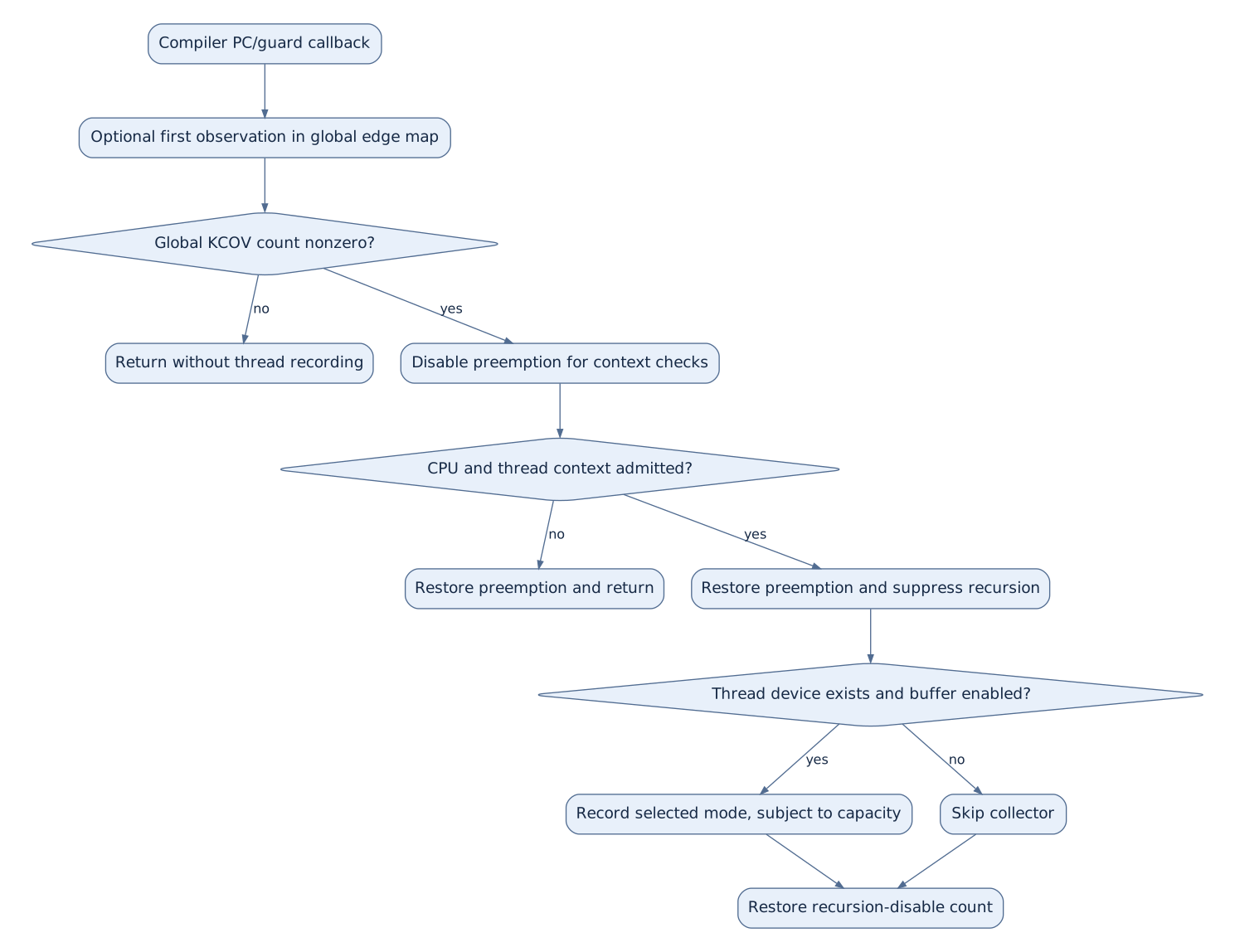
__sanitizer_cov_trace_pc_guard() captures its return address and a local stack address, then calls the common trace_pc_guard(). Before the ordinary recording prologue, the latter invokes kcov_ksancov_trace_guard() to populate the global edge map if one exists and this nonzero guard has not yet been seen. This edge observation is separate from per-thread trace recording and can occur even when that thread has no active trace buffer. ABI entry, dispatch ordering, edge observation.
The ordinary prologue first tests the global enable count. It disables preemption while consulting the CPU enable field and rejects PPL and interrupt contexts, a missing current thread, or a nonzero thread recursion-disable count. It restores preemption before returning the per-thread data. The dispatcher then increments ktd_disabled around stack and KSANCOV recording calls, restoring it afterward. The callback's internal helper calls therefore do not recursively record through that same thread's ordinary path. Context gates, recursion counter, dispatch body.
Mermaid source
flowchart TD
    A["Compiler PC/guard callback"] --> B["Optional first observation in global edge map"]
    B --> C{"Global KCOV count nonzero?"}
    C -->|no| X["Return without thread recording"]
    C -->|yes| D["Disable preemption for context checks"]
    D --> E{"CPU and thread context admitted?"}
    E -->|no| F["Restore preemption and return"]
    E -->|yes| G["Restore preemption and suppress recursion"]
    G --> H{"Thread device exists and buffer enabled?"}
    H -->|yes| I["Record selected mode, subject to capacity"]
    H -->|no| J["Skip collector"]
    I --> K["Restore recursion-disable count"]
    J --> K
The diagram selects PC collection. Comparison callbacks reuse the prologue and recursion protocol but have a separate comparison-buffer enabled check. The indirect-call coverage entry is a no-op in this source. Guard initialization assigns numeric IDs up to KSANCOV_MAX_EDGES; USE_PC_TABLE is defined as zero, so the alternate PC-table initializer is not the selected implementation. Comparison dispatch, indirect-call boundary, guard IDs, PC-table branch.
The ARM64 ignorelist excludes bootstrap, PPL-helper and PAN-disabling paths that cannot safely enter the generic callback. The dispatcher comment explains why it relies on excluding PAN-disabled paths instead of reading PAN on every invocation. A trace's absent edge can consequently mean absent instrumentation or excluded context, as well as an unexecuted branch. ARM64 exclusions, PAN rationale.
7. Trace head reserves space before the record is written
For PC mode, the collector forms VM_KERNEL_UNSLIDE(caller) - 1 and appends it. This is an unslid call-site-related address, not an instruction-count sample or a wall-clock timestamp. The producer checks capacity, atomically reserves an index with relaxed ordering, checks the returned index, and then writes the PC. Mode dispatch.
Source: san/coverage/kcov_ksancov.c, lines 221–231
	if (os_atomic_load(&dev->trace->kt_head, relaxed) >= dev->maxpcs) {
		return; /* overflow */
	}

	uint32_t idx = os_atomic_inc_orig(&dev->trace->kt_head, relaxed);
	if (__improbable(idx >= dev->maxpcs)) {
		return;
	}

	ksancov_trace_pc_ent_t *entries = (ksancov_trace_pc_ent_t *)dev->trace->kt_entries;
	entries[idx] = pc;
The trace is a bounded append buffer: after it fills, subsequent events are dropped rather than overwriting old entries or blocking the kernel operation. The head represents reservation progress. Because it advances before the store and uses relaxed ordering, it is not by itself a release publication of a completed record to an independently concurrent reader. The userspace head helper uses an acquire load and clamps to kt_maxent, but that does not change the producer's order. The supplied test reads after its traced thread has returned to userspace and stopped its buffer. Reader helpers, test stop/read order.
Counters instead index by the masked guard ID and increment an eight-bit hit count only below KSANCOV_MAX_HITS. They lose exact frequency once saturated and do not preserve execution order. The separate edge map associates observed IDs with PCs and marks guards with GUARD_SEEN; a counter array alone is not a list of executed addresses. Saturating producer, edge association.
With CONFIG_STKSZ, the selected stack-record case stores a PC and ktd_stksz.kst_stksz. The stack monitor has its own stksz_enabled control; choosing a KSANCOV stack buffer does not automatically enable that monitor. Its update body requires the observed stack address to be within the thread stack, then computes used bytes as stack end minus that address. Threshold/delta Kdebug and DTrace events are additional consumers. These guarded bodies were read, not build-tested as a stack-monitor configuration. Stack record, mode guard, monitor control and measurement.
Comparison recording independently checks attachment, comparison-buffer presence/enabled state, supported mode and capacity. Scalar entries contain the two values and comparison type. Function logging checks a combined byte limit, can require that the caller belongs to an instrumented/gated region, and reserves a rounded number of slots for its variable-length data. This chapter uses that distinction to explain the test's cursor walk; it does not audit every comparison-hook family or variable-record boundary. Scalar producer, function producer.
8. Detach and close establish different lifetime boundaries
ksancov_detach() first clears the attached thread's ktd_device pointer. If detaching a different thread, it calls thread_wait(thread, TRUE) before dropping the global enable counts and its thread reference. The wait implementation waits until the thread is neither on a CPU nor runnable; it is not a thread-termination operation. Detach from the current thread skips that wait. Detach, scheduler wait.
Close adds device-discovery exclusion before that thread synchronization. Its exclusive device-table acquisition waits for existing shared-lock ioctl users. It removes the table entry and unlocks, then clears enabled fields, detaches and frees the device. The callback does not take d->lock; the detached thread route and wait are the relevant protection for that participant. Ioctl lifetime lock, close.
Source: san/coverage/kcov_ksancov.c, lines 1283–1291
	if (d->mode != KS_MODE_NONE && d->hdr != NULL) {
		os_atomic_store(&d->hdr->kh_enabled, 0, relaxed); /* stop tracing */
	}
	if (d->cmps_mode != KS_CMPS_MODE_NONE && d->cmps_hdr != NULL) {
		os_atomic_store(&d->cmps_hdr->kh_enabled, 0, relaxed); /* stop tracing cmps */
	}

	ksancov_detach(d);
	free_dev(d);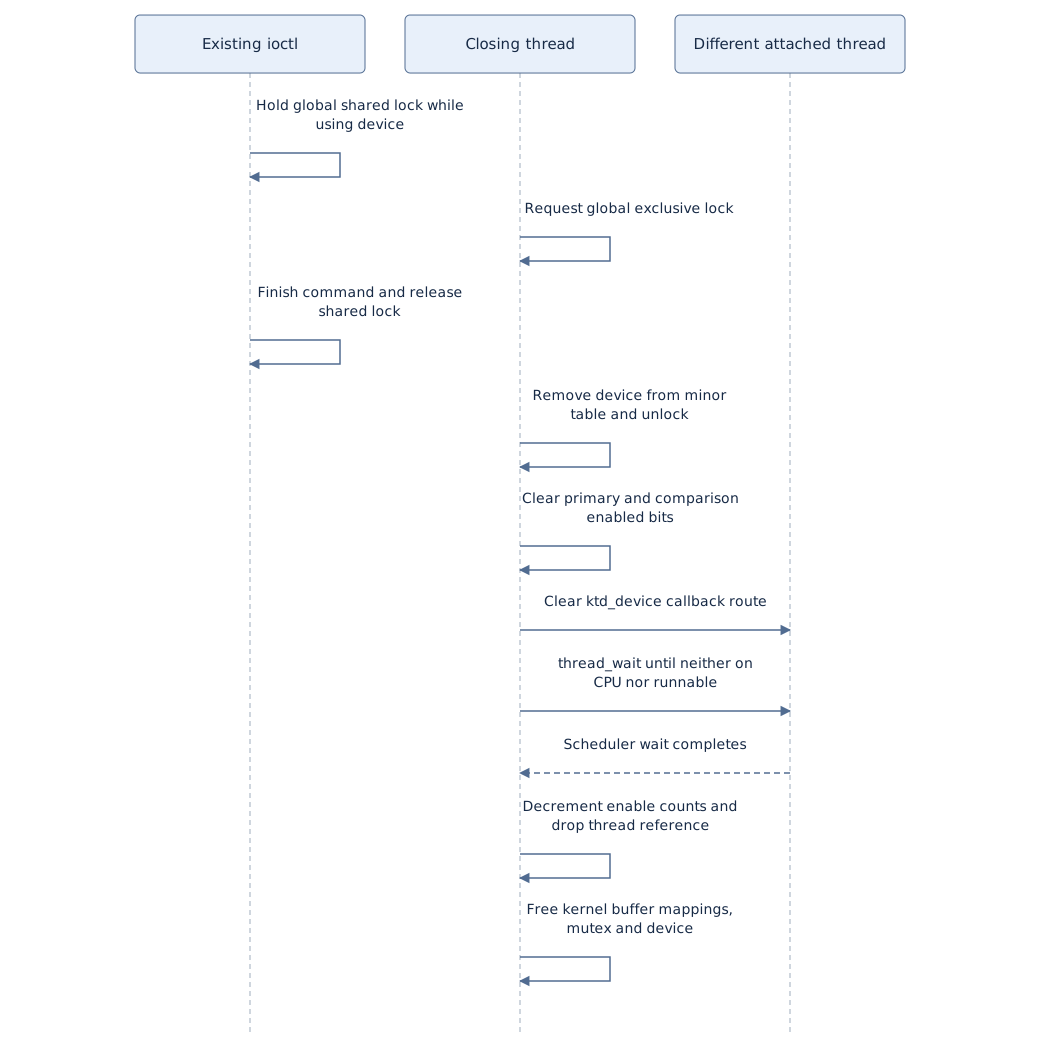
Mermaid source
sequenceDiagram
    participant I as Existing ioctl
    participant C as Closing thread
    participant T as Different attached thread
    I->>I: Hold global shared lock while using device
    C->>C: Request global exclusive lock
    I->>I: Finish command and release shared lock
    C->>C: Remove device from minor table and unlock
    C->>C: Clear primary and comparison enabled bits
    C->>T: Clear ktd_device callback route
    C->>T: thread_wait until neither on CPU nor runnable
    T-->>C: Scheduler wait completes
    C->>C: Decrement enable counts and drop thread reference
    C->>C: Free kernel buffer mappings, mutex and device
This schedule selects close by a different thread and an ioctl already holding the shared lock. After table removal, a subsequent lookup cannot obtain this old device through that slot. A new open may eventually use the minor for a different object; the closing thread continues to own its detached local pointer. An already entered callback is handled through the detach/wait sequence rather than through the table lookup lock.
free_dev() releases the configured kernel trace/counter allocation, optional comparison buffer and optional testcase allocation, then destroys the mutex and frees the device. It does not free the permanent global edge map. Stopping a shared buffer alone performs none of this cleanup. Free path, permanent map allocation.
9. On-demand gates control callback invocation, not attachment
KSANCOV initializes on-demand support from ksancov.on_demand, with support enabled in the initial configuration. Guard registration can bookmark a loaded module only when support and initialization are ready, a module summary exists, and its image contains __DATA,__sancov_gate. The runtime records its bundle name, guard range, gate address and unslid text range. It cannot add compiler instrumentation to arbitrary uninstrumented code. Boot configuration, module registration.
The on-demand ioctl holds ksancov_od_lck while locating a registered module and getting/setting its gate or reporting a guard range. A PC-to-bundle query searches recorded text intervals. Missing modules/ranges and unsupported operations produce EINVAL. The gate is module state shared across device instances, not a per-thread trace enabled flag. Command implementation.
The comparison-function path also consults whether its caller is in the instrumented kernel or an enabled registered module. That decision is separate from buffer capacity, thread attachment and kh_enabled. A module can invoke callbacks while no thread collector accepts them, and an enabled buffer cannot record a callback the compiler gate suppresses. Caller-region decision, function-comparison call site.
10. What the supplied tests establish
| Source test | Actual assertions and boundaries |
|---|---|
kcov_ksancov_mode_trace |
Requires runtime and kernel instrumentation sysctls; configures/maps/attaches a trace, records around getppid(), expects a positive head and accesses entry zero, then checks close success |
kcov_ksancov_mode_trace_kext |
Requires on-demand support and the selected iPhone platform; enables the IOSurface module gate, opens/closes its user client, disables recording/gate, and expects a nonempty PC trace |
kcov_ksancov_mode_trace_cmp_kext |
Also configures and enables a comparison buffer, expects both traces nonempty, walks scalar/variable comparison records and asserts the cursor ends exactly at the head |
kcov_ksancov_testcases |
Checks returned mapping size and fixed testcase-buffer size, writes a small record and advances the ring head; invokes serial logging without asserting its return because boot configuration can disable it |
PC test, module PC test, comparison test, testcase-buffer test.
These tests do not assert exact PCs for getppid(), complete branch coverage, counter saturation, the stack-size mode, failure rollback, or close racing an active callback on another thread. A nonempty trace can include surrounding instrumented work; the test does not attribute every entry to one syscall body. The IOSurface provider is an external boundary: the tests and local KSANCOV transport are present, while that service's full implementation is not supplied here.
The reviewed sources cover device admission/configuration/mapping, primary trace/counter production, thread attachment/detachment, callback context checks, close cleanup, on-demand registration/control, selected comparison paths and the test assertions above. Serialized testcase panic dumping and every compiler/runtime hook were not exhaustively traced. Build selection, byte-exact excerpts, local links and standalone diagrams were checked for this documentation; no kernel configuration was compiled and no runtime test was executed.