Executable pages and UPL I/O: permission, copies, and backing lifetime
VM index · Executable-memory policy · UPL gathering and completion · User buffer to DMA completion
Preparing executable memory for I/O can return pages containing a copy of the requested bytes rather than the physical pages underlying the original user mapping. This chapter follows that decision through vm_map_create_upl() in xnu-12377.121.6: map-entry admission, temporary kernel storage, byte-offset changes, recursive UPL gathering and completion after the temporary mapping has gone. It separates common code, CONFIG_SPTM and non-macOS policy; the worked example selects ARM64 with 16 KiB system VM pages and 16 KiB source-map pages.
1. I/O direction and CPU permission describe different operations
vm_map_create_upl() is an internal map-to-backing interface. Concrete callers include IOGeneralMemoryDescriptor::wireVirtual(), the filesystem-facing vm_map_get_upl() wrapper and development VM tests. It can fault, allocate and wait; it is not an interrupt-context operation merely because the resulting pages will be used by a device. The caller supplies the map in which the input address has meaning. Descriptor call, wrapper, test caller.
| I/O intention | UPL input flag | Concrete IOKit direction | Consequence for backing |
|---|---|---|---|
| Consumer reads existing host bytes | UPL_COPYOUT_FROM set |
kIODirectionOut; kIODMAMapReadAccess |
Read-only I/O request; selected executable/debug mappings require a copy |
| Consumer may write host bytes | UPL_COPYOUT_FROM clear |
kIODirectionIn or kIODirectionOutIn |
Requires map-entry write permission, with additional SPTM restrictions |
The flag describes the consumer's use of host memory. It does not mean that the CPU must execute a function named copyout(): the temporary-copy path uses copyinmap() to read user bytes into a kernel buffer. IOKit adds UPL_SET_IO_WIRE | UPL_SET_LITE; it obtains the UPL before a DMA command obtains device-address segments. Direction translation, DMA operation.
Keep four representations separate:
| Representation | What the selected code inspects or creates |
|---|---|
| VM map entry | Current protection, vme_xnu_user_debug, backing object and object offset |
| CPU translation | The pmap/PTE allowing a CPU access; its effective permissions can be narrower than the entry's mask |
| Physical-page state | On SPTM, a monitor-reported frame type; separately, VM's I/O-wire/cleaning state |
| I/O exposure | A UPL and page-information array, followed optionally by descriptor/mapper/device mappings |
An RWX/JIT entry does not establish that writable DMA is permitted, and a UPL page number is not a device IOVA. The executable-memory chapter traces entry-to-PTE/frame classification; the DMA chapter follows physical backing into a device address space.
2. The entry predicates choose rejection, direct gathering, or copying
For a writable request, vme_allows_upl_write() first rejects an entry lacking current VM_PROT_WRITE. Under CONFIG_SPTM, it then rejects an executable entry or one marked vme_xnu_user_debug, records a VM guard exception and returns false. This second branch applies even if the entry already permits CPU writes. The caller releases its range lock and returns KERN_PROTECTION_FAILURE. An RX entry fails the first check; the later executable-write guard is not emitted by that already-returned branch. Writable predicate, caller result.
SPTM's additional writable-UPL condition — vm_pageout.c, lines 7422–7427.
	if ((entry->protection & VM_PROT_EXECUTE) || entry->vme_xnu_user_debug) {
		vm_map_guard_exception(map, offset, kGUARD_EXC_SEC_UPL_WRITE_ON_EXEC_REGION);
		ktriage_record(thread_tid(current_thread()), KDBG_TRIAGE_EVENTID(KDBG_TRIAGE_SUBSYS_VM,
		    KDBG_TRIAGE_RESERVED, KDBG_TRIAGE_VM_UPL_WRITE_ON_EXEC_REGION), (uintptr_t)offset);
		return false;
	}
For a read-only request, vme_allows_upl_read() initializes copy_required = false and applies two independently compiled rules:
| Configuration and source entry | Result of the read helper |
|---|---|
CONFIG_SPTM, non-kernel pmap, entry has execute permission or the debug marker |
Require copying, including RWX/JIT and debug entries that currently lack execute permission |
!XNU_TARGET_OS_OSX, non-kernel pmap, entry has execute permission and lacks write permission |
Require copying, whether SPTM is selected or not |
| Neither condition matches | Leave copy_required false |
Both conditions test map->pmap != kernel_pmap, rather than merely comparing the map pointer with kernel_map. The writable helper has no corresponding kernel-pmap exemption. These are entry-policy tests, not a query for a file signature or an inspection of every resident physical frame. Read helper.
The non-macOS read-copy predicate — vm_pageout.c, lines 7474–7480.
	if (map->pmap != kernel_pmap &&
	    (entry->protection & VM_PROT_EXECUTE) &&
	    !(entry->protection & VM_PROT_WRITE)) {
		*copy_required = true;
	}
#endif /* !XNU_TARGET_OS_OSX */
	return true;
Despite its name, the read helper always returns true in this checkout and does not test VM_PROT_READ. Its output chooses backing; it is not a complete user-read admission check. When copying is selected, the subsequent copyinmap() must actually read the address and can fail. When direct gathering is selected, the later operation faults the selected object, not through a new user-map read-permission check in this helper. This internal API therefore must not be described as an independent user-facing read capability. Helper return, object fault.
The non-macOS comment explains the copy's purpose: an I/O wire can proactively resolve COW into pages that do not retain the original signed backing's status. The gather's slow path really requests prot | VM_PROT_WRITE from vm_fault_page(), even for output. Copying the bytes into a separate buffer avoids using that I/O-wire operation on the selected executable mapping's backing; it does not make the copied bytes an executable or signed mapping. Policy explanation, fault protection, gather invocation.
3. Range preparation happens before the copy decision
The function captures the input flags in caller_flags, rejects unknown bits and, where tagging support is compiled, rejects a noncanonical address. UPL_QUERY_OBJECT_TYPE takes an early branch that reports private/contiguous object properties without creating a UPL or reaching the read/write predicates. Treat querying and preparing I/O as different operations. Input and query branch.
Normal creation requests a shared range lock with VMRL_SH_STREAM_NO_HOLES, constant-submap descent and COW/object resolution. Its preflight requests preparation for UPL sharing when the object is absent, a constant submap requires unnesting, or the object still uses symmetric copying. The lock machinery can allocate, clip, resolve COW and prepare the object before returning the selected entry. A later rejection therefore does not prove that no map/object preparation occurred. Preflight and lock request, actual preparation.
The selected entry must have an object; a reserved objectless region returns protection failure. The effective range can shorten *upl_size, and noncontiguous backing is capped at MAX_UPL_SIZE_BYTES. The predicates apply to that selected region. The function does not assemble an arbitrarily large multi-entry request into one UPL; callers must honor the returned length and collect further pieces when needed. Object and extent decisions, descriptor continuation.
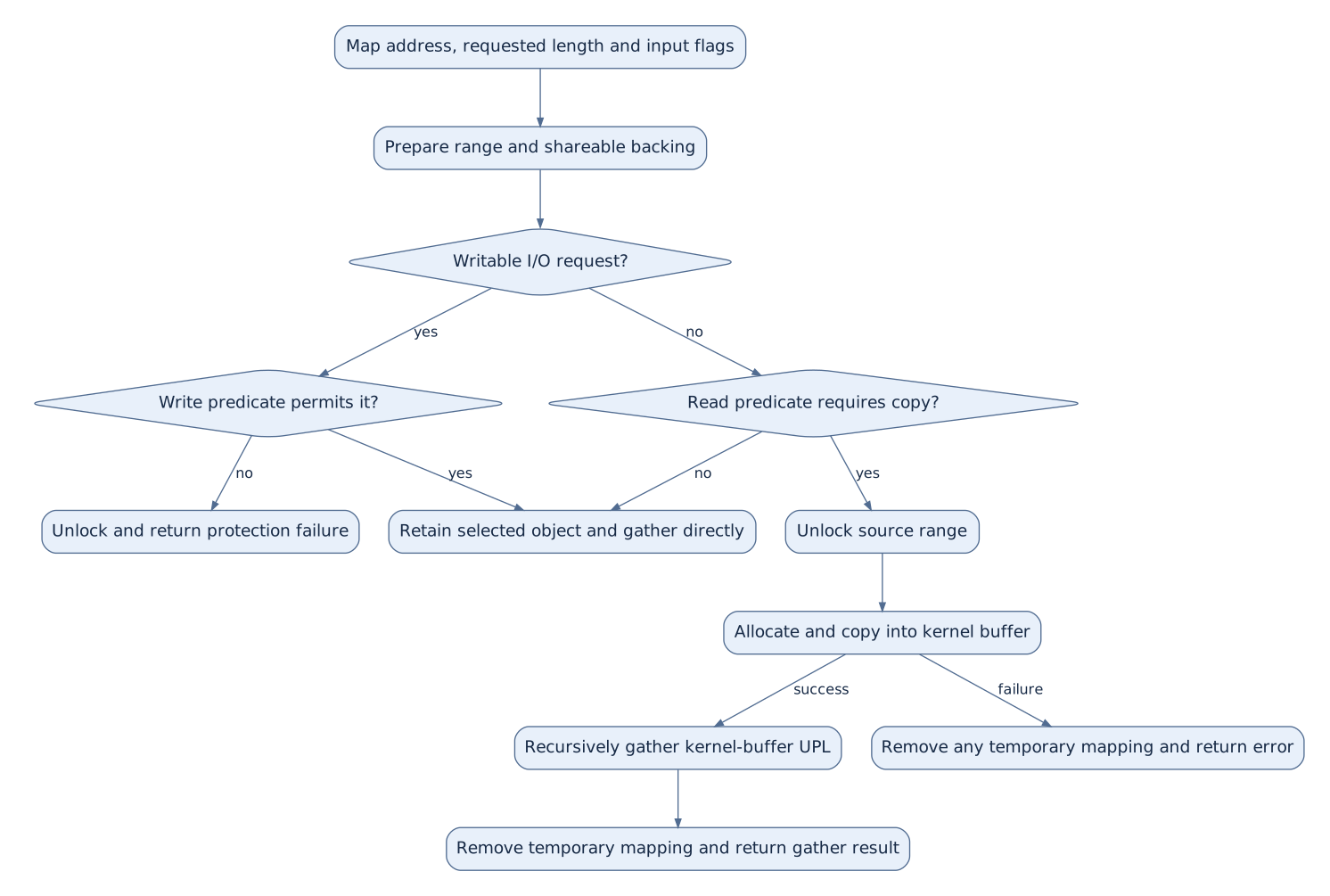
Mermaid source
flowchart TD
    R["Map address, requested length and input flags"] --> P["Prepare range and shareable backing"]
    P --> E{"Writable I/O request?"}
    E -->|yes| W{"Write predicate permits it?"}
    W -->|no| F["Unlock and return protection failure"]
    W -->|yes| D["Retain selected object and gather directly"]
    E -->|no| C{"Read predicate requires copy?"}
    C -->|no| D
    C -->|yes| U["Unlock source range"]
    U --> K["Allocate and copy into kernel buffer"]
    K -->|success| G["Recursively gather kernel-buffer UPL"]
    K -->|failure| X["Remove any temporary mapping and return error"]
    G --> T["Remove temporary mapping and return gather result"]
The diagram omits the query-only branch and the ordinary path's explicit synchronization retries. It does not imply that allocating or gathering always succeeds.
4. The copied path changes backing after releasing source protection
When copying is required, the function releases the source range lock and clears its saved entry/map pointers. It allocates round_page(*upl_size) bytes in kernel_map with KMA_PAGEABLE | KMA_DATA_SHARED, copies exactly the current requested bytes into the beginning of that allocation, and zeroes its trailing page padding. These flags select a separately allocated VM object rather than kernel_object_default; the allocation establishes delayed-copy strategy and true-share state. Being mapped in kernel_map is not the same as being backed by the special kernel object. Allocation selection.
Lock release, allocation and copy — vm_pageout.c, lines 7680–7691.
		vm_map_range_sh_unlock(ctx, &original_map);
		entry = VM_MAP_ENTRY_NULL;
		entry_map = NULL;
		/* allocate kernel buffer */
		ksize = round_page(*upl_size);
		kaddr = 0;
		ret = kmem_alloc(kernel_map, &kaddr, ksize,
		    KMA_PAGEABLE | KMA_DATA_SHARED, tag);
		if (ret == KERN_SUCCESS) {
			/* copyin the user data */
			ret = copyinmap(original_map, offset, (void *)kaddr, *upl_size);
		}
copyinmap() uses copyin() directly for the current user map. For another user map, it retains the map, switches the thread's map with the security-override variant, performs the copy, switches back and releases the map. A copy failure becomes KERN_INVALID_ADDRESS. Its kernel-pmap branch uses memcpy(), but the selected non-kernel-pmap executable source takes a user-copy branch. Copy helper.
The range lock is not held over this copy. Another thread's unmap or protection change can make it fail; mutable source contents can change during copying. The successful result is a separately held byte copy, not a promise that a concurrent source was sampled atomically. This path does not retain the earlier source object and copy from that saved object after unlocking: it calls copyinmap(original_map, offset, ...) using the address again. The worked example below excludes submap translation and concurrent mutation.
After zeroing the padding, the function recursively calls vm_map_create_upl() on the kernel buffer using the same output pointers and flags. The read-copy predicates no longer request a copy because this map uses kernel_pmap. The recursive call performs normal range/object gathering against the new buffer. Regardless of its result, an allocated temporary mapping is then removed with kmem_free(). Recursion and removal.
Padding, recursive gathering and cleanup — vm_pageout.c, lines 7692–7708.
		if (ret == KERN_SUCCESS) {
			if (ksize > *upl_size) {
				/* zero out the extra space in kernel buffer */
				memset((void *)(kaddr + *upl_size),
				    0,
				    ksize - *upl_size);
			}
			/* create the UPL from the kernel buffer */
			ret = vm_map_create_upl(kernel_map,
			    (vm_map_address_t)kaddr, upl_size, upl, page_list, count, flags, tag);
		}
		if (kaddr != 0) {
			/* free the kernel buffer */
			kmem_free(kernel_map, kaddr, ksize);
			kaddr = 0;
			ksize = 0;
		}
This branch does not revisit the original map after the successful copy, and it contains no later copy-back to the original executable bytes. It was selected only for UPL_COPYOUT_FROM.
5. Worked 16 KiB example: the first byte moves to offset zero
Select an untagged, non-kernel ARM64 map with 16 KiB pages, an ordinary RX entry, CONFIG_SPTM, no submap and no concurrent source mutation. Assume the prepared entry covers [0x100000000, 0x100008000), its backing object begins at offset 0x20000, and the request is:
source VA                 U = 0x100000800
requested byte length     L = 0x5000
input flags               UPL_COPYOUT_FROM | UPL_SET_IO_WIRE |
                          UPL_SET_LITE | UPL_SET_INTERNAL
The request occupies [0x100000800, 0x100005800). In the source object this would be [0x20800, 0x25800): object offset 0x20000 plus the 0x800 displacement in the entry. Let source physical page bases be A and B, with no assumed physical adjacency. These are illustrative addresses and offsets, not observations of a running kernel.
The copied path allocates ksize = round_page(0x5000) = 0x8000. Call its aligned kernel VA base K, and its two physical page bases P0 and P1. The first source byte U is copied to K, not K + 0x800. New backing begins at object offset zero. Its useful byte interval is [0,0x5000) and the interval [0x5000,0x8000) is zeroed padding.
| Offset within the requested bytes | Source coordinate | Copied-backing coordinate |
|---|---|---|
[0,0x3800) |
A + 0x800 through the end of source page A |
P0 + 0 through P0 + 0x37ff |
[0x3800,0x4000) |
First 0x800 bytes of source page B |
Last 0x800 bytes of copied page P0 |
[0x4000,0x5000) |
Source page B at offsets [0x800,0x1800) |
First 0x1000 bytes of copied page P1 |
| Outside the requested bytes | No additional source bytes copied | P1 offsets [0x1000,0x4000) contain zero padding |
The source page boundary and the copied-buffer page boundary occur at different transfer offsets. A consumer that retained the original 0x800 displacement would start at the wrong bytes of the new backing.
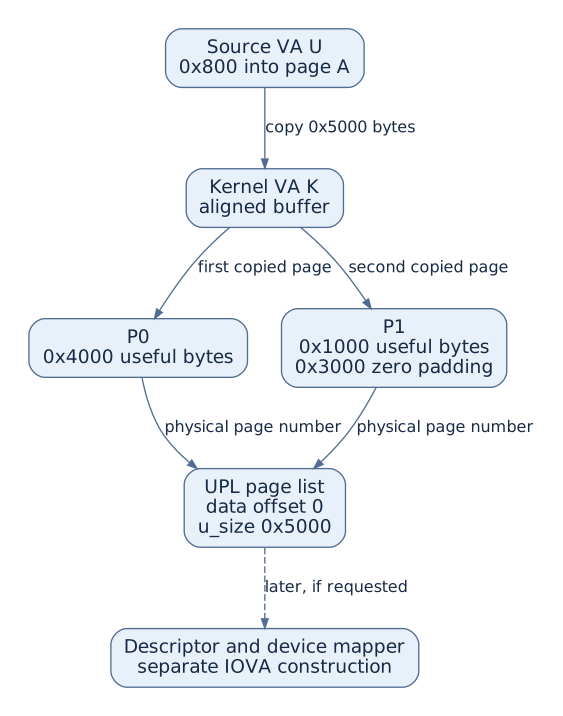
Mermaid source
flowchart TD
    U["Source VA U<br/>0x800 into page A"] -->|"copy 0x5000 bytes"| K["Kernel VA K<br/>aligned buffer"]
    K -->|"first copied page"| P0["P0<br/>0x4000 useful bytes"]
    K -->|"second copied page"| P1["P1<br/>0x1000 useful bytes<br/>0x3000 zero padding"]
    P0 -->|"physical page number"| L["UPL page list<br/>data offset 0<br/>u_size 0x5000"]
    P1 -->|"physical page number"| L
    L -.->|"later, if requested"| M["Descriptor and device mapper<br/>separate IOVA construction"]
vm_object_iopl_request() rounds the gathered extent to physical VM pages while retaining the original byte extent supplied to that recursive call. Here it gathers [0,0x8000), records u_offset = 0, u_size = 0x5000 and returns internal page information for P0 and P1. upl_get_data_offset() therefore returns zero. The caller's useful transfer length remains 0x5000; padding does not extend it. Gather rounding, UPL coordinates, data-offset helper.
The IOKit caller handles this representation change in its byte-aligned path: after creating a UPL, it obtains iopl.fPageOffset from upl_get_data_offset() and records descriptor/page-list coordinates. It does not assert that the returned displacement equals the original user address's low bits. A named-memory-entry path and mixed page sizes require their own coordinate handling. Byte-aligned source selection, returned offset and record.
6. Removing the temporary mapping does not finish the UPL
The source comment says the UPL holds the last reference until commit. The concrete lifetime uses several different counters. In the ordinary lite IOPL path selected here, the UPL records map_object, takes an object activity hold and acquires page wires. It does not retain a permanent ordinary vm_object.ref_count reference merely because upl->map_object contains the pointer. The recursive map call separately takes and later drops a temporary ordinary object reference around gathering. UPL association and activity, temporary ordinary reference.
| Stage | Kernel VA mapping | Object/page obligation | UPL metadata |
|---|---|---|---|
| Allocate and copy | [K,K+0x8000) exists |
Mapping owns the new object; bytes are initialized | No successful UPL yet |
| Recursive gather succeeds | Still exists | UPL activity and page wires hold copied backing | Own UPL reference, page list and participation bitmap |
Outer kmem_free() |
Temporary mapping removed | Backing remains needed by the UPL; final object termination can be deferred | Returned UPL remains usable under its protocol |
| Commit or appropriate abort | No temporary mapping to remove | Selected wires end; an empty ordinary lite UPL ends its activity hold | Header still requires deallocation |
Final upl_deallocate() |
Unchanged | Optional tracking hold ends at destruction | Final header/page-list/bitmap reference released |
The activity helper increments activity_in_progress, not ref_count. If releasing the mapping initiates final object termination while activity remains, vm_object_terminate() marks the object terminating/not alive and queues asynchronous reaping. The reaper waits for both paging and activity counts to drain before releasing the object's remaining backing. Thus logical unmapping, UPL completion and physical reclamation are different events. Activity counters, deferred termination, reaper wait, wait predicate.
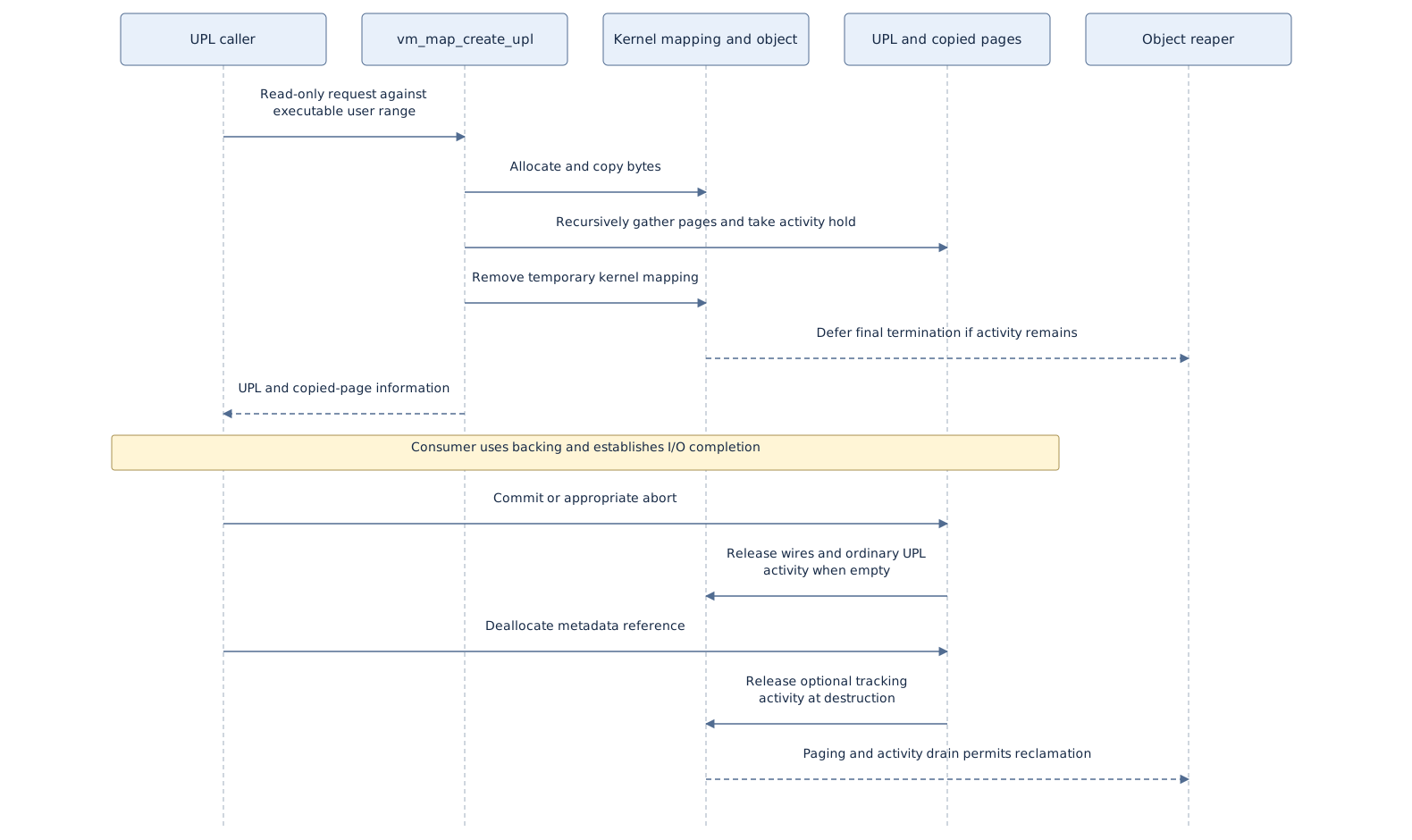
Mermaid source
sequenceDiagram
    participant C as UPL caller
    participant V as vm_map_create_upl
    participant K as Kernel mapping and object
    participant U as UPL and copied pages
    participant R as Object reaper
    C->>V: Read-only request against executable user range
    V->>K: Allocate and copy bytes
    V->>U: Recursively gather pages and take activity hold
    V->>K: Remove temporary kernel mapping
    K-->>R: Defer final termination if activity remains
    V-->>C: UPL and copied-page information
    Note over C,U: Consumer uses backing and establishes I/O completion
    C->>U: Commit or appropriate abort
    U->>K: Release wires and ordinary UPL activity when empty
    C->>U: Deallocate metadata reference
    U->>K: Release optional tracking activity at destruction
    K-->>R: Paging and activity drain permits reclamation
The diagram selects success and final completion, and does not impose ordering on every possible extra holder. Optional I/O tracking can add another activity hold until UPL destruction; a separately created mapping of the UPL adds its own lifecycle. Tracking hold, tracking release.
For ordinary valid copied pages, commit removes the UPL's wires. Once its entire participation bitmap is empty, the ordinary lite/non-kernel-object path ends object activity. Normal I/O-wire abort without UPL_ABORT_DUMP_PAGES delegates to commit with UPL_COMMIT_FREE_ABSENT; valid pages do not become absent merely because the I/O failed. Finally, upl_deallocate() releases metadata and any final tracking hold. It is not a substitute for completing the pages. I/O-wire completion, empty/activity decision, abort shortcut, metadata release.
7. Physical-page checks cover more than the original entry
Entry checks cannot describe every alias or alternate entry point. A named-memory-entry request can reach vm_object_iopl_request() without this executable-map copy branch, and a nonexecutable alias can refer to a physical page with an executable frame type. The gather marks delayed work with DW_vm_page_iopl_wire, adding DW_vm_page_iopl_wire_write for writable I/O. Alternate interface, gather flags.
Under CONFIG_SPTM, vm_page_do_delayed_work() checks writable I/O against PMAP_PAGE_IS_USER_EXECUTABLE(m) at the point where it would mark the page IOPL-wired. The macro translates the VM physical page number to a physical address, obtains the monitor frame type and classifies it. This differs from reading the source entry's execute bit. The worker may have dropped and reacquired the object lock to obtain page-queue protection, so the check belongs beside the state transition, not only in an earlier caller. It records protection failure while finishing the batch so the gather can unwind its completed work. Frame query, lock handoff, check and transition.
The complementary fault-side check asks whether a proposed CPU mapping would retype a page that is already IOPL-wired or cleaning. An IOPL-wired page then produces KERN_PROTECTION_FAILURE with an execute-on-IOPL guard; cleaning instead requests a wait. This is not an unconditional ban on every CPU access during an I/O wire. Its pmap_will_retype() predicate matters. Fault validation, locked caller.
Retyping while a UPL holds the page — vm_fault.c, lines 3650–3661.
	if (__improbable((m->vmp_cleaning || VM_PAGE_IOPL_WIRED(m)) &&
	    pmap_will_retype(pmap, vaddr, VM_PAGE_GET_PHYS_PAGE(m), prot, fault_info->pmap_options |
	    ((fault_info->fi_xnu_user_debug && !VM_PAGE_OBJECT(m)->code_signed) ? PMAP_OPTIONS_XNU_USER_DEBUG : 0),
	    PMAP_MAPPING_TYPE_INFER))) {
		if (__improbable(VM_PAGE_IOPL_WIRED(m))) {
			vm_map_guard_exception(current_map(), vaddr, kGUARD_EXC_SEC_EXEC_ON_IOPL_PAGE);
			ktriage_record(thread_tid(current_thread()), KDBG_TRIAGE_EVENTID(KDBG_TRIAGE_SUBSYS_VM,
			    KDBG_TRIAGE_RESERVED, KDBG_TRIAGE_VM_EXEC_ON_IOPL_PAGE), (uintptr_t)vaddr);
			return KERN_PROTECTION_FAILURE;
		}
		*page_sleep_needed = m->vmp_cleaning;
	}
The temporary copy avoids coupling the original executable frame to the selected read-only I/O wire. The UPL contains copied data-page identities; it does not transfer the original mapping's executable authority. The external monitor still implements its own frame/mapping policy, and an actual device mapper has a separate publication and invalidation protocol.
8. Return values, retries, and partial progress
| Stage or flag | Actual result and cleanup boundary |
|---|---|
| Unknown flags or noncanonical input where checked | Return before normal gathering; this function does not promise to initialize every output pointer on all early errors |
| Range preparation or entry admission fails | Release held range protection; prior object/COW preparation and a shortened *upl_size are not rolled back |
| Temporary allocation fails | Skip copy and recursion; remove a nonzero temporary address if one was returned |
copyinmap() fails |
Return its translated error, skip gathering, and remove the allocated mapping; a copied prefix is never published as a successful UPL |
| Recursive gathering fails | Remove the temporary mapping after the gather's own cleanup; no general retry of allocation/copy/gather is added by the outer branch |
| Direct-path COW/data synchronization | Retain the selected object, unlock, request synchronization, release that reference and reacquire/reselect through create_upl_retry_entry |
UPL_FORCE_DATA_SYNC with the copied path |
The copy branch runs before the ordinary synchronization branch; recursion receives the flag and applies it to copied backing |
UPL_REQUEST_NO_FAULT with the copied path |
The later gather receives the flag; it does not suppress the earlier allocation or copyinmap() and its potential faults |
| Successful recursion | Return its UPL/page information and property-output flags after removing the temporary mapping |
The copy branch is here; the two direct-path synchronization retries are here. caller_flags preserves each call's input controls, while *flags later becomes object-property output such as UPL_DEV_MEMORY/UPL_PHYS_CONTIG. The recursive call uses that same in/out storage; callers must not interpret successful output as an unchanged copy of input controls. Flags publication and gather handoff.
The general gather initializes *upl_ptr = NULL, and its late error path releases recorded page work, ends activity, destroys the provisional UPL and resets the pointer. Its cleanup does not restore all dirty/reference bits or undo every earlier VM-side transformation. The gather companion also records the separate unresolved unwind boundary after a resident fast path has acquired pages out of offset order; this chapter does not turn recursive gathering into a transactional guarantee. Initialization, late cleanup.
9. Source tests and the remaining implementation boundary
The local vm_upl test helper creates a UPL, maps it into kernel space, compares it with user bytes, checks selected physical-page identities, unmaps, commits and deallocates. Its userspace cases encode configuration-dependent expectations. These are inspected test bodies, not tests executed for this documentation. Helper operation, byte and page comparison.
| Local case | What its body requests or checks | Boundary |
|---|---|---|
| RO UPL on RX | Expect copying except macOS without SPTM; exercise an offset request as well | No real device mapping or DMA transfer |
| RW UPL on RX | Expect KERN_PROTECTION_FAILURE through the helper |
Does not imply the later SPTM guard branch ran when WRITE was already absent |
| RO UPL on JIT | Expect a copy when SPTM is enabled; compare bytes and selected physical identity | Conditional on JIT admission and thread access controls |
| RW UPL on JIT | SPTM failure plus the selected map-entry guard; non-SPTM success expectation | Skips unsupported/translated configurations; not a general claim about every product |
| Writable object UPL | Bypass map-copy selection and expect the physical-page guard on SPTM | Deliberately specialized object helper, not the normal map-facing route |
| RO object UPL then execute fault | Expect rejection of a retyping fault during the UPL's lifetime | Kernel helper deliberately recycles the page's type to exercise this branch |
The specialized object helper explicitly requires caller-controlled, stable source regions because it does not retain normal map-range protection. It simulates page recycling, calls the fault path, then completes the UPL; its body must not be presented as ordinary production UPL creation. Helper contract, simulated retype and fault.
This chapter establishes the local entry predicates, copied-byte layout, object/activity handoff, completion obligations and complementary physical-page checks. It does not establish every submap/mixed-page-size/MTE combination, concurrent remapping interleaving, monitor transition implementation, concrete IOMMU permissions or device-stop protocol. The SPTM/TXM implementations and a particular DMA provider remain external; no kernel build, privileged test, hardware I/O experiment or HTML generation was performed.