Quota records, cache identity and filesystem boundaries
VFS · Mount lifecycle · Vnode caching
The generic quota implementation caches per-identity records and reads/writes quota files. A filesystem decides where allocation is charged and which quota control operations it implements. This checkout exposes the cache and VFS dispatch but does not supply a complete APFS quota-accounting implementation.
Control dispatch and the stored objects
quotactl resolves the target mount, handles operation-specific user data and the configured MAC check, and calls VFS_QUOTACTL. The filesystem's registered operation is the boundary for enable/disable, retrieval, additional permission checks and accounting policy. Syscall dispatch.
A quotafile holds the backing vnode, stored credentials, quota-file lock, opening/closing/reference state, table dimensions and grace intervals. A dquot holds identity/type, reference count, flags, quota record, on-disk index and links into the hash and reusable/dirty lists. dqblk carries current bytes/inodes, hard/soft limits and grace deadlines. The hash key includes quota-file vnode plus ID, so user 501 on two mounts does not share one record. Definitions, hash and lists.
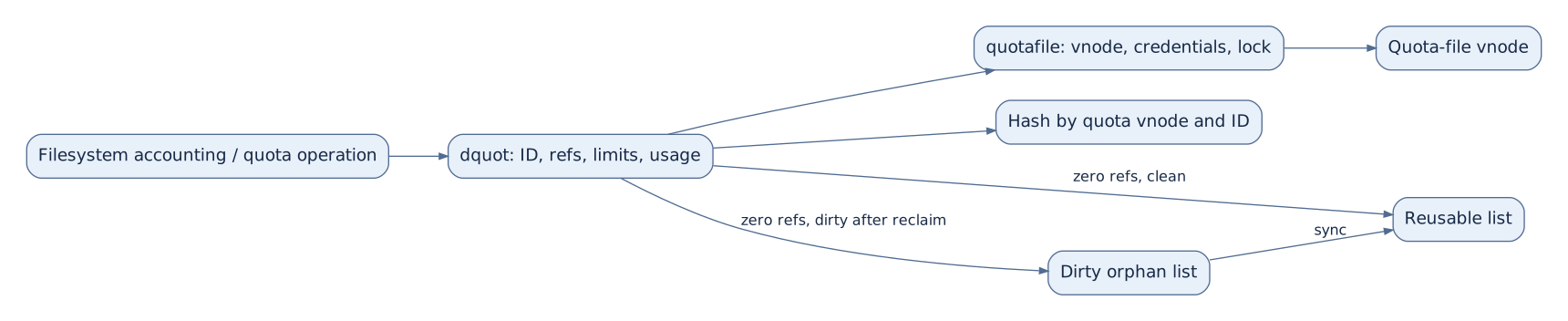
Mermaid source
flowchart LR
    FS[Filesystem accounting / quota operation] --> D[dquot: ID, refs, limits, usage]
    D --> Q[quotafile: vnode, credentials, lock]
    Q --> V[Quota-file vnode]
    D --> H[Hash by quota vnode and ID]
    D -->|zero refs, clean| F[Reusable list]
    D -->|zero refs, dirty after reclaim| O[Dirty orphan list]
    O -->|sync| F
Quota-file open and close exclusion
qf_get(QTF_OPENING) prevents overlapping opens and waits for closing. qf_get(QTF_CLOSING) marks closing and drains both an in-progress open and qf_refcnt. New qf_ref requests fail while opening/closing, so a quota-off operation can stop new dqget users before waiting for existing ones. qf_put clears the transition flag and wakes waiters. These temporary file references are distinct from dq_cnt. Transition protocol.
dqfileopen reads a fixed header using the quota credential, verifies magic/version, power-of-two entry count and consistency with file size, then establishes table/grace parameters. dqfileclose reads the header and attempts to write the updated entry count. It returns void and ignores that final write result; it is not a durability-reporting API. Open/close.
Cache lookup survives sleeping and races
dqget verifies initialization and input, acquires a quota-file reference under the global list lock, then searches by vnode/ID. Its per-record lock helper may sleep while dropping the global lock. Therefore a pointer found before that wait must have both list generation and identity revalidated afterward. A cached zero-reference object is removed from the clean or dirty free list before reuse as an active reference. Hit path.
bsd/vfs/vfs_quota.c, lines 514–528:
		dq_lock_internal(dq);
		if (dq_list_lock_changed(listlockval)) {
			dq_unlock_internal(dq);
			goto relookup;
		}

		/*
		 * dq_lock_internal may drop the quota_list_lock to msleep, so
		 * we need to re-evaluate the identity of this dq
		 */
		if (dq->dq_id != id || dq->dq_qfile == NULL ||
		    dq->dq_qfile->qf_vp != dqvp) {
			dq_unlock_internal(dq);
			goto relookup;
		}
On a miss the allocator drops the global lock to allocate, then searches again: another thread may have created the same identity. Reusing a clean free record also detaches old identity and restarts before publication. The cache refuses exhausted capacity with EUSERS. A newly inserted record remains per-record locked across dqlookup, so another finder cannot use incompletely loaded contents. I/O failure removes its published identity and releases the candidate. Allocation/relookup/publication.
Example: A and B simultaneously request (quota vnode Q, ID 501). Both can initially miss. A allocates while unlocked; B inserts the record first. A must discard its unused allocation and return B's record, otherwise two independently modified copies would represent one on-disk quota.
The on-disk lookup and byte order
dqlookup serializes quota-file access with qf_lock, calculates a primary index and secondary probe stride, and reads fixed dqblk records through VNOP_READ. Empty ID zero means an unallocated entry: the code writes a zeroed record with the requested ID to reserve it, increments the entry count on successful write and saves its index. Existing records are converted from big-endian fields. Short reads/writes become EIO where checked. Disk lookup.
dqget sets DQ_FAKE when all limits are zero and initializes missing grace deadlines from the quota-file intervals. Those are record initialization decisions. The actual allocation path that increments usage or rejects an allocation must come from a filesystem caller; a search for dqget here finds the exported implementation rather than an in-tree APFS charging routine.
Three release routes and their different I/O rules
| Route | Last-reference behavior |
|---|---|
dqrele |
Attempts synchronization if modified, then puts the object on the reusable list |
dqreclaim |
Performs no I/O; moves a modified zero-reference record to the dirty-orphan list |
dqsync_orphans |
Takes an orphan record, revalidates it after possible sleeps, writes it and moves it to reusable state |
Release/reclaim/orphan synchronization. The dirty list preserves work when reclaim context cannot write. Synchronization cannot assume identity remained fixed while locking: dqsync_orphans checks quota-file association and dirty state again after the per-record lock acquisition.
bsd/vfs/vfs_quota.c, lines 890–897:
	if (dq->dq_flags & DQ_MOD) {
		TAILQ_INSERT_TAIL(&dqdirtylist, dq, dq_freelist);
	} else {
		TAILQ_INSERT_TAIL(&dqfreelist, dq, dq_freelist);
	}

	dq_unlock_internal(dq);
	dq_list_unlock();
dqsync_locked writes a big-endian snapshot to the stored index under record ownership and stored credentials. It reports a short write as EIO, but clears DQ_MOD even if the write failed. Callers such as dqrele deliberately ignore its result. Do not describe a dirty flag clearing as confirmed persistence or an automatic write retry guarantee. Writeback.
dqflush detaches every cache identity for a quota-file vnode and expects no live record references; a remaining count triggers a panic. Storage can remain on the reusable list after identity is gone. Flush.
This explains the generic record/cache route. Filesystem allocation hooks, quota-file creation policy, transactional charging and APFS-specific quota domains are not bodies supplied by this source tree and should remain labeled provider boundaries.