Registry and service lifecycle
Subsystem overview · Execution and power · User connections
For the complete selected lifecycle trace, read service matching and coordinated termination: catalogue-generation retries, probe/start failure ownership, client start deferral, and the phase-3 finalize/stop/detach lists.
The registry plane and property chapter follows reciprocal link references, property snapshot depth, path lookup and live-versus-snapshot iteration. Notification and arbitration explains callback registration/replay, removal drains and service-owner handoff.
A registry entry is an object with relationships
IORegistryEntry contains fPropertyTable and fRegistryTable. The former describes the entry; the latter carries registry bookkeeping, including links indexed by plane. IORegistryPlane has symbols identifying parent/child sets and plane-specific names and locations. Consequently, “the registry tree” is an incomplete description: entries can participate in multiple planes, and a plane can have multiple parents. IORegistryEntry fields, IORegistryPlane.
attachToParent takes the global registry write lock, assigns a monotonically allocated entry ID if necessary, and creates reciprocal parent and child links. It releases the graph lock before performing property-table work and the reciprocal attachment callback. detachFromParent temporarily retains the parent while removing links and invoking the reciprocal operation. These references matter because an array removal can release its contained object. attachToParent, detachFromParent.
The registry has two separate locking domains. RLOCK/WLOCK protect the global graph and generation count; PLOCK protects an entry's property table with its recursive lock. A getProperty result is borrowed after the property lock is released. Use the copyProperty ownership path when the object must remain valid independently of concurrent replacement. This is especially visible in matching, which repeatedly copies properties and explicitly releases them. Registry lock macros, getProperty, copyProperty definitions.
Published collection-valued properties are marked immutable by attachToParent and setProperty. This protects the registry's published object graph from casual mutation through an obtained collection pointer; it does not make every other driver field atomic. setProperty.
Publishing triggers matching
IOService adds __provider, its provider-generation cache, __owner, __state[2], and pwrMgt. Attachment, publication, successful start, exclusive opening, and power registration are different transitions. IOService fields.
attach(provider) serializes against the provider's arbitration state and refuses an inactive provider. It adds the service to gIOServicePlane; it does not itself select a driver. registerService checks that the object is connected to the registry root, allows platform adjustment, installs platform actions, and calls startMatching. The latter records pending configuration and busy state, then arranges synchronous or asynchronous matching according to options and inherited state. attach, registerService, startMatching.
Mermaid source
sequenceDiagram
    participant P as Published provider
    participant C as IOCatalogue
    participant M as OSMetaClass
    participant D as Driver candidate
    P->>C: findDrivers(provider, generation)
    C-->>P: Ordered personality set
    P->>P: Passive and family property matching
    P->>M: allocClassWithName(IOClass)
    M-->>P: Candidate instance
    P->>D: init(personality), attach(provider)
    P->>D: probe(provider, score)
    P->>D: detach(provider)
    P->>P: Order candidates within match categories
    P->>D: attach(provider), start(provider)
    D->>D: Optionally publish further services
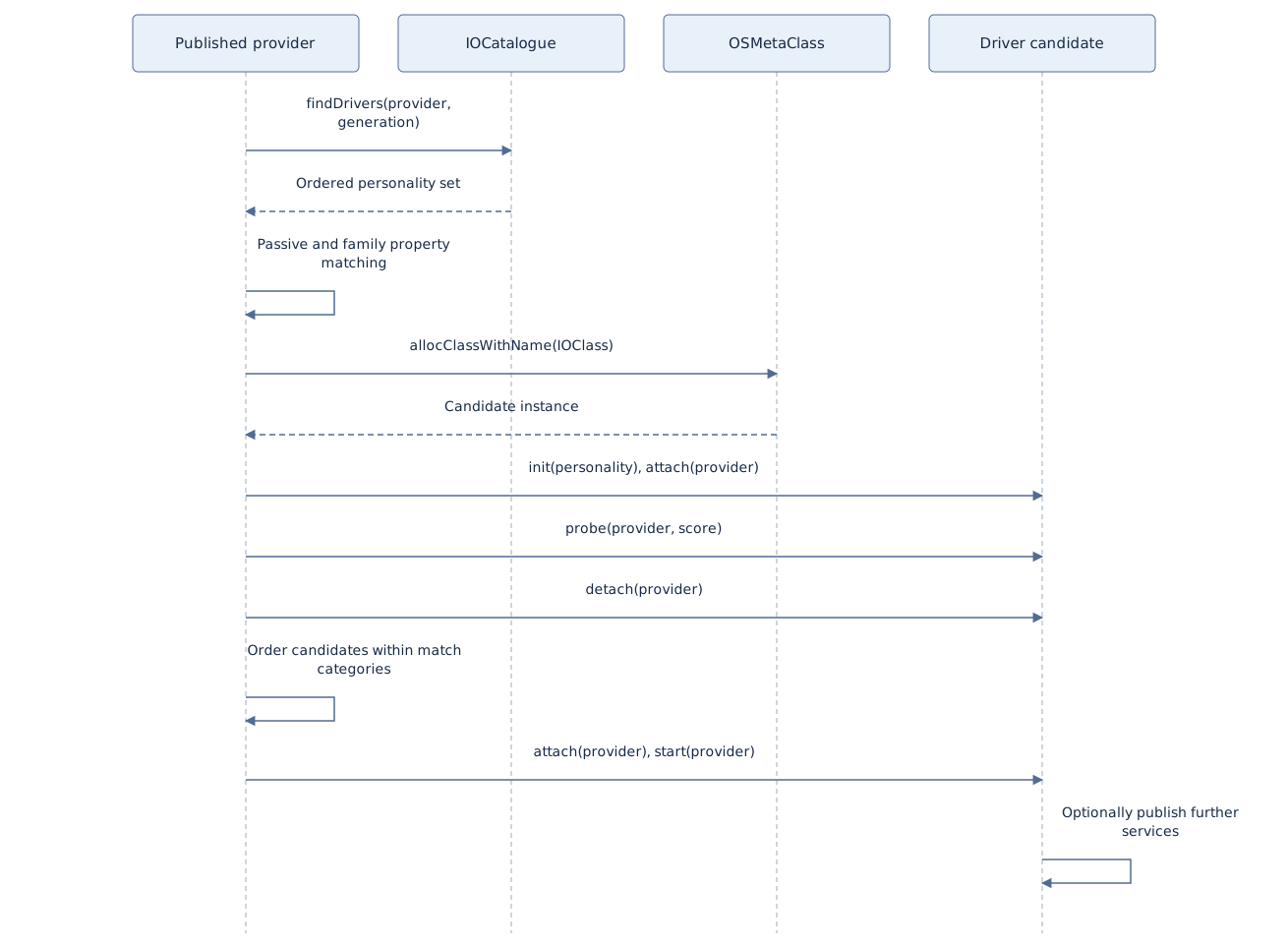
IOCatalogue::findDrivers traverses the provider's metaclass superclass chain, accumulating personalities indexed by those classes. It returns an ordered set and a catalogue generation under the catalogue read lock. This is candidate discovery, not the entire matching decision. findDrivers.
doServiceMatch updates publication state and notifications, obtains resources, and invokes probeCandidates. It repeats if the service was re-registered or the catalogue generation changed. At completion it clears configuration state, permits deferred termination to advance, and decrements its busy count. A successful return from a publication call therefore should not be confused with a guarantee that every child is fully initialized. doServiceMatch.
Probe results and start are separate decisions
probeCandidates copies each personality before matching can modify it. It checks passive matching, category occupancy, availability of the executable, and DriverKit-specific launch conditions. A missing module can stall matching until loading makes the class available. Candidates are allocated by the personality's IOClass through the metaclass runtime, initialized, temporarily attached, and probed. probe can return an instance and change its score; the implementation then detaches the probing instance and orders returned candidates within each match category. probeCandidates, probe and start defaults.
startCandidate reattaches the selected service and calls start. For DriverKit personalities it also obtains a user server and checks the applicable entitlement/matching conditions before startup; see DriverKit. A failed start causes detachment. The category loop tries candidates until one starts, while deferred matching can stop the attempt. This is why a high initial IOProbeScore alone does not prove that a driver owns a device. startCandidate, start invocation and cleanup.
Provider opening is another operation. open uses arbitration, checks inactivity, and calls the overridable open policy. The base handleOpen stores one __owner, with a seize path that requests the existing owner to close; subclasses can implement other policies. The existence of an attachment does not imply exclusive hardware access. open, handleOpen.
Removal is a coordinated protocol
terminate does not simply delete the object. Phase 1 visits affected services, marks them inactive, removes published/matched state, and coordinates termination through clients. The worker's next phase waits for conflicting configuration/start activity, runs termination callbacks, and records phase-3 state. Finalization is deferred until client relationships allow it. Some callbacks are routed through the service's workloop, so removal crosses both arbitration and driver execution domains. terminatePhase1, terminateWorker.
detach removes the service-plane relationship, updates busy propagation and termination scheduling, and can initiate provider rematching when the appropriate flag is set. free separately releases PM, interrupt, user-server, and superclass resources. An inactive service can therefore remain allocated while references or clients still exist. detach, free.
When debugging a missing device, follow these questions in order: did its provider publish; did the catalogue produce a personality; did passive/family matching accept it; was the executable available; did probe return an instance; did start succeed; and did the resulting service publish what its next client expects? For a disappearing device, inspect inactive/configuration flags, outstanding clients and opens, and callback completion before assuming the C++ destructor is the relevant boundary.