IPC spaces and entries: allocating, finding and retiring capabilities
A task's ipc_space turns a user-visible Mach port name into rights to an IPC object. The space, its replaceable entry table and the referenced ports have different allocations, locks and lifetimes. This chapter follows those boundaries in xnu-12377.121.6, starting at task->itk_space and ending when the last space reference and the retired table are released.
Key structures · Task and its protected data · Ports and kernel objects · IPC guide
Use this chapter as a field-and-access companion to names and rights. The latter develops right accounting and reverse hashing; port lifecycle follows transfers and notifications. The distinction that matters throughout is a name selects a right in one space; the entry pointer itself is not a capability or an independently retained object. Entry representation, locked lookup contract.
Inspect the live ipc_entry layout for the selected source profile.
1. Three allocations, three meanings of ownership
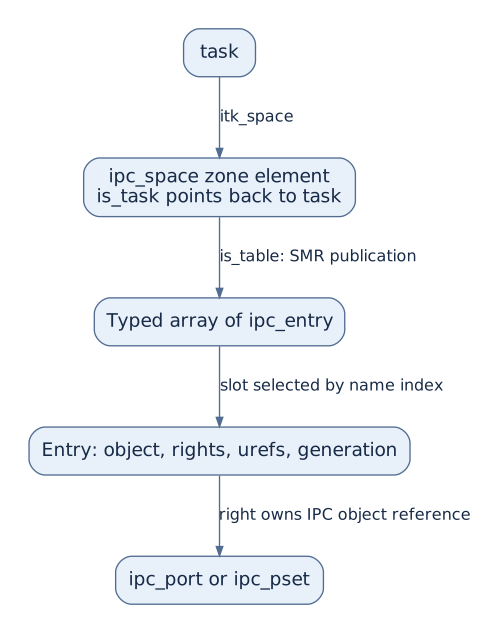
Mermaid source
flowchart TD
    T["task"] -->|"itk_space"| S["ipc_space zone element<br/>is_task points back to task"]
    S -->|"is_table: SMR publication"| A["Typed array of ipc_entry"]
    A -->|"slot selected by name index"| E["Entry: object, rights, urefs, generation"]
    E -->|"right owns IPC object reference"| P["ipc_port or ipc_pset"]
The entry box is a portion of the array, not another allocation. Several entries in different spaces can refer to the same port; the space's owning task is distinct from a port's receiving task. A send entry in task A can point to a port whose receive right belongs to task B. Structures, port receiver fields, task attachment.
| Storage or relationship | Allocation/publication | Release and what it protects |
|---|---|---|
ipc_space |
ipc_space_alloc() uses the ipc spaces zone with `Z_WAITOK |
Z_ZERO |
ipc_entry_table_t |
A KALLOC_ARRAY_TYPE_DEFINE array of struct ipc_entry; helpers provide its base, count and byte size |
Replacement/termination schedules the old array through smr_ipc_call; it is not freed when the published pointer first changes. |
One ipc_entry |
Claimed inside the current table under the space lock | No entry refcount. Returning the slot to the free list and freeing the array are separate operations. |
Entry's ie_object |
Installed during claim/initialization or right copyout | An occupied object-bearing entry carries the appropriate object reference. A combined send/receive entry shares one object reference. Dead-name entries can have no object. |
| Task association | ipc_task_init() assigns space->is_task = task and task->itk_space = space |
Assignment does not take a task reference. Preserve the task/active-space protocol before following this backpointer; a retained dead space is not a retained task. |
Sources: space allocator/reference release, typed array definition, retirement, entry claim/deallocation, dead-name creation, combined-right reference handling, task-side final release.
Neither the space nor its entry array is proc_ro storage. Their normal mutations use locks, atomics and SMR publication. The RO-zone update interface is useful contrast, but is not used to turn is_table or ie_bits into read-only fields. Space zone, entry mutation.
2. Read the current space fields, not the historical comments
| Field/group | What the value means | How to read or change it |
|---|---|---|
is_lock |
Ticket lock serializing namespace writers and locked readers | Both is_read_lock and is_write_lock call ipc_space_lock; the names do not imply a reader/writer lock. |
is_bits |
Atomic reference count with six low flag bits reserved, including resource-limit notification state | Ref helpers use masked reference operations; is_bits_set/clear/test manipulate flags. |
is_table |
SMR-published typed-array handle | Ordinary active-space access uses the lock/serialized helpers or the explicit SMR lookup protocol. A null table marks an ordinary namespace inactive. |
is_table_free, is_table_hashed |
Free name slots and pure-send entries in the reverse hash | Updated under the space lock; they count different populations. |
is_entropy, is_prng |
State for free-list/generation randomization | Constructor and entry allocation/growth consume this state; it is not a reference or unique-ID mechanism. |
is_grower, is_low_mod, is_high_mod |
Current grower thread and changed-entry bounds | A grower runs much of its copy unlocked; writers mark modified indices so it can rescan. |
is_task |
Associated task pointer | Used with the caller's task/space lifetime and activity guarantees; it is not a new task reference. |
is_policy |
IPC-space policy value stored with a data-PAC discriminator when supported | Use ipc_space_policy() and ipc_space_set_policy(); the discriminator includes the field address. |
is_label |
ipc_label_t privilege/substitution bitmask |
This is a uint64_t IPC label, not a struct label * from the MAC framework. |
Limits and is_telemetry |
Conditional table limits and atomic event-rate state | CONFIG_PROC_RESOURCE_LIMITS changes the layout and limit-handling paths. |
Sources: field declaration, policy accessors, flags and predicates, activity/growth helpers, lock aliases, IPC label type.
Two comments need qualification when reading this version. The is_bits field comment says it holds “refs, active, growing”, but is_active() actually tests is_table and is_growing() tests is_grower. The header also describes an is_table[0].ie_size field that is absent from today's ipc_entry; current callers obtain array sizes through typed-table helpers. Follow the declarations and bodies rather than interpreting these comments as current layout. Old comments, current predicates, current entry.
3. Construction and the two initial references
ipc_space_create() first allocates a zeroed table with a minimum requested count of 32, then the space. It asks the allocation for its actual count, initializes the PRNG/free list, reserves index zero and publishes the table into the still-private space. The two initial references are the caller's reference and the active-space reference later dropped by termination. This is not one reference for every table entry. Constructor, active-reference release.
Source: osfmk/ipc/ipc_space.c, lines 291–298
	os_ref_init_count_mask(&space->is_bits, IS_FLAGS_BITS, &is_refgrp, 2, 0);
	space->is_table_free = count - 1;
	space->is_label = label;
	space->is_low_mod = count;
	smr_init_store(&space->is_table, table);

	*spacep = space;
	return KERN_SUCCESS;
ipc_task_init() attaches this space before completing the task's IPC setup. The task holds its space reference until final task_deallocate() cleanup. convert_port_to_space_with_flavor() can obtain an additional space reference while holding a task-port lock: successful task conversion means IPC disablement has not yet severed the association, and space termination occurs after that disablement. It also checks task->active. The conversion returns a referenced space; it does not return a borrowed pointer merely because the input port was valid. Task constructor, conversion ordering, task final release.
Special spaces have a different construction contract
ipc_space_create_special() allocates only the space, starts with one reference, installs kernel policy and sets IPC_LABEL_SPECIAL; it does not allocate or publish an ordinary name table. ipc_space_kernel and ipc_space_reply are created this way. These are placeholders for naked receive rights, whose port stores MACH_PORT_SPECIAL_DEFAULT as its receiver name. A null is_table therefore cannot be interpreted as “this special kernel space has undergone ordinary task termination”. Special constructor, startup assignments, special port allocation.
4. Decode a name before following an entry pointer
The user-visible name combines an index and generation encoding:
Source: osfmk/mach/port.h, lines 278–280
#define MACH_PORT_INDEX(name)           ((name) >> 8)
#define MACH_PORT_GEN(name)             (((name) & 0xff) << 24)
#define MACH_PORT_MAKE(index, gen)      (((index) << 8) | ((gen) >> 24))
As an illustrative example, 0x403 selects index 4 and yields generation value 0x03000000. It says nothing about an address or which task owns another name with the same integer. ipc_entry_lookup() rejects index zero, out-of-range indices, generation mismatch and MACH_PORT_TYPE_NONE. A live name also needs the right requested by the caller; finding an entry is only the first step. Lookup, right-specific translation.
Part of ipc_entry |
Active interpretation | Different interpretation later |
|---|---|---|
| First pointer union | ie_object, ie_port and ie_pset are typed views of the referenced IPC object; ie_volatile_object supports speculative lookup |
Index zero's ie_self holds the table handle during SMR retirement. |
ie_bits low 16 bits |
Send, send-once or dead-name urefs | Free slots preserve generation/rollover bits while clearing rights/urefs. |
| Rights and extended bits | MACH_PORT_TYPE_*, former-receive marker, pinned-send and immovable-send state |
A dead-name conversion replaces the live-right type; this is separate from freeing the slot. |
| Generation/rollover bits | Six generation bits and two rollover-selector bits | Reclaim advances the generation using the selector; it can wrap and is not a permanent unique ID. |
ie_request / ie_next |
Notification-request table index for an occupied entry | Next free-slot index when free; index zero anchors the free list. |
ie_dist, ie_index |
Reverse-hash bucket displacement and referenced entry index | The bucket's own normal name entry can describe an unrelated right. |
Second union's ie_smr_node |
Not an extra per-entry callback object during ordinary use | Overlays the ordinary bits/request/hash fields in the base entry when the whole table is retired. |
Sources: complete entry and masks, generation functions, deallocation, hash storage, retirement overlay.
IE_BITS_GEN() forces the external low generation bits to the required rollover-mask value. Named allocation rejects names that do not match ipc_entry_name_mask(). The internal increment depends on the rollover selector and can restart with new randomness on overflow. Thus the worked 0x403 arithmetic is an encoding example, not a promise that allocation returns that value or that the next name is 0x404. Masks, name mask and advancement, named allocation validation.
The reverse hash answers “does this space already have an ordinary send/receive name for this object?”, allowing send rights to coalesce on copyout. Only pure-send entries are placed in the hash; receive ownership has its own reverse path, and send-once rights receive distinct entries. Do not read table[h].ie_object as the hash result: the bucket's ie_index identifies the actual entry to inspect. Reverse lookup, hash lookup, copyout selection.
5. Reservation, initialization and publication
An ordinary port allocation obtains a zeroed port before it claims a namespace slot. ipc_entry_alloc() locks the space and repeats active-space/capacity checks, growing the table if necessary. Success returns with the space locked. ipc_port_init() then establishes the port's object reference, locked wait queue, receiver and label; ipc_entry_init() installs rights/urefs and records the modification before the space is unlocked. The caller receives a locked port, not an additional owned port reference. Allocation sequence, entry allocator, policy-aware entry initialization.
| Stage | What has happened | What must still happen |
|---|---|---|
ipc_entries_hold(space, n) |
Checks sufficient free slots and projected reverse-hash capacity while locked | It has not removed slots or allocated an independent reservation. Preserve the lock until claim. |
ipc_entry_claim() |
Removes a free-list head, advances generation, clears request state and stores the object pointer | Complete initialization and mark the entry modified before unlocking. |
ipc_entry_init() |
Adds actual rights/urefs and applicable immovable-send policy | Caller completes its publication/lock-release contract. |
| Space unlock | Other namespace operations can observe the initialized right | The returned name still belongs only to this space; later lookup must revalidate it. |
ipc_entry_dealloc() |
Clears rights/object state, relinks the slot and records the change | It does not itself perform all port-right/reference cleanup. The enclosing right operation owns that work. |
Sources: hold, claim, initialize, deallocate.
The claim deliberately starts with generation bits, not a ready capability:
Source: osfmk/ipc/ipc_entry.c, lines 284–287
	gen = ipc_entry_next_gen(entry->ie_bits, space);
	entry->ie_bits = gen;
	entry->ie_request = IE_REQ_NONE;
	entry->ie_object = object;
For a hypothetical 32-entry array, index zero leaves 31 ordinary slots. The hold check separately rejects a projected hashed population above 32 * 7 / 8 = 28. “No space” can therefore mean hash-capacity pressure even while free name slots exist. Actual capacities come from the typed-array helpers, and the check conservatively assumes each requested entry needs hashing. Capacity branch.
If slot allocation fails after the raw port allocation, ipc_port_alloc() frees the label and port before returning. Named allocation additionally distinguishes an existing right under the requested name, a free slot, incompatible generation and an index requiring growth. A failed higher-level operation can leave a larger namespace table even though it did not publish the requested new right. Port failure cleanup, named allocation, grow-and-retry loop.
6. Lookup: protect the table and revalidate the relationship
| API | Successful result | Protection that ends on return |
|---|---|---|
ipc_entry_lookup() |
Entry pointer inside the current active table | None added: the caller must already hold the space lock and continue holding it while using the entry. |
ipc_right_lookup_write() |
Entry pointer, space locked | Do not keep that pointer after unlocking or across a helper that drops the lock to grow. |
ipc_right_lookup_read() |
Object locked and entry bits copied out | IPC SMR has been left; it returns no table/entry pointer and adds no object reference. |
ipc_object_translate() |
Object locked, with requested right checked | No object reference is donated; the caller must obtain any longer-lived ownership explicitly. |
ipc_object_copyin() |
Owned transferred/created right on success | Space locking and deferred copyin cleanup have finished. This is a different contract from lookup. |
Sources: entry lookup, write/read lookup, translation, copyin.
Read lookup combines two mechanisms. IPC SMR keeps a loaded table allocation from being reclaimed; the port/port-set's sequestered, cleared storage supports speculative io_lock_allow_invalid(). That helper validates the candidate's allocator zone and attempts to lock a wait queue whose valid bit distinguishes initialized objects from cleared storage. A successful lock alone does not prove that the user's name still denotes this object. Lookup body, speculative object lock, port-zone rationale.
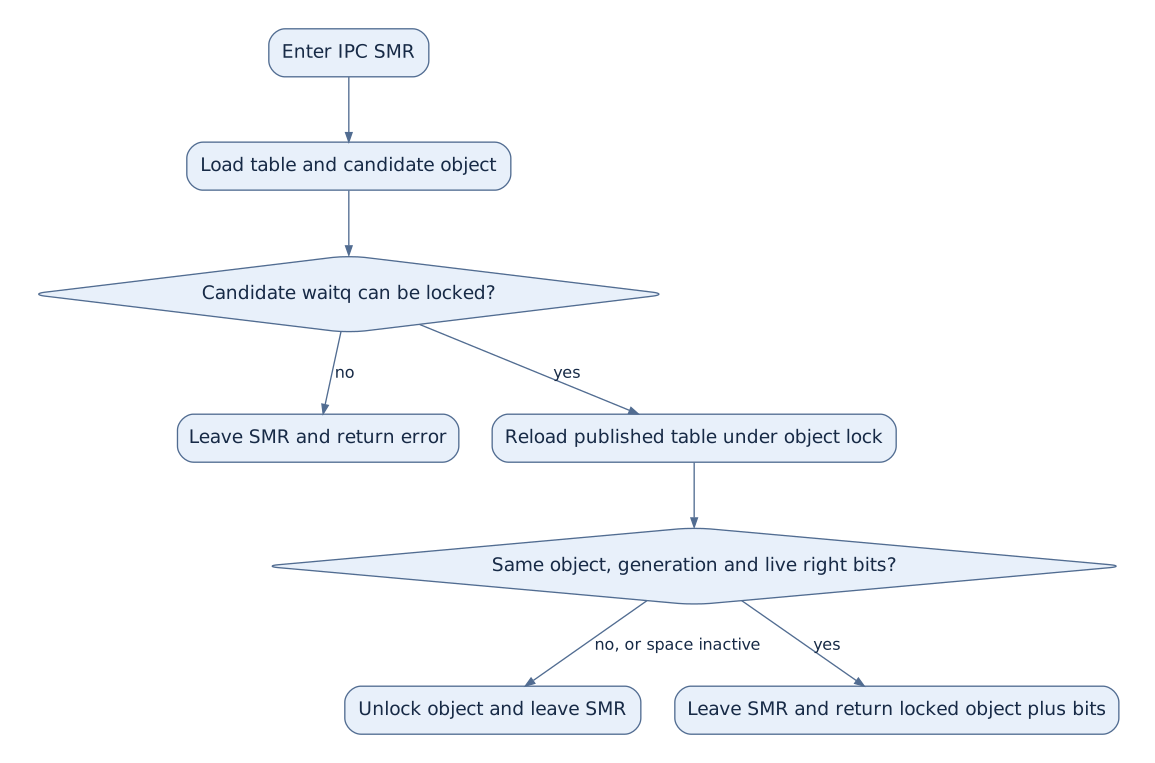
Mermaid source
flowchart TD
    A["Enter IPC SMR"] --> B["Load table and candidate object"]
    B --> C{"Candidate waitq can be locked?"}
    C -->|"no"| F["Leave SMR and return error"]
    C -->|"yes"| D["Reload published table under object lock"]
    D --> E{"Same object, generation and live right bits?"}
    E -->|"no, or space inactive"| G["Unlock object and leave SMR"]
    E -->|"yes"| H["Leave SMR and return locked object plus bits"]
The initial table/index checks can also fail before a lock attempt; they are folded into the error route. The second table load matters because growth may have replaced the first table, followed by an entry mutation. The code uses an ordering barrier before the object lock and reloads is_table after locking; it then compares the pointer, generation and nonempty right bits. Table growth can still occur later, which is why even those final entry reads remain inside SMR. Ordering argument and reload.
Source: osfmk/ipc/ipc_right.c, lines 237–254
	if (__improbable(entry->ie_object != object)) {
		kr = KERN_INVALID_NAME;
		goto out_put_unlock;
	}

	ipc_entry_bits_t bits = entry->ie_bits;
	if (__improbable(IE_BITS_GEN(bits) != MACH_PORT_GEN(name) ||
	    IE_BITS_TYPE(bits) == MACH_PORT_TYPE_NONE)) {
		kr = KERN_INVALID_NAME;
		goto out_put_unlock;
	}

	/* Done with hazardous accesses to the table */
	smr_ipc_leave();

	*bitsp = bits;
	*objectp = object;
	return KERN_SUCCESS;
Do not infer that every field in an entry is protected solely by the port lock. For example, send copyout can release the port lock before final entry uref bookkeeping while retaining the space lock and the entry's object reference. The read-lookup contract is the checked object/right relationship; it is not an API for an independently stable uref snapshot or an arbitrary entry pointer. Copyout lock handoff.
7. Growth replaces the array without replacing the space
ipc_entry_grow_table() enters with the active space locked. If another grower exists it sleeps on the space, then returns for the caller to recheck. Otherwise it computes a bounded target size, records itself as grower, initializes modification bounds and drops the lock before allocating/copying. A table reference is not handed to every user; the growth/termination protocol prevents the source array from being freed during this work. Sizing/start, grower completion, termination wait.
The copy snapshots object, bits and request/free-list state once per entry. These unlocked snapshots may be inconsistent, so it reconstructs the new table conservatively, rebuilds pure-send reverse-hash entries, and tolerates a changed free list. After relocking, it either abandons the replacement because the space died, rescans the modified index interval, or publishes the completed table. It transfers the representation of existing rights; it does not create a second owned send right merely because the object pointer now appears in both old and replacement arrays. Copy/rescan, publication.
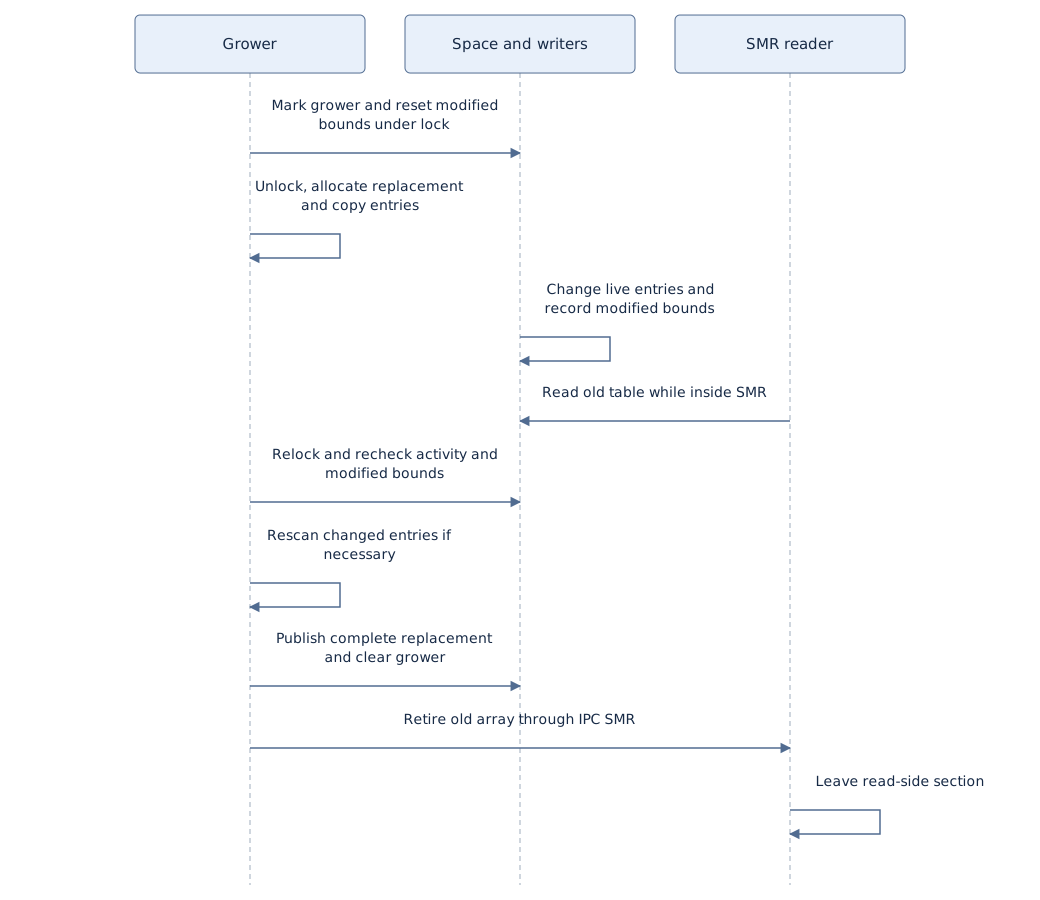
Mermaid source
sequenceDiagram
    participant G as Grower
    participant S as Space and writers
    participant R as SMR reader
    G->>S: Mark grower and reset modified bounds under lock
    G->>G: Unlock, allocate replacement and copy entries
    S->>S: Change live entries and record modified bounds
    R->>S: Read old table while inside SMR
    G->>S: Relock and recheck activity and modified bounds
    G->>G: Rescan changed entries if necessary
    G->>S: Publish complete replacement and clear grower
    G->>R: Retire old array through IPC SMR
    R->>R: Leave read-side section
The diagram selects successful growth; allocation failure and termination branches are separate. The unlock/wakeup and retirement sequence is explicit:
Source: osfmk/ipc/ipc_entry.c, lines 828–838
	smr_serialized_store(&space->is_table, ntable);

	ipc_space_done_growing_and_unlock(space);

	/*
	 *	Now we need to free the old table.
	 */
	ipc_space_retire_table(otable);
	is_write_lock(space);

	return KERN_SUCCESS;
KERN_SUCCESS from growth means the caller can continue with the space lock held, not necessarily that the space is still active or that a new right exists. The termination-during-growth branch frees the uninstalled replacement, relocks and returns success so the outer allocator/copyout loop can detect death. Allocation failure returns KERN_RESOURCE_SHORTAGE unlocked; maximum capacity returns KERN_NO_SPACE unlocked. Termination/rescan branch, failure return, maximum limit.
The retired array contains its own callback record
ipc_space_retire_table() uses reserved index zero to store the table handle and callback node. The callback needs the retired table, not a live ipc_space pointer; consequently the table's delayed release and the space's final-reference release are distinct completion events. Retirement callback.
Source: osfmk/ipc/ipc_space.c, lines 137–140
	base = ipc_entry_table_base(table);
	size = ipc_entry_table_size(table);
	base->ie_self = table;
	smr_ipc_call(&base->ie_smr_node, size, ipc_space_free_table);
The *_free_noclear name is an allocator-helper choice. It does not mean the entry's capability remains valid after namespace removal, or permit using an entry after SMR/locking protection ends. Continue with SMR publication for the generic grace-period model.
8. Namespace death before final allocation release
ipc_space_terminate() first locks the space and returns immediately if already inactive. It saves the table handle and clears the published table pointer; new lookups can now reject the space. It waits for any grower to discover this state before beginning unlocked entry cleanup. Initial termination.
Source: osfmk/ipc/ipc_space.c, lines 413–423
	table = smr_serialized_load(&space->is_table);
	smr_clear_store(&space->is_table);

	/*
	 *	If somebody is trying to grow the table,
	 *	we must wait until they finish and figure
	 *	out the space died.
	 */
	while (is_growing(space)) {
		is_write_sleep(space);
	}
Cleanup runs in two passes: receive rights first, then all remaining nonempty entries. Removing receives first reduces notifications aimed at endpoints that are also dying in this space. Each right type invokes its own cleanup; destroying the space does not imply all referred-to ports die, since many entries contain only send rights. The table is then retired through IPC SMR and termination drops the active reference. The task and other referenced-space callers may still keep the inactive space allocation alive. Two cleanup passes and active-reference release, right termination, space final release.
For a worked sequence, take an ordinary task-owned space at its initial two references. A successful port-to-space conversion adds a third. Namespace termination removes rights and drops the active reference, leaving the task-held and conversion references. Releasing either one still leaves the other; releasing the last destroys the space's ticket lock and allocation. The retired entry array may still be waiting for an SMR reader. This example isolates space references from all port references and makes no claim about scheduling order. Conversion retain, release operation, free prerequisites.
9. Source-reading checklist and limits
When following a new caller, identify whether it owns a space reference or has a valid task/port lifetime that supplies access. Then check whether the helper returns a locked entry, a locked object, or an owned right. Any call that can grow the table can invalidate a cached ipc_entry_t; any right transfer can change the relationship between the name and port without changing the port address. Entry allocation loop, lookup results, copyout growth/restart.
This chapter reviews the common task-space construction, selected entry allocation/lookup, growth, transfer integration and teardown paths in the local snapshot. It does not enumerate every notification command, special-space client, resource-limit policy, PAC code sequence or concurrency interleaving. Port policy, complex-message conversion, concurrent-operation examples and the Mach interface catalogs provide the adjacent routes. No kernel execution or generated MIG-stub inspection is implied.